Visitor Insights
Visiting Congregation Emanu-El
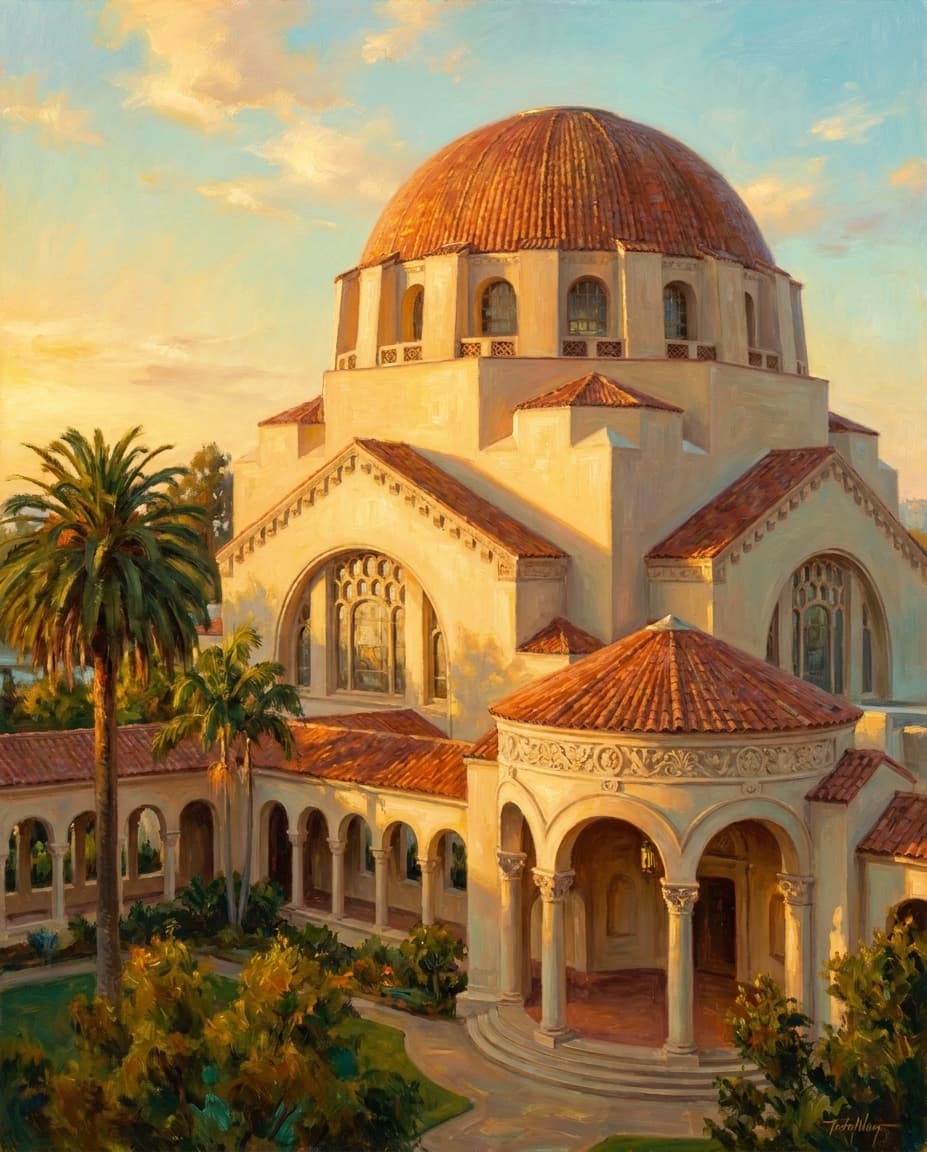
Congregation Emanu-El welcomes visitors for weekly Shabbat worship services, life-cycle ceremonies, and periodic architectural tours. The sanctuary provides a serene atmosphere characterized by soaring Byzantine arches, warm acoustics, and colorful clerestory stained glass.
Highlights
- Monumental 150-foot outer dome and cloistered entry courtyard
- Freestanding bronze and enameled Holy Ark on the main bimah
- Vibrant abstract stained-glass windows representing Fire and Water
- Historic 1926 E.M. Skinner four-manual pipe organ
Things to Know
- All guests must pass security screening at the Lake Street gateway.
- Valid government-issued photo identification is required for entry.
- Presidio Heights street parking is limited; public transit is recommended.
- Photography is generally restricted during sacred Shabbat worship services.
Location
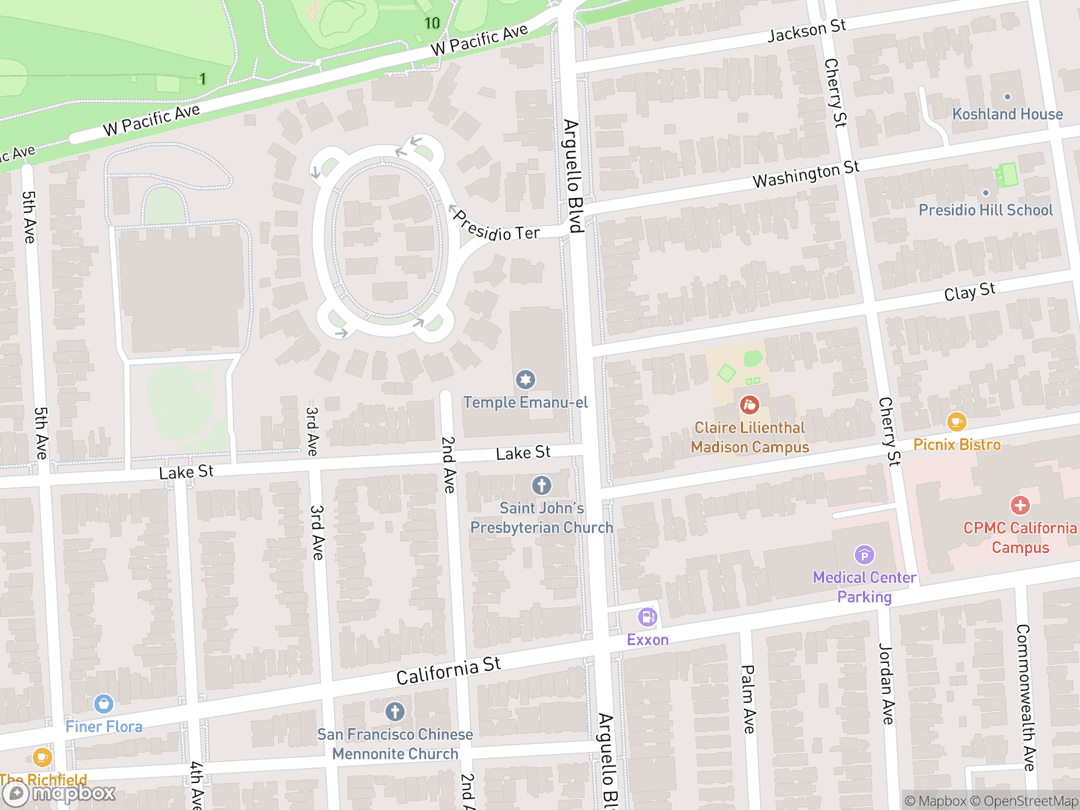
2 Lake Street, San Francisco, California 94118, United States
Hours: Administrative offices: Mon-Fri 9:00 AM - 5:00 PM; Shabbat services Fri 6:00 PM & Sat 10:30 AM
Getting There: Muni bus lines 1-California and 33-Ashbury/18th serve the Arguello Boulevard and Lake Street intersection.
Get DirectionsTips for Your Visit
Arrive Early for Security
Plan to arrive 15 minutes before scheduled services to allow time for security screening.
Best Lighting Viewing
Visit in late afternoon when setting sunlight illuminates the southern clerestory stained glass.
Architectural Tours
Check the temple museum schedule in advance for docent-guided historical and design tours.
About
Congregation Emanu-El is one of the oldest Jewish congregations in the western United States, tracing its lineage to California Gold Rush pioneers who gathered for worship in 1849. Officially chartered in 1851, the congregation grew into a civic pillar of American Reform Judaism.
The monumental 1926 synagogue complex, designed by Arthur Brown Jr. and Sylvain Schnaittacher, crowns Presidio Heights with a 150-foot outer dome. Conceptually influenced by the Second Temple of Jerusalem and Hagia Sophia, its architecture fosters an intentional progression into sacred reverence.
As an anchor of Abrahamic ethical monotheism, Emanu-El balances prophetic justice, egalitarian community worship, and sacred music. A comprehensive centennial renovation completed in 2025 restored its historical procession while renewing its community campus for future generations.
Gallery
Symbolic Elements
The temple's exterior features intricate carvings, each rich with spiritual meaning:

Aron HaKodesh (The Holy Ark)
Freestanding bronze and enameled shrine housing sacred Torah scrolls, evoking the desert tabernacle.

Ner Tamid (Eternal Light)
Suspended bronze filigree lamp symbolizing God's enduring presence and the Temple menorah.
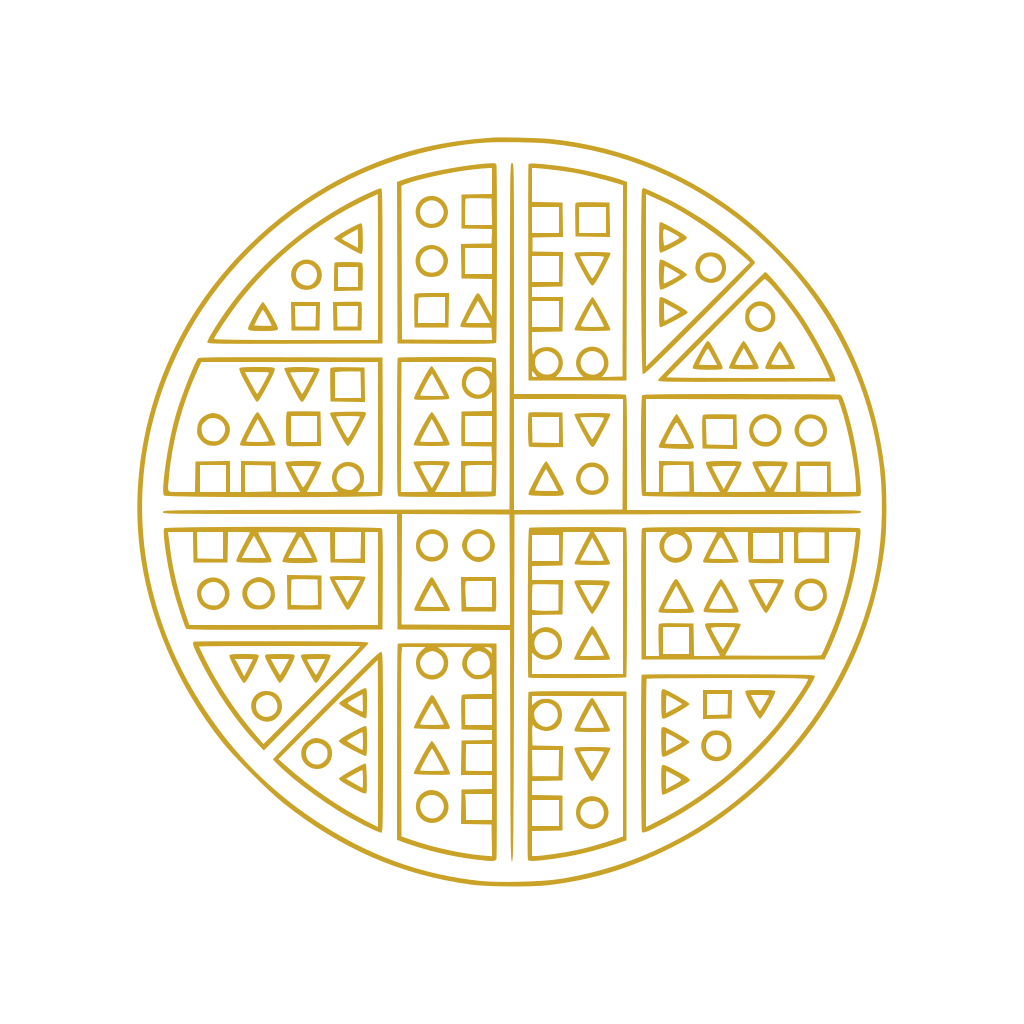
Twelve Tribes Mosaics
Polychrome ceramic and glass tesserae representing the ancient biblical confederation of Israel.
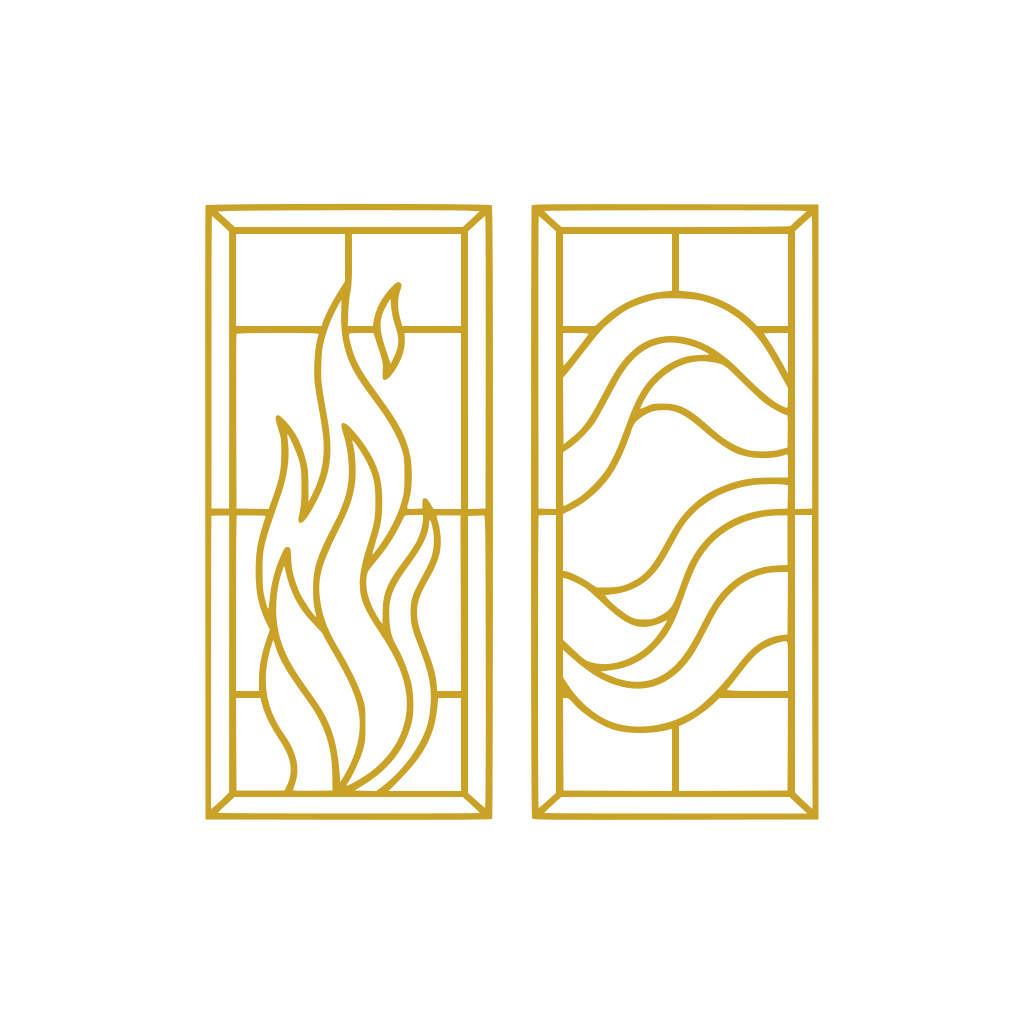
Fire and Water Windows
Clerestory stained-glass installations symbolizing the pillar of fire and parting of the Red Sea.

Luchot HaBrit (Ten Commandments)
Polished carved stone tablets bearing Hebrew inscriptions that celebrate the Sinai covenant.

Levantine Pomegranate Reliefs
Architectural carvings in stone and bronze representing biblical wisdom, abundance, and righteousness.
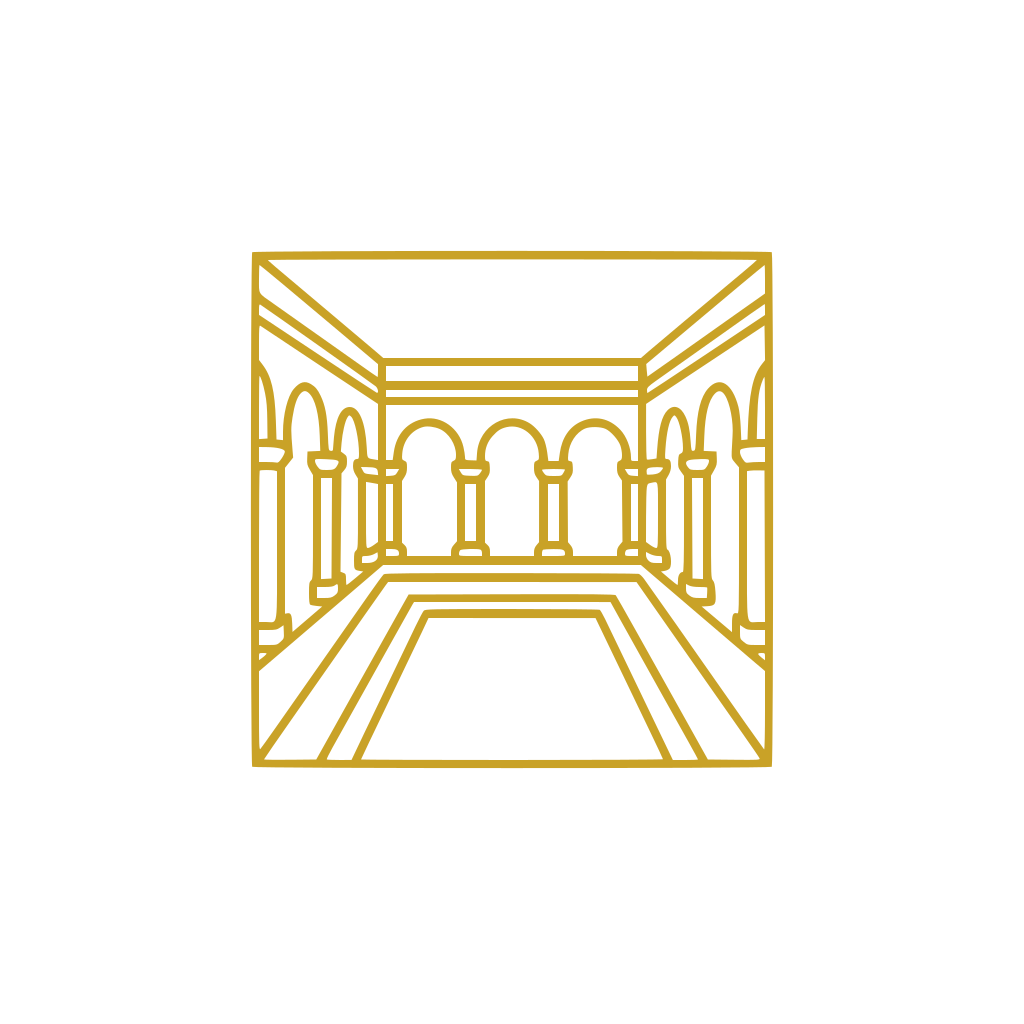
Cloistered Temple Courtyard
Arcaded open-air courtyard serving as a transitional threshold modeled after the Second Temple.
Interesting Facts
Congregation Emanu-El is the oldest continuously operating Jewish congregation west of the Mississippi River (Tier A).
The congregation traces its origin to an 1849 Gold Rush tent store minyan on Jackson Street (Tier B).
Architect Arthur Brown Jr. designed San Francisco City Hall, the War Memorial Opera House, and Emanu-El (Tier B).
The freestanding Holy Ark took fourteen months to craft in European workshops before its 1927 dedication (Tier A).
The sanctuary stained-glass windows were designed by California artist Mark Adams (Tier B).
The building won the 1927 American Institute of Architects Award for Northern California (Tier B).
Cantor Reuben Rinder commissioned composer Ernest Bloch to write his Sacred Service masterwork for the temple (Tier B).
The brick walls of the previous Sutter Street synagogue survived the 1906 earthquake and fire (Tier B).
Notable members have included blue-jeans pioneer Levi Strauss and U.S. Senator Dianne Feinstein (Tier B).
The 2025 renovation re-established the historic street-level entrance on Lake Street for the first time since 1990 (Tier B).
Common Questions
When was Congregation Emanu-El founded?
The congregation was formally chartered in April 1851 after an initial Gold Rush gathering in 1849.
What architectural style is the Lake Street synagogue?
It is built in a synthesis of Byzantine Revival and Mediterranean Revival styles.
Can non-members visit or attend services?
Visitors are welcome at Shabbat services and public programs following a security screening.
Who designed the historic 1926 sanctuary?
The complex was designed by Arthur Brown Jr. and Sylvain Schnaittacher.
What is the significance of the 2025 renovation?
The Emanu-El Next project seismically strengthened the campus and restored the historic street entrance.
Featured Stories
The Gold Rush Tent Minyan
September 1849
In autumn 1849, thirty Jewish pioneers from across Europe gathered inside a modest canvas tent store on Jackson Street to observe Yom Kippur. Amid the muddy turmoil of the Gold Rush boomtown, their prayer service marked the earliest recorded Jewish communal worship west of the Mississippi River. That small pioneer minyan laid the spiritual cornerstone for Congregation Emanu-El.
Source: Congregation Emanu-El Historical Archives
Resilience Through the 1906 Fire
April 1906
The Great Earthquake of 1906 and resulting inferno gutted the interior of Emanu-El's beloved Sutter Street synagogue. Congregants rallied behind Rabbi Jacob Voorsanger, determined to rebuild within the surviving masonry walls. In just seventeen months, the historic sanctuary was completely restored and joyfully rededicated on September 1, 1907.
Source: San Francisco Heritage Survey
Ernest Bloch's Sacred Commission
1933
Cantor Reuben Rinder envisioned Emanu-El as an international hub for sacred liturgical music, actively mentoring emerging composers. In the early 1930s, Rinder commissioned celebrated Swiss-American composer Ernest Bloch to compose a comprehensive Sabbath liturgy. The resulting masterwork, Avodath Hakodesh (Sacred Service), achieved global renown after premiering under temple sponsorship.
Source: Congregation Emanu-El Music Guild Records
Timeline
Gold Rush Tent Minyan
Pioneer Jewish immigrants gather in a tent store on Jackson Street to observe Yom Kippur.
MilestoneFormal Congregation Charter
The Bavarian and German merchant community officially incorporates Congregation Emanu-El.
EventBroadway Synagogue Dedicated
The congregation dedicates its first permanent brick synagogue on Broadway.
DedicationSutter Street Synagogue Opens
Emanu-El dedicates a monumental Gothic-Moorish synagogue featuring twin 160-foot spires.
DedicationUnion Affiliation
Emanu-El becomes the first Pacific Coast congregation to affiliate with the Reform movement.
MilestoneEarthquake Restoration Rededication
Congregants rededicate the Sutter Street synagogue rebuilt after the devastating 1906 fire.
RenovationLake Street Sanctuary Dedication
The monumental Byzantine Revival sanctuary complex at 2 Lake Street is consecrated.
DedicationHoly Ark Consecration
The handcrafted freestanding bronze and cloisonné Holy Ark is consecrated on the bimah.
MilestoneFire and Water Windows Installed
Renowned California artist Mark Adams completes vibrant abstract clerestory stained glass.
MilestoneEmanu-El Next Modernization
A comprehensive seismic restoration re-establishes the historic axial courtyard procession.
RenovationHistory by Decade
1850s — Gold Rush Foundations
Our pioneer fathers built an altar of faith amidst the rush for earthly gold.
Following the initial 1849 tent minyan, German and Bavarian merchants chartered Congregation Emanu-El in April 1851. In September 1854, the congregation consecrated its first permanent brick synagogue on Broadway between Powell and Mason Streets. The young community quickly established mutual aid societies to support incoming frontier families.
1860s–1870s — Sutter Street Monument
Under Rabbi Elkan Cohn, the congregation adopted progressive Reform practices and commissioned architect William Patton to design a new synagogue on Sutter Street. Dedicated in March 1866, the Gothic-Moorish structure featured twin 160-foot spires that guided ships sailing past the Golden Gate. In 1877, Emanu-El became the first Pacific Coast congregation to affiliate with the national Reform movement.
1880s–1900s — Crisis and Reconstruction
Rabbi Jacob Voorsanger expanded the temple's civic prominence through statewide lectures and extensive philanthropic societies. When the 1906 earthquake gutted the Sutter Street building, congregants preserved the external brick shell and rebuilt the interior. The restored sanctuary reopened in September 1907, serving the community as San Francisco rebuilt itself.
1910s–1920s — The Presidio Heights Landmark
As the Jewish community moved westward, trustees purchased a prominent corner parcel at Lake Street and Arguello Boulevard. Architects Arthur Brown Jr. and Sylvain Schnaittacher designed a monumental complex drawing from Byzantine and Levantine precedents. Consecrated in April 1926, the building received the 1927 AIA Northern California Award as the region's finest architectural achievement.
1930s–1970s — Cultural Flourishing
During mid-century decades, Cantor Reuben Rinder commissioned world-renowned Jewish liturgical works, including Ernest Bloch's Avodath Hakodesh. Rabbi Alvin Fine inaugurated the congregation's historical museum and archives in 1950. In the early 1970s, artist Mark Adams installed vibrant stained glass representing the biblical pillar of fire and the parting of the Red Sea.
1980s–2020s — Seismic Renewal and Emanu-El Next
Following regional earthquakes, structural evaluations led to extensive preservation campaigns across the campus. In 2023, the congregation broke ground on the major 'Emanu-El Next' project designed by Mark Cavagnero Associates. Consecrated in September 2025, the renovation seismically fortified the campus and reopened the historic axial entrance on Lake Street.
Architecture & Facilities
Congregation Emanu-El represents a monumental synthesis of Byzantine Revival and Mediterranean Revival architecture, shaped by the Beaux-Arts civic discipline of master architect Arthur Brown Jr. The complex translates ancient Levantine sacred geometry into reinforced concrete and textured stucco, organizing sacred spaces around an axial progression reminiscent of the Second Temple of Jerusalem.
Building Materials
Textured Stucco Cladding
Warm cream-colored stucco finished over reinforced concrete structures.
Mission Tile Roofing
Red-orange barrel clay tiles covering the exterior dome and hipped roofs.
Levantine Marbles
Polished imported marbles lining the elevated chancel and holy ark platform.
Cast Stone Relinquaries
Intricately carved lintels and capitals displaying ancient Levantine plant motifs.
Interior Features
Main Sanctuary (Hekhal)
A column-free cubic assembly hall seating 1,700 beneath a 100-foot ceiling dome.
The Bimah and Chancel
An elevated liturgical platform housing the gilded freestanding Holy Ark and choir.
Martin Meyer Sanctuary
An intimate 250-seat chapel used for daily prayer gatherings and quiet study.
Sanctuary Vestibule
A low-ceilinged narthex transitional foyer leading from the cloister to the hall.
Temple Grounds
The campus centers on an open-air cloistered courtyard with a central limestone fountain, surrounded by modern bronze-and-glass community pavilions.
Additional Facilities
A subterranean educational wing, administrative offices, community banquet halls, preschool play deck, and historical archives museum.
Religious Significance
As part of the Judaic Abrahamic tradition, Congregation Emanu-El serves as a Beit Knesset (house of assembly), Beit Midrash (house of study), and Beit Tefillah (house of prayer). Its liturgy emphasizes ethical monotheism, covenantal responsibility, and the sacred preservation of Torah.
To foster covenantal Jewish life through communal worship, lifelong study, and the prophetic pursuit of justice and compassion.
Sacred Ordinances
Shabbat Services
Weekly communal Sabbath prayers uniting traditional Hebrew liturgy with vernacular reflection.
Torah Reading (Kriat HaTorah)
Chanting sacred scrolls from the bimah to transmit moral instruction to the assembly.
Tikkun Olam
Civic action, philanthropy, and interfaith engagement aimed at repairing the broader world.
Life-Cycle Consecrations
Ceremonies marking covenantal milestones including Bris, B'nai Mitzvah, weddings, and memorial services.
The Reform Synagogue as Temple
In 19th-century Reform theology, congregations adopted the title 'temple' to express that diaspora sacred assemblies meet God directly in their local communities rather than waiting for a restored sacrificial altar in Jerusalem.
The Sacred Architecture of Assembly
Emanu-El's spatial procession from city street through cloistered courtyard to domed sanctuary reflects the ancient biblical Tabernacle, sanctifying the movement of worshippers into quiet communion.
Similar Temples
Sources & Research
Every fact on Temples.org is backed by verified Sources & Research. Each piece of information is rated by source tier and confidence level.
View All Sources (7)
| Field | Source | Tier | Retrieved |
|---|---|---|---|
| About & Historical Background | Congregation Emanu-El (opens in a new tab) | A | 2026-02-18 |
| Architectural Design & AIA Recognition | Architectural Record (opens in a new tab) | B | 2026-02-18 |
| San Francisco AIA Historic Evaluation | AIA San Francisco (opens in a new tab) | B | 2026-02-18 |
| San Francisco Landmark Preservation & 1906 History | San Francisco Heritage (opens in a new tab) | B | 2026-02-18 |
| Seismic Modernization & Campus Architecture | Mark Cavagnero Associates (opens in a new tab) | B | 2026-02-18 |
| Gold Rush Origins & Pioneer Congregations | SFGATE (opens in a new tab) | C | 2026-02-18 |
| Regional Jewish Heritage & Campus Renovations | J. The Jewish News of Northern California (opens in a new tab) | C | 2026-02-18 |