Visitor Insights
Visiting Huhugam Heritage Center & Sacred Ancestral Lands
The Huhugam Heritage Center serves as a contemplative sovereign cultural facility welcoming respectful public visitors into designated exhibition spaces. Guests encounter sacred ancestral art, historical displays, and outdoor landscape architecture rooted in Sonoran Desert traditions.
Highlights
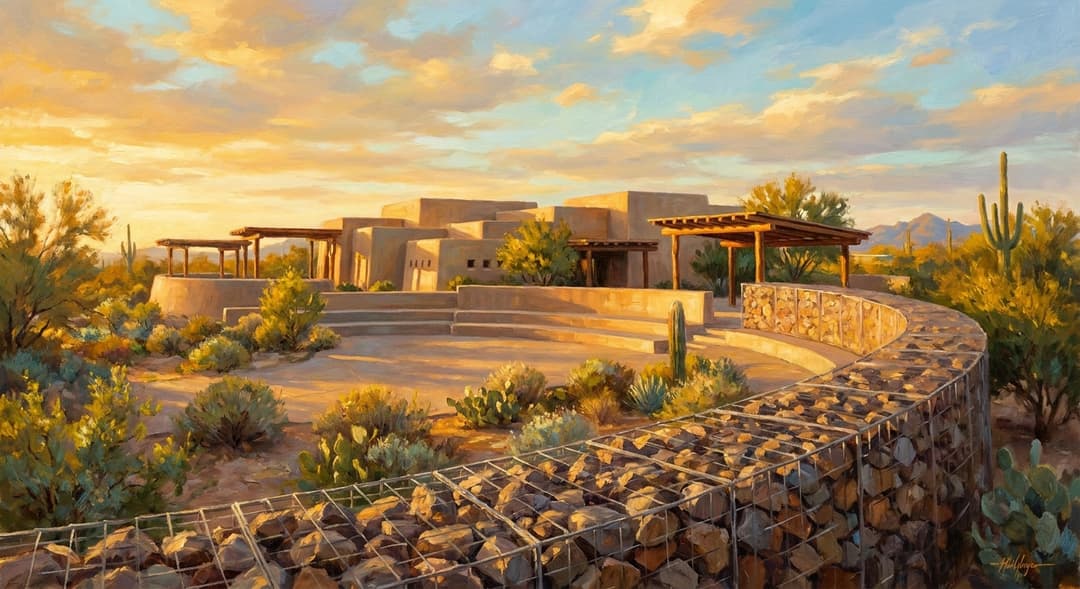
- Monumental 37-foot crescent gabion wall replicating ancient pottery sherd patterns
- Extensive collection of antique Akimel O'odham willow and devil's claw baskets
- Central River Gallery evoking the meandering flow of the sacred Gila River
- Exhibits detailing prehistoric canal engineering and modern tribal water restoration
Things to Know
- Photography of sacred ancestral artifacts and funerary items is strictly prohibited
- Operating hours are limited to Tuesday through Friday from 10:00 AM to 4:00 PM
- Snaketown and ancestral burial sites on the reservation remain strictly closed to the public
- Visitors must maintain quiet decorum on sovereign reservation land
Location
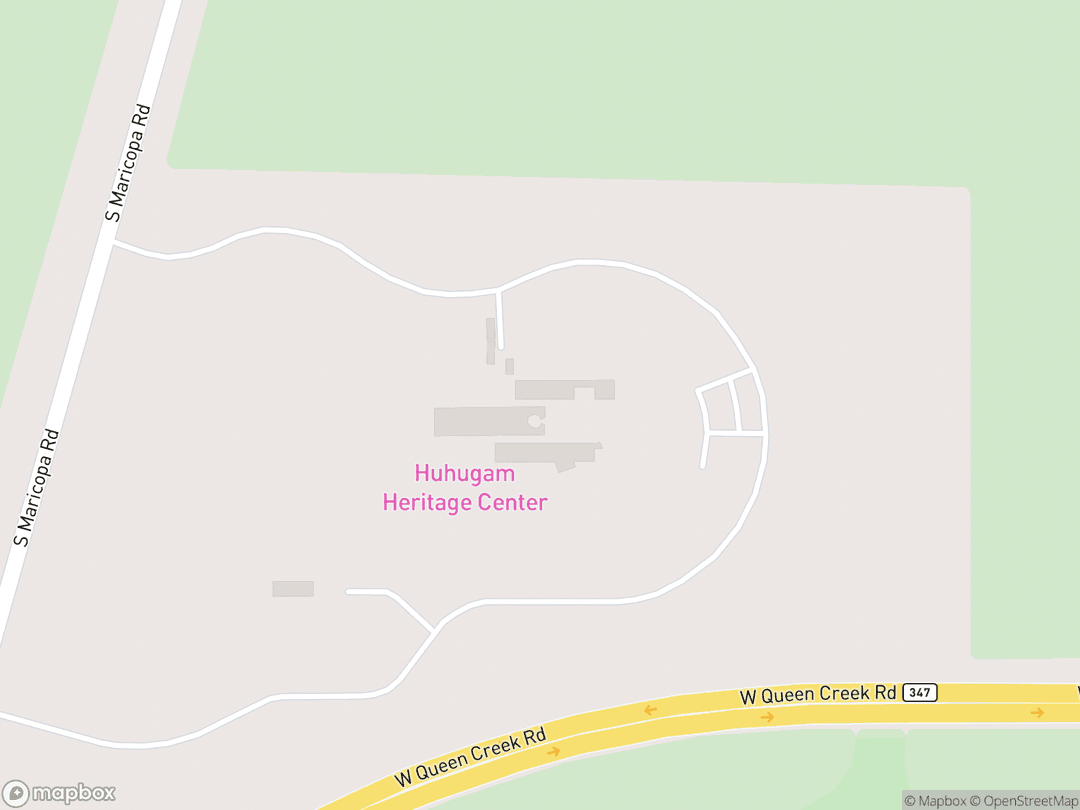
21359 S. Maricopa Rd, Chandler, AZ 85226
Hours: Tuesday through Friday: 10:00 AM – 4:00 PM; Closed Saturday through Monday and tribal holidays.
Getting There: Located off Interstate 10 at Exit 164 on South Maricopa Road, 20 minutes south of Phoenix Sky Harbor Airport.
Get DirectionsTips for Your Visit
Honor Tribal Sovereignty
Always observe posted signage regarding photography restrictions and cultural protocols.
Walk the Exterior Grounds
Take time to examine the stepped gabion wall and native desert botanical plantings.
Check Tribal Holiday Schedules
Confirm operating hours before visiting, as the center observes sovereign community holidays.
About
The Huhugam Heritage Center stands as a sovereign spiritual sanctuary and cultural repository for the Akimel O'odham and Pee-Posh nations of the Gila River Indian Community. Rather than functioning as a detached exhibition museum, the center was consecrated to preserve ancestral remains, repatriated sacred artifacts, and living desert ceremonies.
The Akimel O'odham revere the prehistoric canal builders of the Phoenix basin not as a vanished civilization, but as their direct ancestors, the Huhugam. Through tribally governed care, sacred items are protected in accordance with traditional law away from commercial exploitation.
Anchored in the sacred philosophy of the Himdag, the complex harmonizes traditional desert earthworks with contemporary cultural preservation. Its curved galleries and monumental pottery-sherd gabion wall embody the continuous hydraulic and spiritual relationship between river people and their ancestral homelands.
Interesting Facts
The name Huhugam translates in the O'odham language to 'those who have gone before' or 'our ancestors', refuting the colonial term Hohokam. (Tier A)
The center's 37-foot crescent earth wall was hand-packed with desert rock to visually recreate the broken edge of an ancient painted pottery sherd. (Tier B)
Unlike conventional museums, the facility contains consecrated vaults closed to the public where ancestors recovered from construction sites rest in prayerful dignity. (Tier A)
The facility represents two distinct tribes united in one confederacy: the Uto-Aztecan Akimel O'odham and the Yuman-speaking Pee-Posh. (Tier A)
The center preserves nearly 500 antique masterwork baskets hand-coiled from wild desert willow and dark devil's claw fibers. (Tier B)
Acoustic engineers calibrated the central hall to match the resonant natural soundscape of a desert canyon during sacred chanting. (Tier B)
The complex serves as the spiritual finish line for the annual 24-mile Water Rights run celebrating the historic 2004 water restoration settlement. (Tier A)
The prehistoric gravity canal blueprints archived at the center formed the technical layout used to construct modern Phoenix irrigation networks. (Tier B)
Common Questions
Is the Huhugam Heritage Center an ordinary museum?
No, it is a sovereign tribal repository and cultural sanctuary governed directly by the Gila River Indian Community.
Can visitors tour the nearby Snaketown archaeological ruins?
No, Snaketown is a sacred ancestral resting ground that remains backfilled and strictly closed to all non-authorized entry.
Is photography permitted inside the exhibition galleries?
Photography of sensitive ancestral art, repatriated funerary objects, and ceremonial displays is strictly prohibited.
What does the word Himdag mean?
Himdag translates to 'our way of life' or 'the Path', encompassing all spiritual, cultural, and moral teachings of the O'odham.
Are both Akimel O'odham and Pee-Posh cultures represented?
Yes, the center honors the sovereign alliance, arts, and languages of both confederated nations.
Featured Stories
The Return of Snaketown's Sacred Legacy
January 15, 2004
For decades, ancestral remains and funerary offerings excavated from the sacred desert metropolis of Snaketown were held in distant university vaults. The opening of the Huhugam Heritage Center established a consecrated tribal repository, allowing thousands of sacred items to return home to their sovereign descendants under elder guardianship.
Source: Gila River Indian Community Records
A Defensive Confederation of Two Nations
1850
When the Yuman-speaking Pee-Posh migrated into the middle Gila Valley seeking refuge from warfare along the Colorado River, the Akimel O'odham welcomed them into mutual brotherhood. This alliance forged an enduring spiritual and cultural confederacy where both distinct languages and sacred traditions thrive under one sovereign fire.
Source: O'odham & Pee-Posh Oral History Archive
Reclaiming the Flow of Keli Akimel
December 10, 2004
Following a century of devastating river diversions by upstream settlements, the community achieved passage of the historic Arizona Water Settlements Act. The center serves as the ceremonial finish line for the annual Water Rights run, celebrating the restoration of life-giving canal waters to ancestral farmlands.
Source: Gila River Indian News
Timeline
Canal Engineering of the Huhugam
Ancestral desert engineers construct hundreds of miles of gravity canals throughout the Gila Valley.
MilestoneEarly Spanish Contact
Jesuit missionary Eusebio Kino documents extensive irrigated agriculture cultivated by the Akimel O'odham.
EventO'odham and Pee-Posh Confederacy
The Akimel O'odham and Pee-Posh formally unite to protect ancestral river valleys.
MilestoneReservation Established
The United States establishes the Gila River Indian Reservation over ancestral lands.
MilestoneExcavations at Snaketown
Outside archaeologists begin unearthing ancestral burial mounds without sovereign tribal permission.
EventSacred Enclosure of Snaketown
Tribal leaders mandate that the Snaketown monument remain backfilled and strictly closed to the public.
MilestoneNAGPRA Enacted
Federal legislation accelerates tribal plans for a sovereign repository to receive repatriated ancestors.
MilestoneGroundbreaking of Heritage Center
Community elders break ground on the 68-acre cultural facility and sovereign repository.
component.timeline.groundbreakingCeremonial Opening
The center opens its doors to receive sacred collections and welcome respectful visitors.
DedicationWater Rights Settlement
Federal legislation restores sacred water rights to the community, establishing the center as its celebration site.
MilestoneGallery Transformation
The center completes a major elder-guided reinterpretation of its permanent exhibition halls.
RenovationHistory by Decade
Ancestral Era — The Canals of the Huhugam
For over a millennium, the ancestors of the Akimel O'odham cultivated lush agricultural fields across the arid Sonoran Desert. Their hand-dug canal networks constituted the most sophisticated hydraulic engineering project in ancient North America. Sacred platform mounds and ceremonial plazas flourished along the living waters of the Gila River.
1850s–1880s — Alliance and Reservation Life
The mid-nineteenth century brought the peaceful integration of the Pee-Posh into the Gila River basin, forming a resilient defensive confederacy. In 1859, federal boundaries enclosed the reservation, anchoring tribal sovereignty to core ancestral territories. Community farmers fed desert travelers while fiercely defending their shared cultural identity.
1930s–1970s — Protection of Ancestral Remains
Large-scale archaeological excavations at Snaketown during the mid-twentieth century removed sacred pottery and ancestral burials to outside universities. The community responded by asserting cultural sovereignty, requiring that the ancestral site be sealed from tourists. These violations galvanized decades of advocacy to reclaim stolen ancestors.
1990s–2004 — Vision and Construction of the Center
Following the passage of NAGPRA, tribal leadership commissioned architect Donald Stastny to design a sacred repository and educational center. Construction commenced on a 68-acre campus using native earth tones, heavy cast concrete, and symbolic pottery gabions. In 2004, the Huhugam Heritage Center opened to house repatriated collections with full ceremonial honor.
2010s–Present — Living Sovereignty and Cultural Continuance
Today, the center stands as a vibrant educational headquarters and spiritual anchor for the community. Ongoing language preservation classes, ceremonial gatherings, and youth water runs emanate from its halls. The living Himdag continues to guide the care of ancestral items and the education of future generations.
Architecture & Facilities
Contemporary Indigenous Landform Architecture rooted in Sonoran Desert vernacular and ancient puddled caliche construction traditions, designed to emerge directly from the desert floor.
Building Materials
Earth-Pigmented Tilt-Up Concrete
Cast-on-site concrete panels colored with native desert pigments to modernize ancient caliche mud architecture.
Terramesh Gabion Basalt Cages
Stepped wire baskets hand-filled with local basalt rock to replicate geometric red-on-buff ceramic patterns.
Mesquite and Saguaro Rib Woodwork
Locally gathered native desert timbers crafted into exterior shading ramadas and ceiling accents.
Thermal Cladding and Deep Eaves
High-performance insulating envelopes and broad overhangs engineered for passive desert cooling.
Interior Features
River Gallery
A two-story curving exhibition space illuminated by clerestory light that mimics the meandering Gila River.
Sovereign Repatriation Vault
A climate-controlled curatorial sanctum accessible only to spiritual leaders for ancestral ceremonies.
Acoustically Tuned Auditorium
A ceremonial lecture hall calibrated to reproduce the natural resonance of Sonoran Desert canyon walls.
Tribal Archive and Research Library
A secure research repository preserving oral history recordings, historic treaties, and elder genealogies.
Temple Grounds
The 68-acre campus features native Sonoran flora, demonstration agricultural canals, walking paths, and ceremonial vato ramadas aligned with surrounding mountain peaks.
Additional Facilities
Includes secure tribal curation laboratories, educational classrooms, outdoor amphitheater grounds, and an authentic indigenous artisan gift shop.
Religious Significance
To the Akimel O'odham and Pee-Posh, the Huhugam Heritage Center is a consecrated sanctuary maintaining spiritual communion between living community members and their ancestors.
To safeguard ancestral remains, preserve the sacred Himdag way of life, and protect repatriated sacred cultural properties under sovereign tribal law.
Sacred Ordinances
Himdag Stewardship
The comprehensive practice of maintaining spiritual harmony, ancestral reverence, and kinship obligations to the Sonoran Desert.
Ancestral Care and Repatriation
Ceremonial reception, sacred blessing, and protective seclusion of ancestral burials and funerary vessels.
Ha:ṣan Bak Observance
Ceremonial gathering and blessing of the sacred saguaro cactus fruit to welcome the summer desert rains.
Continuity of the Huhugam Lineage
The center fundamentally rejects colonial narratives that cast the prehistoric builders of the Gila basin as a lost civilization. The Akimel O'odham honor the Huhugam as immediate forebears whose spiritual authority and hydraulic ingenuity remain alive in the community.
Water as Spiritual Breath
Water is revered in the Himdag as a sacred spiritual giver of life rather than a commodity. The reclamation of ancestral water rights along the Gila River represents both an ecological victory and a profound spiritual restoration.
Similar Temples

Sources & Research
Every fact on Temples.org is backed by verified Sources & Research. Each piece of information is rated by source tier and confidence level.
View All Sources (8)
| Field | Source | Tier | Retrieved |
|---|---|---|---|
| About & Historical Background | Gila River Indian Community (opens in a new tab) | A | 2026-03-31 |
| Religious Significance & Water Sovereignty | Gila River Indian News (opens in a new tab) | A | 2026-03-31 |
| Repatriation & Curatorial Repository | U.S. Bureau of Reclamation (opens in a new tab) | A | 2026-03-31 |
| Visitor Insights & Cultural Protocol | Gila River Indian Community Enterprises (opens in a new tab) | A | 2026-03-31 |
| Architecture & Structural Engineering | PKA Structural Engineers (opens in a new tab) | B | 2026-03-31 |
| Architecture & Gabion Earth Berm | Maccaferri Engineering (opens in a new tab) | B | 2026-03-31 |
| Sacred Arts & Basketry Traditions | Smithsonian National Museum of the American Indian (opens in a new tab) | B | 2026-03-31 |
| Gallery Design & Symbolic Elements | Ganymede Design Group (opens in a new tab) | B | 2026-03-31 |