Visitor Insights
Visiting Mission San Xavier del Bac
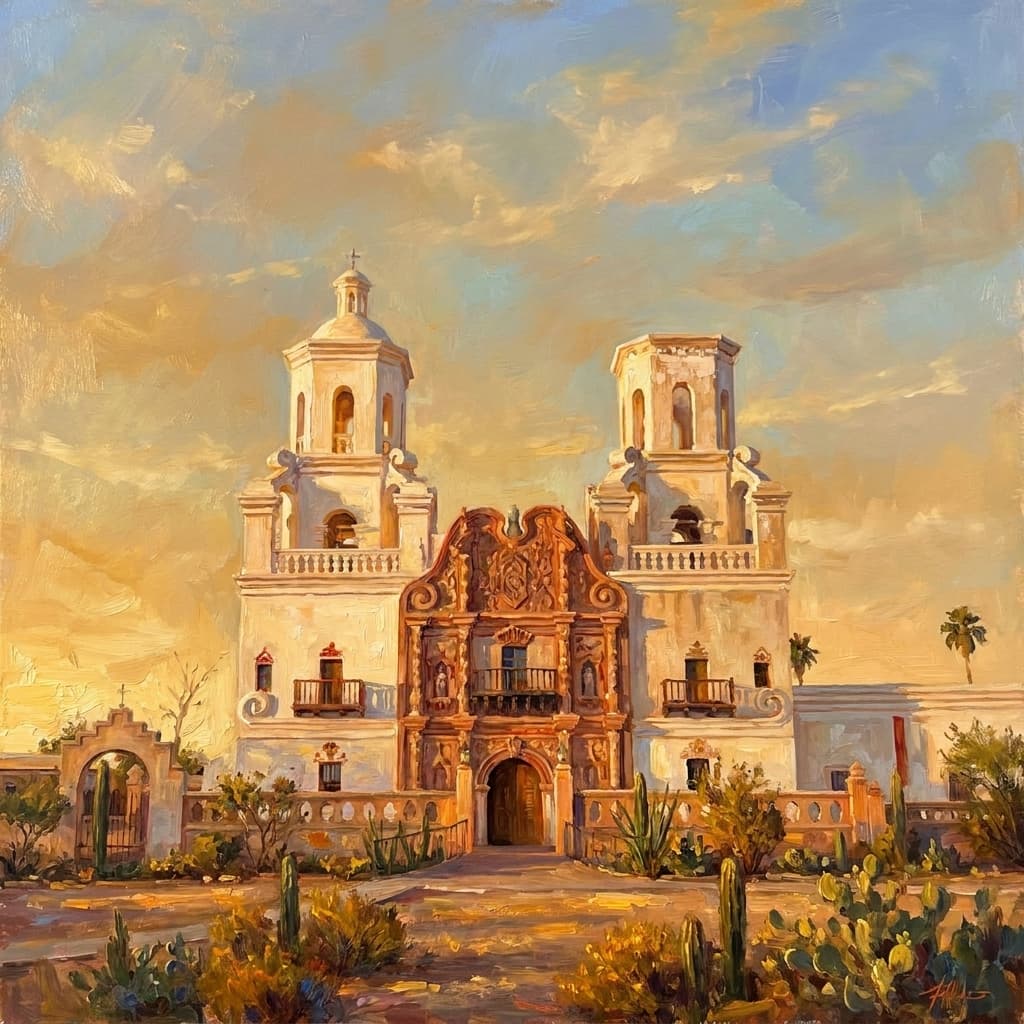
Mission San Xavier del Bac offers visitors a serene encounter with active Catholic worship, 18th-century Mexican Ultra-Baroque artistry, and living Tohono O'odham heritage. Early morning visits provide optimal natural lighting on the dazzling white façade and a quiet environment for contemplation.
Highlights
- Marvel at the gilded Retablo Mayor and original 18th-century tempera interior murals.
- Explore the asymmetrical exterior facade featuring the unfinished east bell tower.
- Visit the West Chapel and its devotional reclining statue of Saint Francis.
- Ascend the adjacent volcanic hill to view the 1908 Lourdes Grotto replica.
Things to Know
- Respect active Catholic Mass schedules and private prayer in the sanctuary.
- Flash photography and video recording are strictly prohibited during religious services.
- Temperatures reach extreme highs during summer months, making morning visits ideal.
Location
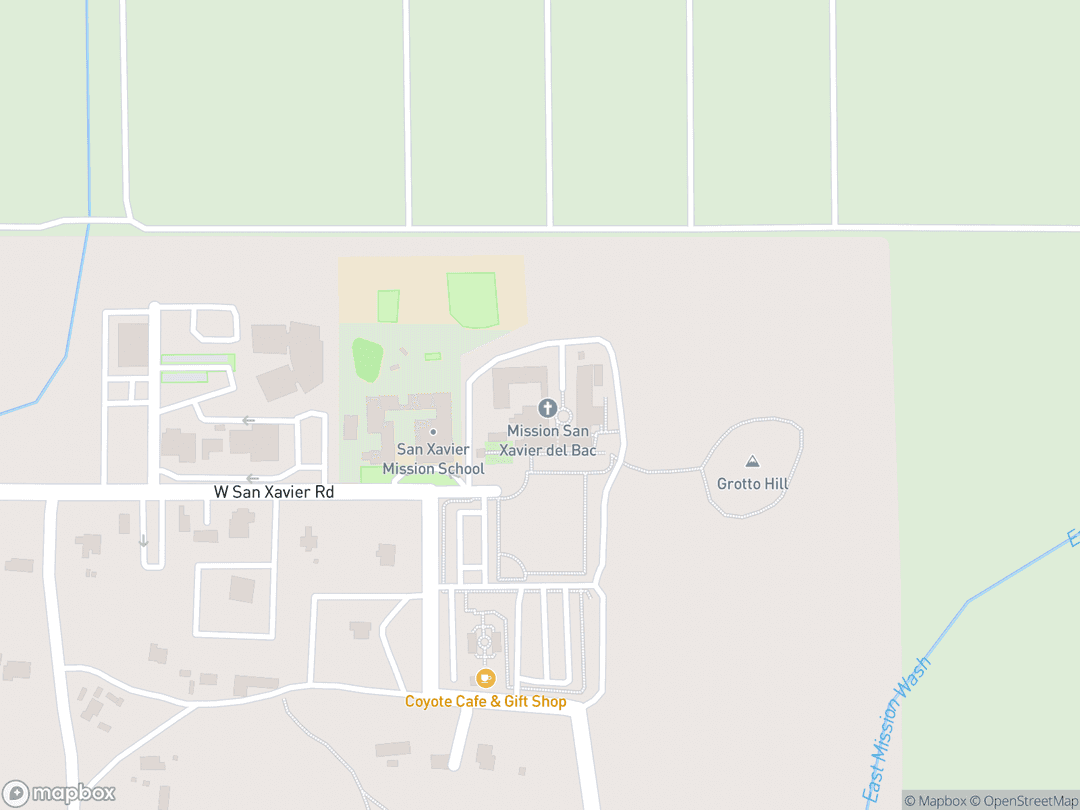
1950 W. San Xavier Rd., Tucson, Arizona 85746
Hours: Open daily from 9:00 AM to 4:00 PM; parish office and gift shop operating during standard hours.
Getting There: Located 10 miles south of downtown Tucson via Interstate 19 Exit 92 on West San Xavier Road.
Get DirectionsTips for Your Visit
Respect Sacred Space
Please wear modest attire and maintain respectful silence inside the church sanctuary.
Optimal Photography
Photograph the southern exterior in mid-morning light to capture the brilliant white limewash.
About
Mission San Xavier del Bac is an active Roman Catholic parish and National Historic Landmark located on the Tohono O'odham Nation near Tucson, Arizona. Founded in 1692 by Jesuit missionary Father Eusebio Francisco Kino, the current Ultra-Baroque church was constructed between 1783 and 1797 under Franciscan direction.
Rooted in shared Christian monotheism and Abrahamic salvation history, the mission expresses Catholic theology through sacred architecture, sacramental worship, and the communion of saints. The sanctuary stands as a living center of faith where European Baroque artistry converges with Indigenous Tohono O'odham heritage.
Gallery
Symbolic Elements
The temple's exterior features intricate carvings, each rich with spiritual meaning:

Shell Motif (Escalopa)
Scalloped shell carvings symbolize baptismal rebirth and spiritual pilgrimage.

Franciscan Cord
Sculpted three-knotted ropes along interior walls represent poverty, chastity, and obedience.
Heralding Lions
Reclining portal lions represent the Tribe of Judah and spiritual vigilance.

Sacred Monograms
Intertwined IHS and Auspice Maria monograms honor Jesus and the Virgin Mary.
Cat and Mouse Relief
Facade carvings of a cat and mouse embody local Tohono O'odham legendary traditions.

Polychrome Estofado Statuary
Gilded wooden statues feature delicate painted robes and interchangeable vestments.
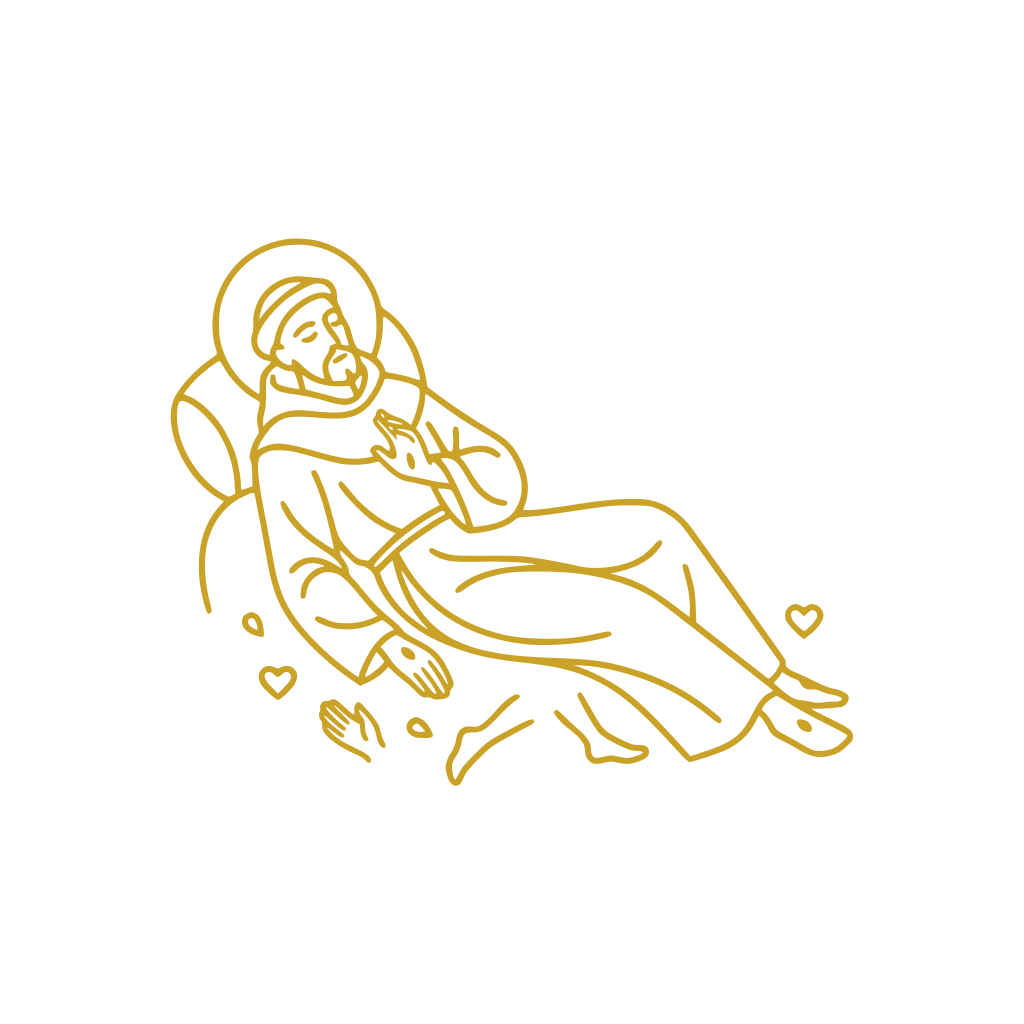
Reclining Saint Francis
A cherished devotional statue in the West Chapel receives pilgrim prayers and milagros.
Interesting Facts
San Xavier del Bac is the oldest intact European-built structure in Arizona (Tier A).
The entire roof is built from masonry brick vaults without structural wooden beams (Tier A).
Traditional plaster repairs use boiled juice from prickly pear cactus pads as a water repellent (Tier B).
Local Tohono O'odham families hid sacred gold vessels in desert caves for 30 years to protect them (Tier B).
The church facade features small relief carvings of a cat and mouse wrapped in local folklore (Tier B).
Statue faces were sculpted in Querétaro, Mexico, while bodies were crafted locally by O'odham artists (Tier A).
The church contains over 50 original 18th-century polychrome wooden statues (Tier A).
An outdoor replica of the Lourdes Grotto stands atop the volcanic hill east of the mission (Tier A).
Common Questions
Why is the eastern bell tower of the church unfinished?
Historical records show work stopped in 1797 because construction funds were fully depleted.
Is Mission San Xavier del Bac an active church or a museum?
It is an active Roman Catholic parish church serving the Tohono O'odham community.
What is the nickname of Mission San Xavier del Bac?
It is widely known as 'The White Dove of the Desert' due to its brilliant white exterior.
Who built the physical church structure between 1783 and 1797?
Spanish master mason Ignacio Gaona directed skilled Tohono O'odham artisans and laborers.
Featured Stories
Protection by Tohono O'odham Guardians
1828–1859
When the Mexican government expelled Spanish clergy in 1828, Mission San Xavier del Bac was left without resident priests for over thirty years. Tohono O'odham families took personal custody of their beloved sanctuary, hiding sacred gold vessels, vestments, and statues in secret desert caves to shield them from theft. Their devotion preserved the intact 18th-century interior until Catholic clergy returned following the Gadsden Purchase.
Source: Patronato San Xavier Historical Archives
The Prickly Pear Plaster Secret
1990s
During mid-20th-century renovations, well-meaning workers applied modern cement plaster that trapped moisture inside the historic brick walls. When international conservators restored the facade in the 1990s, they revived an authentic 18th-century recipe combining slaked lime, river sand, and boiled juice extracted from prickly pear cactus pads. This organic binder allows the building to breathe while repelling desert rain storms.
Source: Patronato San Xavier Conservation Reports
The Legend of the Cat and the Mouse
1790s–Present
High upon the ornate Ultra-Baroque front portal are two tiny carved stone figures—a cat on the right scrollwork and a mouse on the left. Local Tohono O'odham folklore maintains that if a visitor spots both creatures they will receive good fortune. Tribal legend humorously warns that if the stone cat ever catches the mouse, the world will come to an end.
Source: National Park Service Cultural Surveys
Timeline
Mission Established
Jesuit missionary Father Eusebio Francisco Kino establishes the mission at the O'odham settlement of Wa:k.
MilestoneFirst Chapel Foundation
Father Kino lays the foundation for an early chapel two miles north of the current site.
component.timeline.groundbreakingPermanent Site Established
Father Francisco Pauer constructs a modest adobe chapel at the mission's present location.
MilestoneJesuit Expulsion
King Charles III expels the Society of Jesus from Spanish dominions, transferring the mission to Franciscans.
EventApache Raid Destruction
An Apache raid destroys the early adobe church, forcing temporary site relocation.
EventChurch Construction Begins
Master mason Ignacio Gaona and Franciscan Friar Juan Bautista Velderrain break ground on the current church.
component.timeline.groundbreakingChurch Consecration
Construction concludes under Father Juan Bautista Llorenz and the church is formally consecrated.
DedicationMexican Clergy Expulsion
Mexican decree expels Spanish friars, leaving local Tohono O'odham families as sole guardians of the sanctuary.
EventGadsden Purchase
Southern Arizona becomes U.S. territory, placing San Xavier under American Catholic jurisdiction.
EventSonoran Earthquake
A major regional earthquake damages the mortuary chapel and outer atrium walls.
EventGranjon Restoration
Bishop Henry Granjon repairs collapsed arcades and builds the hill top Lourdes Grotto.
RenovationNational Historic Landmark
The United States Department of the Interior designates the mission a National Historic Landmark.
MilestonePatronato San Xavier Formed
Community leaders create a non-profit foundation to manage scientific conservation.
MilestoneWest Tower Conservation Complete
Artisans finish stripping damaging mid-century cement plaster and apply traditional cactus-lime mortar.
RenovationHistory by Decade
1690s–1760s — Jesuit Foundation
Father Eusebio Francisco Kino established the mission in 1692 among the Tohono O'odham at Wa:k. Early Jesuit missionaries built modest adobe structures while establishing agricultural and spiritual roots in the Sonoran Desert.
1760s–1820s — Franciscan Construction
Following the 1767 Jesuit expulsion, Franciscan friars assumed stewardship. Between 1783 and 1797, Friar Juan Bautista Velderrain and master mason Ignacio Gaona directed Tohono O'odham artisans to erect the current Ultra-Baroque masterpiece.
1820s–1880s — Tribal Custody and Transitions
After Mexican independence and clerical expulsion in 1828, Tohono O'odham families safeguarded the empty church. The 1853 Gadsden Purchase brought southern Arizona into the United States, restoring Catholic diocesan oversight.
1880s–1910s — Earthquakes and Restoration
A powerful 1887 earthquake damaged outer structures, prompting early repairs. Bishop Henry Granjon initiated extensive restoration from 1906 to 1910, rebuilding collapsed arcades and constructing the hilltop Lourdes Grotto.
1910s–1970s — Franciscan Return and Preservation
Franciscan friars returned to permanent residency in 1913, maintaining continuous ministry. Designation as a National Historic Landmark in 1960 affirmed the mission's paramount architectural and cultural significance.
1970s–2020s — Scientific Conservation
The non-profit Patronato San Xavier was established in 1978 to direct scientific conservation. Master conservators and tribal craftspeople have systematically cleaned interior murals and restored historic lime plaster facades.
Architecture & Facilities
Mission San Xavier del Bac represents the finest surviving example of Spanish Colonial Ultra-Baroque (Churrigueresque) architecture in North America. The design combines dramatic theatrical ornamentation with Byzantine low-dome vaulting and Moorish Mudéjar carved geometric motifs.
Building Materials
Kiln-Fired Brick & Mortar
Walls are constructed from dense kiln-fired clay bricks set in thick lime mortar.
Volcanic Basalt Stone
Foundations utilize dark local volcanic basalt stone quarried from nearby hills.
Prickly Pear Lime Plaster
Exterior surfaces are coated in lime plaster mixed with organic prickly pear cactus juice.
Gilded Mesquite Wood
Interior altarpieces are carved from native mesquite and pine, coated in gold leaf.
Interior Features
Nave & Barrel Vault
A single long aisle covered by low saucer domes painted with tempera biblical scenes.
Retablo Mayor
A multi-tiered gilded wooden altarpiece housing statues of Saint Francis Xavier and the Virgin Mary.
West Chapel of the Sorrowful Mother
A side chapel featuring a devotional reclining statue of Saint Francis covered in votive offerings.
Crossing Dome
An octagonal drum dome rising 52 feet over the transept decorated with paintings of holy women.
Temple Grounds
The mission complex encompasses a quiet cloistered convento patio, an outer walled atrium, a domed West Mortuary Chapel, and an eastern volcanic hill topped with a white cross and a 1908 stone Lourdes Grotto.
Additional Facilities
A parish museum and gift shop operate on site, supporting ongoing tribal community ministry and historic preservation.
Religious Significance
Within Catholic theology, Mission San Xavier del Bac is a consecrated sanctuary where heaven and earth intersect through the Holy Sacrifice of the Mass and the Seven Sacraments. As part of the broader Abrahamic tradition of sacred space, the building embodies God's covenant with humanity fulfilled through Jesus Christ.
To serve as a living house of Catholic worship, sacramental grace, and spiritual community for the Tohono O'odham people.
Sacred Ordinances
Holy Mass (Eucharist)
The central act of Catholic worship where Christ becomes present in the Blessed Sacrament.
Sacrament of Baptism
The foundational sacrament of spiritual initiation into the Christian Church.
Feast Day Processions
Annual devotional processions honoring Saint Francis Xavier and Saint Francis of Assisi.
Catechism in Color and Stone
Before written literacy was widespread in the frontier Sonoran Desert, the vibrant Ultra-Baroque murals and estofado statues of San Xavier served as visual sermons, communicating Catholic theology and biblical history across language barriers.
Similar Temples
Sources & Research
Every fact on Temples.org is backed by verified Sources & Research. Each piece of information is rated by source tier and confidence level.
View All Sources (8)
| Field | Source | Tier | Retrieved |
|---|---|---|---|
| About & Historical Background | National Park Service (opens in a new tab) | A | 2026-02-18 |
| Religious Significance & Sacraments | Roman Catholic Diocese of Tucson (opens in a new tab) | A | 2026-02-18 |
| Architecture & Conservation | Patronato San Xavier (opens in a new tab) | A | 2026-02-18 |
| Religious Significance & Sacraments | Franciscan Friars Province of Saint Barbara (opens in a new tab) | A | 2026-02-18 |
| Architecture & Conservation | Library of Congress Historic American Buildings Survey (opens in a new tab) | B | 2026-02-18 |
| Timeline & Featured Stories | Arizona State Museum (opens in a new tab) | B | 2026-02-18 |
| Architecture & Conservation | Journal of the Southwest (opens in a new tab) | B | 2026-02-18 |
| Visitor Insights & Cultural Heritage | Smithsonian Institution (opens in a new tab) | B | 2026-02-18 |