Visitor Insights
Visiting St. Mary's Basilica
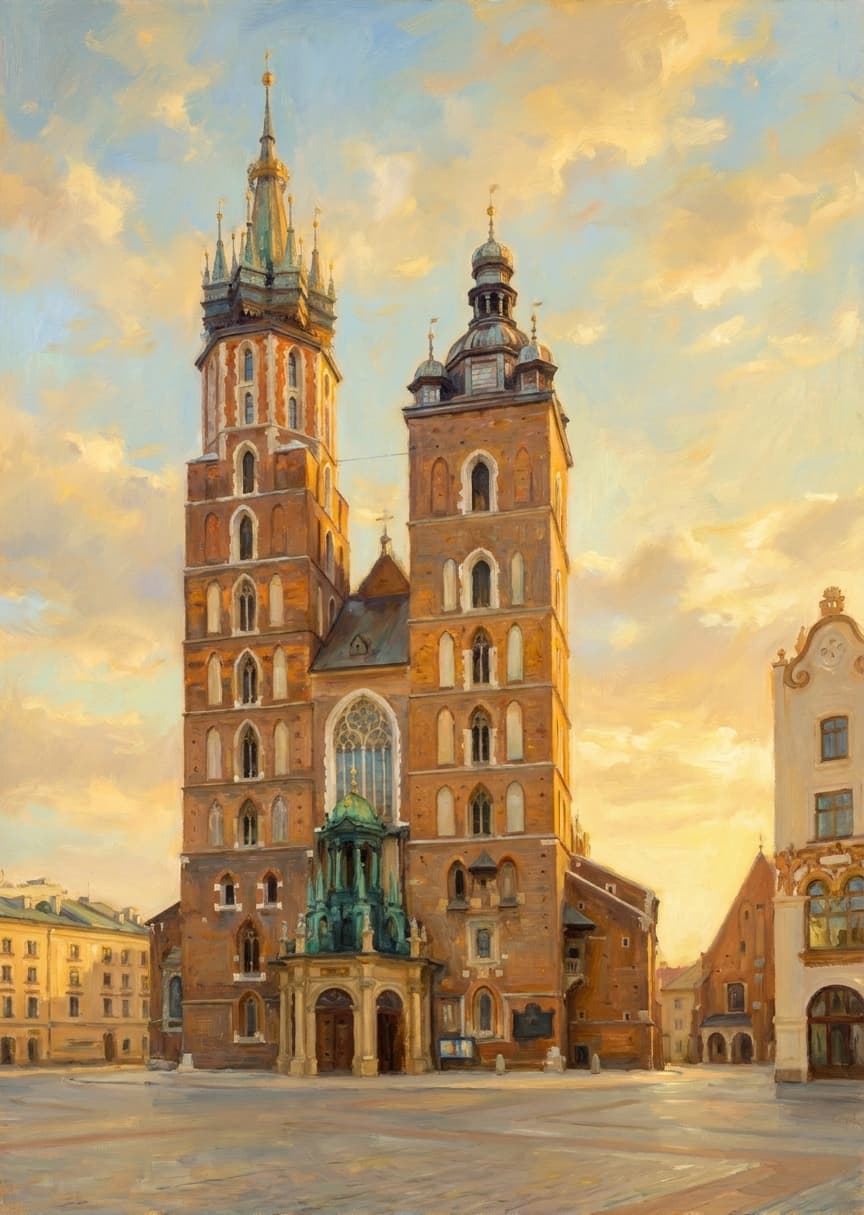
St. Mary's Basilica offers a serene, prayerful refuge in downtown Phoenix, welcoming visitors to experience sacred historic architecture and vibrant liturgical worship. The sanctuary is open daily for personal reflection, self-guided tours, and Mass services.
Highlights
- Arizona's largest collection of historic Munich-style stained glass by Emil Frei Studio
- Austro-Bavarian copper onion domes crowning twin Mission Revival bell towers
- Historical papal kneeler and balcony preserved from Pope John Paul II's 1987 visit
- Peaceful outdoor sculpture garden featuring St. Francis, Mother Teresa, and St. John Paul II
Things to Know
- Mid-morning on weekdays provides optimal natural sunlight through the stained glass
- Visitors are asked to refrain from touring during active Mass celebrations
- Downtown event traffic and Convention Center schedules may affect street parking
Location
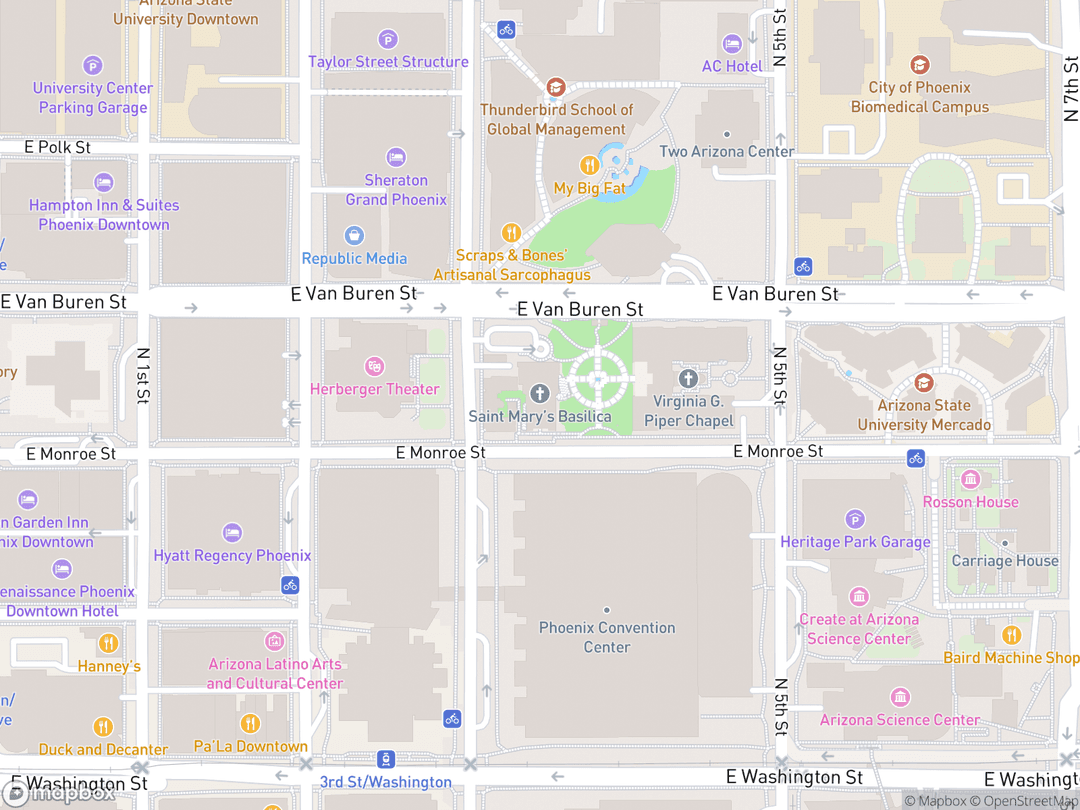
231 N. 3rd Street, Phoenix, AZ 85004
Hours: Mon-Fri 9:00 AM - 3:00 PM; Sat 8:00 AM - 6:00 PM; Sun 8:00 AM - 1:00 PM
Getting There: Take Valley Metro Light Rail to 3rd St/Washington or 3rd St/Jefferson station and walk three blocks north on 3rd Street to Monroe Street.
Get DirectionsTips for Your Visit
Stained Glass Viewing
Visit between 10:00 AM and 11:30 AM on sunny mornings to view the brilliant Munich-style glass at peak natural illumination.
Self-Guided Walking Tour
Informational brochures detailing the iconographic windows, side altars, and papal symbols are available near the vestibule entrance.
Sculpture Garden Reflection
Spend time in the quiet outdoor plaza garden adjacent to the parish center to view the bronze statues and Lourdes grotto.
About
St. Mary's Basilica—officially titled the Basilica of the Immaculate Conception of the Blessed Virgin Mary—is the oldest Catholic parish in Phoenix, Arizona. Established in 1881 as a modest adobe mission, the current landmark structure was completed in 1914 and solemnly dedicated in 1915. It stands as a vibrant spiritual sanctuary in downtown Phoenix, rooted in the monotheistic heritage of the God of Abraham and centered on Jesus Christ as Lord and Savior.
As a Minor Basilica, the church embodies key traditions of the Latin Rite Catholic Church, including Sacramental Realism focused on the Eucharist, deep Marian devotion, and a historic bond with the Pope. Staffed for over a century by the Franciscan Friars, the basilica reflects Franciscan principles of peace, humility, and dedicated service to the surrounding community.
Designated as a Phoenix Point of Pride and listed on the National Register of Historic Places, the basilica is celebrated for its Spanish Colonial Revival architecture, Austro-Bavarian copper onion domes, and Arizona's largest collection of historic Munich-style stained glass windows crafted by the Emil Frei Studio.
Gallery
Symbolic Elements
The temple's exterior features intricate carvings, each rich with spiritual meaning:

The Ombrellone (Conopopeum)
A yellow and red silk umbrella kept half-open in the sanctuary, signifying direct ties to the Holy See.

The Tintinnabulum
A ceremonial brass bell carried during solemn processions on papal and basilica feast days.

Crossed Keys of Saint Peter
Papal heraldic emblem representing apostolic authority and the sacrament of Reconciliation.

Franciscan Crest
Crossed arms of Christ and Saint Francis before the cross, symbolizing Franciscan spirituality.

Austro-Bavarian Onion Domes
Copper-plated bulbous domes crowning the twin towers, reflecting the European heritage of Franciscan builders.

Twelve Consecration Candles
Candles mounted along interior walls symbolizing the Twelve Apostles as foundations of the Church.
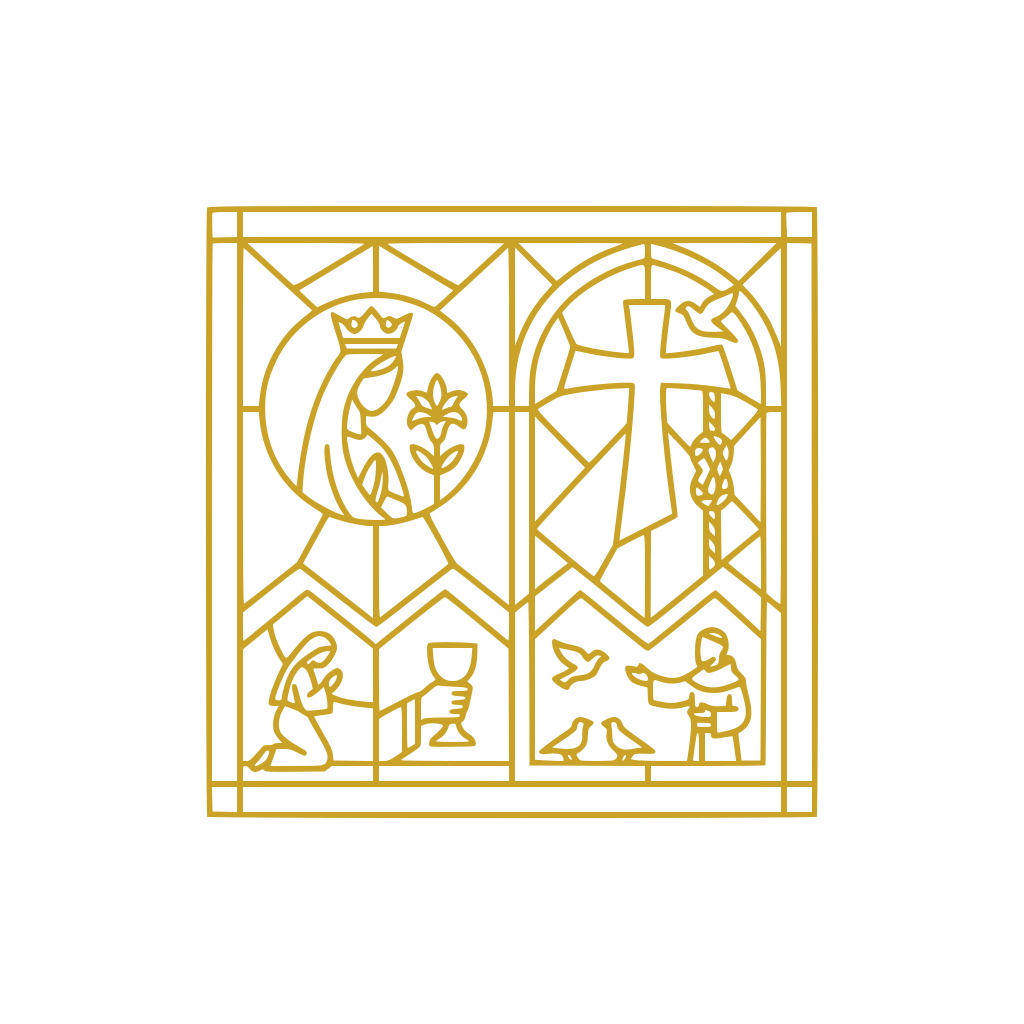
Emil Frei Stained Glass Suite
Hand-painted Munich-style glass panels portraying Marian and Franciscan iconographic narratives.
Interesting Facts
St. Mary's is the oldest Catholic parish in Phoenix, founded in 1881 when the town had fewer than 2,000 residents. (Tier A)
It remains the only church in the entire state of Arizona designated as a Minor Basilica. (Tier A)
The twin bell towers feature Austro-Bavarian onion domes honoring early German Franciscan builders. (Tier B)
Before air conditioning, parishioners built a basement church in 1903 to keep cool during desert summers. (Tier B)
Pope John Paul II addressed over 100,000 people from the upper balcony during his 1987 visit. (Tier A)
Lead designer Brother Adrian Wewer, O.F.M., designed over 100 churches without accepting a personal fee. (Tier B)
The sanctuary houses Arizona's largest collection of historic Munich-style stained glass windows. (Tier B)
The four north tower bells ring daily across downtown Phoenix, continuing a 19th-century tradition. (Tier B)
Common Questions
What is the official name of St. Mary's Basilica?
The official title is the Basilica of the Immaculate Conception of the Blessed Virgin Mary.
When was St. Mary's elevated to a Minor Basilica?
Pope John Paul II elevated the church to Minor Basilica status on September 2, 1985.
Can tourists visit the basilica outside of Mass times?
Yes, self-guided tours are welcome weekdays from 9:00 AM to 3:00 PM and on weekends.
Why does the church have Bavarian onion domes in Phoenix?
The onion domes reflect the Central European heritage of pastor Fr. Novatus Benzing and architectural consultant Br. Leonard Darscheid.
Is parking available at the basilica?
Parking is available in the garage adjacent to the diocesan chancery and along nearby downtown streets.
Featured Stories
Building the Underground Sanctuary
1902–1903
Faced with extreme Sonoran Desert summer heat and limited initial capital, Phoenix Catholics began construction in 1902 on a semi-subterranean sanctuary known as the 'basement church.' Dedicated on February 11, 1903, this lower level provided a cool refuge for liturgical worship while funds were raised to construct the grand upper basilica above it.
Source: Basilica Historical Archives
The Historic 1987 Papal Visit
September 14, 1987
During his pastoral visit to Phoenix, Pope John Paul II spent private moments of prayer inside St. Mary's Basilica before stepping onto the upper balcony. Looking out over 3rd Street, he greeted an ecstatic crowd of over 100,000 faithful, marking one of the most memorable spiritual gatherings in Arizona history.
Source: Diocese of Phoenix Records
Franciscan Labor and Architectural Devotion
1895–1915
Brother Adrian Wewer, O.F.M., designed over 100 sacred buildings across North America without ever accepting personal payment under his Franciscan vow of poverty. Working alongside Brother Leonard Darscheid, he combined Southwestern Mission Revival exterior lines with German Romanesque interior vaulting to create Phoenix's mother church.
Source: Franciscan Province Archives
Timeline
Parish Established
Father Edouard Gérard establishes the Parish of the Immaculate Conception in Phoenix.
MilestoneFranciscan Arrival
Franciscan Friars assume pastoral responsibility for the growing Catholic parish community.
MilestoneBasement Church Dedicated
A semi-subterranean sanctuary is dedicated to serve parishioners while upper church funds are raised.
DedicationSanctuary Dedication
Bishop Henri Granjon solemnly dedicates the completed upper church sanctuary.
DedicationSchantz Pipe Organ Installed
A historic 26-rank electro-pneumatic pipe organ is installed in the rear choir loft.
EventNational Register Listing
St. Mary's is officially listed on the National Register of Historic Places.
MilestoneElevated to Minor Basilica
Pope John Paul II designates St. Mary's as Arizona's first and only Minor Basilica.
MilestoneHistoric Papal Visit
Pope John Paul II prays in the basilica and addresses over 100,000 citizens from the balcony.
EventStained Glass Conservation
A multi-year conservation project restores and reinforces the historic Emil Frei glass windows.
RenovationCentennial Jubilee
The parish celebrates 100 years since the dedication of the upper church sanctuary.
EventHistory by Decade
1880s — Pioneer Adobe Beginnings
Father Edouard Gérard established the Parish of the Immaculate Conception in 1881 as the first Catholic parish in Phoenix. A modest 60-by-40-foot adobe structure was erected on 3rd Street to serve the pioneer frontier town.
1890s — Franciscan Stewardship
In 1895, Bishop Peter Bourgade entrusted the growing parish to the Franciscan Friars of the Sacred Heart Province. The friars expanded pastoral care and initiated plans for a lasting stone and brick landmark.
1900s — Construction of the Lower Sanctuary
Deterioration of the pioneer adobe building led to construction of a semi-subterranean basement church in 1902. Dedicated in 1903, this lower level offered cool shelter from Sonoran heat while fundraising continued.
1910s — Upper Sanctuary & Dedication
Under Franciscan architects Brother Adrian Wewer and Brother Leonard Darscheid, upper construction surged. The sanctuary, crowned with copper onion domes and Munich-style stained glass, was solemnly dedicated on February 15, 1915.
1970s — Historic Preservation Recognition
Recognized for its architectural and cultural legacy, St. Mary's was placed on the Arizona State Inventory of Historic Places in 1977 and listed on the National Register of Historic Places in 1978.
1980s — Basilica Elevation & Papal Visit
Pope John Paul II elevated St. Mary's to Arizona's only Minor Basilica on September 2, 1985. Two years later, on September 14, 1987, the Pontiff visited the basilica and addressed over 100,000 citizens from the balcony.
Architecture & Facilities
St. Mary's Basilica is an architectural hybrid combining Mission Revival and Spanish Colonial Revival exterior forms with a Romanesque Revival interior plan. Its twin bell towers topped with Austro-Bavarian copper-plated onion domes merge Southwestern regional styling with Central European Catholic architectural traditions.
Building Materials
Exterior Stucco Masonry
Durable brick and stone wall construction coated in stucco to withstand desert climate conditions.
Copper Roof Domes
Bulbous onion-shaped copper plates crowning the bell towers and glass cupolas.
Oak Interior Furnishings
Quarter-sawn solid oak pews and wall paneling crafted in Cleveland by Theodore Kuntz.
Munich-Style Stained Glass
Hand-painted glass panels fired by the Emil Frei Studio depicting biblical and Franciscan scenes.
Interior Features
Main Nave & Barrel Vault
Soaring Romanesque barrel vaulting framing a central processional aisle leading to the altar.
High Sanctuary Altar
Intricately carved high altar centered beneath a dedicated roof cupola illuminating the Eucharistic table.
Saint Joseph Side Altar
Dedicated side chapel altar crafted in 1910 featuring sculptural devotional figures.
Sacred Heart Side Altar
Devotional side chapel honoring the Sacred Heart of Jesus set against gold-leaf backdrops.
Temple Grounds
The basilica grounds feature a formal outdoor entry plaza, historic bell display, and a peaceful sculpture garden with statues of St. Francis of Assisi, Mother Teresa, and St. John Paul II.
Additional Facilities
Facilities include a parish hall, diocesan administrative offices, gift shop, and the subterranean historical exhibit center.
Religious Significance
St. Mary's Basilica is a primary center of Catholic liturgical life and spiritual devotion in the Diocese of Phoenix, rooted in the monotheistic worship of God and salvation in Jesus Christ.
To serve as a house of prayer, a sanctuary for the Holy Eucharist, and a center of Franciscan hospitality and social ministry.
Sacred Ordinances
The Holy Eucharist (Mass)
The source and summit of Christian life celebrated daily at the main high altar.
Sacrament of Reconciliation
Sacramental confession offered regularly under the papal emblem of crossed keys.
Marian Devotion
Liturgical honors celebrating Mary's title of the Immaculate Conception.
Franciscan Liturgical Rites
Special feast day liturgies honoring Saint Francis of Assisi and Franciscan heritage.
Minor Basilica Privileges
As a Minor Basilica, St. Mary's displays the Ombrellone and Tintinnabulum, symbolizing its papal bond and special liturgical privileges.
Sources & Research
Every fact on Temples.org is backed by verified Sources & Research. Each piece of information is rated by source tier and confidence level.
View All Sources (8)
| Field | Source | Tier | Retrieved |
|---|---|---|---|
| About & Historical Background | St. Mary's Basilica Parish (opens in a new tab) | A | 2026-02-23 |
| About & Historical Background | Roman Catholic Diocese of Phoenix (opens in a new tab) | A | 2026-02-23 |
| Architecture & Designation | National Register of Historic Places (Ref #78000551) (opens in a new tab) | A | 2026-02-23 |
| Historical Timeline & Franciscan Legacy | Franciscan Friars Sacred Heart Province (opens in a new tab) | A | 2026-02-23 |
| Papal Visit & Elevation | Holy See (Vatican Decree Una Propemodum Voce) (opens in a new tab) | A | 2026-02-23 |
| Visitor Insights & Cultural Heritage | City of Phoenix Points of Pride Program (opens in a new tab) | B | 2026-02-23 |
| Architecture & Stained Glass | Emil Frei Art Glass Studio Archives (opens in a new tab) | B | 2026-02-23 |
| History & Organ Restoration | Schantz Organ Company Archives (opens in a new tab) | B | 2026-02-23 |