Visitor Insights
Visiting Cathedral of Saint Matthew the Apostle
Visitors experience a serene haven of Byzantine mosaics and classical Romanesque arches moments from downtown business corridors. Open daily for prayer, the cathedral invites travelers to contemplate historic memorials and rich spiritual art. Self-guided QR audio tours provide comprehensive background on the chapels and architectural details.
Highlights
- Vast 35-foot apse mosaic of Saint Matthew created by Edwin Blashfield
- Inlaid black-and-gold marble floor plaque marking where President John F. Kennedy's casket rested
- Side chapels honoring the Blessed Sacrament, Saint Anthony, and Our Lady
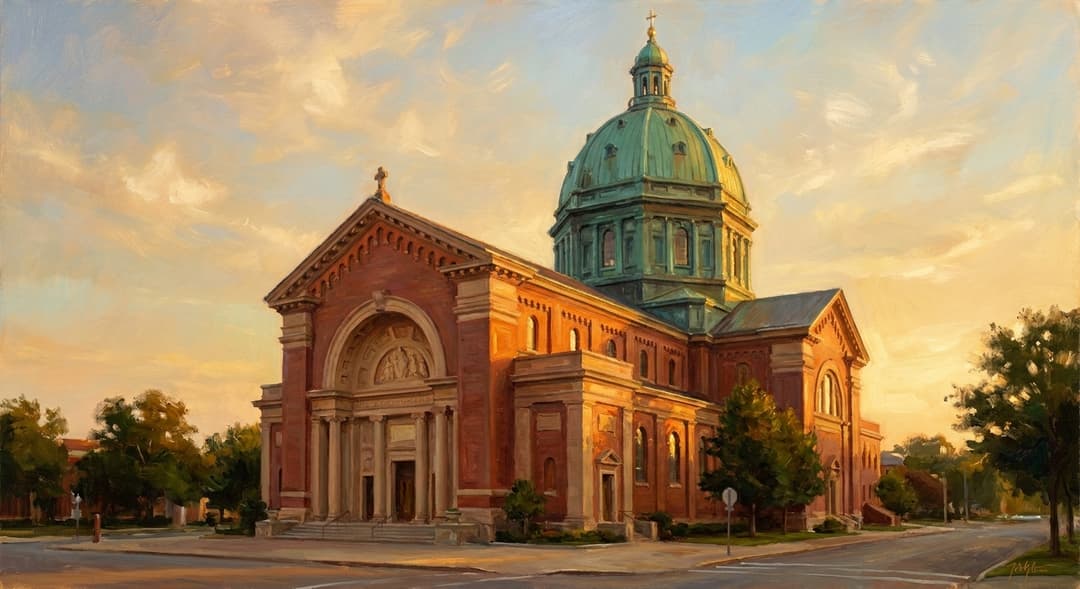
- Soaring 200-foot copper-clad octagonal dome and cupola
Things to Know
- Silence is observed in all nave areas during services and confessions
- Photography is restricted during active liturgies and choir rehearsals
- Street parking is strictly metered; Metrorail access is strongly recommended
Location

1725 Rhode Island Avenue NW, Washington, D.C. 20036
Hours: Monday through Friday 7:00 AM – 6:30 PM, Saturday 7:00 AM – 7:00 PM, Sunday 6:30 AM – 7:00 PM
Getting There: Located a three-minute walk from Farragut North Station on the Red Line, or six minutes from Farragut West Station.
Get DirectionsTips for Your Visit
Optimal Lighting Hours
Visit mid-morning between 9:30 AM and 11:30 AM to see natural sunlight illuminate Blashfield's apse mosaic.
Public Transit Access
Take the Red Line to Farragut North and exit via L Street for the shortest walk to the cathedral doors.
Respect Scheduled Masses
Plan interior sightseeing around daily midday services to maintain a quiet atmosphere for worshipers.
About
The Cathedral of Saint Matthew the Apostle serves as the mother church and episcopal seat of the Roman Catholic Archdiocese of Washington. Founded as a downtown parish in 1840, the current monumental structure on Rhode Island Avenue was designed by architect Christopher Grant La Farge and consecrated for worship in 1895. Sharing the historic Abrahamic tradition of consecrated sanctuaries, the cathedral stands as an earthly locus of prayer and covenantal gathering in the nation's capital.
The interior combines Romanesque Revival structure with opulent Byzantine Revival decorative art, featuring radiant mosaics by Edwin Blashfield and Jan Henryk de Rosen. Consecrated to Saint Matthew, the patron saint of civil servants and publicans, the sanctuary provides pastoral ministry to federal leaders, local citizens, and international diplomats.
Renowned globally as the site of President John F. Kennedy's 1963 state funeral, the cathedral has welcomed popes, world leaders, and jurists. It remains the perpetual home of the annual Red Mass, invoking spiritual wisdom and justice upon the United States judiciary.
Gallery
Symbolic Elements
The temple's exterior features intricate carvings, each rich with spiritual meaning:

The Winged Man
The traditional tetramorph symbol of Saint Matthew signifies Christ's human incarnation.

Drinking Peacocks
Ancient catacomb motifs of peacocks drinking from a chalice symbolize eternal life through the Eucharist.

JFK Memorial Plaque
An engraved floor stone marks the site where President Kennedy's casket rested during his requiem.

The Archiepiscopal Cathedra
The bishop's chair stands as a physical sign of apostolic teaching authority and pastoral unity.

Red Vestments and Tongues of Fire
Liturgical red highlights the descent of the Holy Spirit's guidance during the Red Mass.

Latin Doctors of the Church
Carvings of Saints Ambrose, Augustine, Jerome, and Gregory honor orthodox Catholic teaching.

Mother Teresa Bronze
A bronze memorial commemorating her 1974 visit depicts compassion for the poor and vulnerable.

Octagonal Dome Cross
The cupola cross marks the spiritual apex of the building rising 200 feet over the city.
Interesting Facts
The cathedral hosted the televised State Funeral Requiem Mass for President John F. Kennedy on November 25, 1963. (Tier A)
A circular marble marker in the nave center aisle permanently commemorates the site of President Kennedy's casket. (Tier A)
Every autumn the cathedral hosts the Red Mass, attended by Supreme Court Justices and government leaders. (Tier A)
Saint Matthew was a tax collector, making him the patron saint of civil servants in the nation's capital. (Tier A)
Two Roman Pontiffs have visited the cathedral: Pope Saint John Paul II in 1979 and Pope Francis in 2015. (Tier A)
Architect Christopher Grant La Farge also drafted original schemes for the Cathedral of St. John the Divine. (Tier B)
The dark brick exterior conceals an interior completely surfaced in polychrome marble, gilding, and tesserae. (Tier B)
An archiepiscopal crypt beneath the sanctuary contains the tombs of three resident Archbishops of Washington. (Tier A)
The Lively-Fulcher organ houses 5,045 pipes behind an Italianate case crowned with polished tin pipes. (Tier A)
Apse muralist Edwin Blashfield also painted the iconic central dome of the Library of Congress. (Tier B)
Common Questions
Why is Saint Matthew the titular patron of this cathedral?
As a former publican, Saint Matthew is the patron of civil servants working in the nation's capital.
Can visitors view the JFK memorial in the nave?
Yes, the inscribed marble plaque in the central aisle is fully visible during public visiting hours.
What is the significance of the annual Red Mass?
It petitions the Holy Spirit for divine wisdom and justice upon judges, jurists, and lawmakers.
Is the cathedral open to members of all faiths?
Yes, visitors of all backgrounds are welcome daily for quiet meditation, prayer, and architecture tours.
Featured Stories
A Nation Mourns President Kennedy
November 25, 1963
On a somber November morning, Cardinal Richard Cushing celebrated the State Requiem Mass for assassinated President John F. Kennedy before world dignitaries and grieving citizens. Jacqueline Kennedy and family members knelt in the front pews while global leaders filled the nave. Today, an inlaid stone marker in the central aisle designates where the president's casket rested in prayer.
Source: Cathedral of Saint Matthew the Apostle Archives
Inauguration of the Red Mass Tradition
February 15, 1953
Archbishop Patrick O'Boyle and the John Carroll Society initiated the annual Red Mass to pray for guidance across the judicial branch of government. Sitting presidents, cabinet officers, and Supreme Court justices regularly attend the solemn autumn liturgy. The traditional red vestments invoke the gifts of wisdom, fortitude, and justice upon those tasked with upholding the law.
Source: Archdiocese of Washington Historical Records
Papal Blessings on Rhode Island Avenue
September 23, 2015
Pope Francis arrived at Saint Matthew's to lead midday prayer with hundreds of assembled American bishops. The pontiff reflected warmly on the ministry of pastor and shepherd within the vibrant American Church. His visit renewed the historic precedent set in 1979 when Pope John Paul II celebrated the cathedral's first papal liturgy.
Source: Vatican Press Office Documentation
Timeline
Parish Established
Father William Matthews dedicates the original parish church of St. Matthew at 15th and H Streets NW.
MilestoneCornerstone Laid
Construction begins on the current Rhode Island Avenue site under architect Christopher Grant La Farge.
component.timeline.groundbreakingFirst Mass Celebrated
The congregation gathers for the first Eucharistic liturgy in the newly erected church superstructure.
EventSt. Anthony Chapel Blessed
The Chapel of Saint Anthony of Padua opens as the first completely decorated side chapel in the nave.
MilestoneDome Completed & Dedicated
Father Edward L. Buckey completes the 200-foot octagonal dome and dedicates the finished church building.
DedicationBlashfield Mosaic Finished
Muralist Edwin Blashfield completes the colossal 35-foot apse mosaic of Saint Matthew enthroned.
MilestoneElevated to Co-Cathedral
Pope Pius XII designates St. Matthew's as co-cathedral of the Archdiocese of Baltimore-Washington.
MilestoneArchdiocesan Cathedral
The Archdiocese of Washington is established as an independent see with St. Matthew's as its cathedral.
MilestoneFirst Annual Red Mass
Archbishop Patrick O'Boyle and the John Carroll Society inaugurate Washington's legal Red Mass.
EventJFK Funeral Mass
Cardinal Richard Cushing presides over the televised State Funeral Requiem Mass for President John F. Kennedy.
EventHistoric Landmark Listing
The cathedral is officially entered onto the National Register of Historic Places.
MilestonePapal Visit of Pope Francis
Pope Francis leads midday liturgical prayer with the assembled bishops of the United States.
MilestoneHistory by Decade
1840s–1880s — The Original Downtown Parish
Father William Matthews established the parish on November 1, 1840, erecting its original brick sanctuary at 15th and H Streets NW. For five decades, the church ministered faithfully to downtown residents, government clerks, and diplomatic personnel.
1890s — Relocation and New Foundation
Pastor Thomas Sim Lee acquired property along Rhode Island Avenue in 1892 and hired renowned architect Christopher Grant La Farge. The cornerstone was blessed in 1893, and the first Mass was offered inside the rising structure on June 2, 1895.
1900s–1910s — Raising the Great Dome
Following Monsignor Lee's death, Father Edward L. Buckey supervised vaulting and the completion of the 200-foot octagonal dome. The finished landmark church was formally dedicated in the autumn of 1913 before local civic and religious dignitaries.
1920s–1930s — Apse Art and Co-Cathedral Rank
Artist Edwin Blashfield executed the towering 35-foot mosaic of Saint Matthew enthroned, elevating the apse into a Byzantine showpiece. In 1939, Pope Pius XII designated the church as co-cathedral of the Archdiocese of Baltimore-Washington.
1940s–1950s — Archiepiscopal Elevation and Civic Tradition
On November 15, 1947, Saint Matthew's became the sole cathedral of the newly created Archdiocese of Washington. In 1953, Archbishop Patrick O'Boyle instituted the annual Red Mass to invoke divine guidance upon the nation's jurists and statesmen.
1960s–1970s — Global Mourning and Historic Landmark
The cathedral became the focal point of world grief on November 25, 1963, during President Kennedy's televised funeral Mass. It gained entry on the National Register of Historic Places in 1974, followed by a papal Mass by Pope John Paul II in 1979.
1980s–1990s — Crypt and Organ Installation
The archdiocese constructed a dedicated crypt for its archbishops beneath the chapels. In 1995, a premier Lively-Fulcher pipe organ of 5,045 pipes was installed to accompany the cathedral's celebrated musical programs.
2000s–Present — Restoration and Apostolic Pilgrimage
A comprehensive restoration cleaned the mosaics and stabilized the dome, celebrating rededication on September 21, 2003. Pope Francis visited in 2015, and the cathedral was designated a premier pilgrimage site for the 2025 Vatican Jubilee.
Architecture & Facilities
The Cathedral of Saint Matthew the Apostle represents an exceptional synthesis of North Italian Romanesque Revival architecture combined with Byzantine Revival spatial forms and decorative treatments, featuring a quiet brick exterior that yields to an opulent, light-filled cruciform interior finished in polychrome marble and brilliant tesserae.
Building Materials
Exterior Red Brick and Terra Cotta
Deep red pressed bricks are trimmed with sandstone and decorative terra cotta corbel moldings.
Polychrome Marble Revetment
Fine Italian Carrara marble, Siena brocatelle, and verd antique line the nave walls and pillars.
Glass and Stone Tesserae
Millions of gilded and enameled mosaic pieces coat the apse, domes, and side chapels.
Structural Copper Dome
The exterior octagonal masonry drum supports a copper-clad hemispherical dome crowned by a cupola cross.
Interior Features
The Sanctuary Apse
Houses Edwin Blashfield's 35-foot mosaic portraying Saint Matthew enthroned beside a radiant angel.
Chapel of the Blessed Sacrament
Reserved for Eucharistic adoration with a mosaic depicting the Road to Emmaus supper.
Chapel of Saint Anthony of Padua
Showcases elaborate mosaic scenes of Saint Francis designed by artist Jan Henryk de Rosen.
The Archiepiscopal Crypt
An eight-chamber stone vault resting beneath the nave houses the tombs of former archbishops.
Temple Grounds
Situated directly along the urban corridor of Rhode Island Avenue NW with paved pedestrian approaches, barrier-free access ramps, and manicured streetfront plantings.
Additional Facilities
Features an extensive parish center, diocesan meeting rooms, choir rehearsal halls, and an automated self-guided visitor greeting center.
Religious Significance
Within the Abrahamic tradition shared by Judaism, Christianity, and Islam, the sacred sanctuary stands as a dedicated locus of prayer, covenantal memory, and communion between God and humanity. In Roman Catholic theology, a cathedral is the mother church of a diocese and the permanent seat of the bishop, embodying apostolic succession and sacramental unity.
To serve as the cathedral seat of the Archbishop of Washington and provide a spiritual home of sacramental life, intercession, and civic prayer in the nation's capital.
Sacred Ordinances
The Holy Sacrifice of the Mass
The central Eucharistic sacrament celebrated daily, where Christ's sacrifice is memorialized and the faithful receive communion.
Sacrament of Reconciliation
Daily confessions offering divine mercy, repentance, and spiritual reconciliation to parishioners and visitors.
The Annual Red Mass
A solemn votive Mass of the Holy Spirit celebrated each autumn for justices, attorneys, and public officials.
Episcopal and Priestly Ordinations
Conferral of Holy Orders imparting sacramental ministry upon newly ordained priests and regional auxiliary bishops.
The Cathedra as Symbol of Apostolic Unity
The bishop's chair, or cathedra, placed in the sanctuary visibly represents the teaching office and pastoral shepherd authority of the Archbishop of Washington. It links the local metropolitan church directly to the See of Peter in Rome, upholding sacramental integrity across generations.
Sacramental Beauty and Civic Intercession
Reflecting Catholic sacramental theology, the cathedral employs physical beauty—mosaics, marble, stained glass, and sacred polyphony—to lift the human heart toward the transcendent mystery of God. Consecrated to an apostle who served as a tax collector, the sanctuary continuously offers intercessory prayer for righteous governance, peace, and the welfare of public servants.
Sources & Research
Every fact on Temples.org is backed by verified Sources & Research. Each piece of information is rated by source tier and confidence level.
View All Sources (8)
| Field | Source | Tier | Retrieved |
|---|---|---|---|
| About & Historical Background | Cathedral of Saint Matthew the Apostle (opens in a new tab) | A | 2026-03-31 |
| National Register Architectural Ledger | National Park Service National Register of Historic Places (opens in a new tab) | B | 2026-03-31 |
| Archdiocesan History and Establishment | Roman Catholic Archdiocese of Washington (opens in a new tab) | A | 2026-03-31 |
| Papal Visit and Liturgical Homily | The Holy See (opens in a new tab) | A | 2026-03-31 |
| JFK Funeral Liturgy Records | John F. Kennedy Presidential Library and Museum (opens in a new tab) | A | 2026-03-31 |
| The Red Mass Civic Tradition | The John Carroll Society (opens in a new tab) | A | 2026-03-31 |
| Historic American Buildings Survey | Library of Congress (opens in a new tab) | B | 2026-03-31 |
| Architectural Profile of Christopher Grant La Farge | Society of Architectural Historians Archipedia (opens in a new tab) | B | 2026-03-31 |