Visitor Insights
Visiting Franciscan Monastery of the Holy Land in America
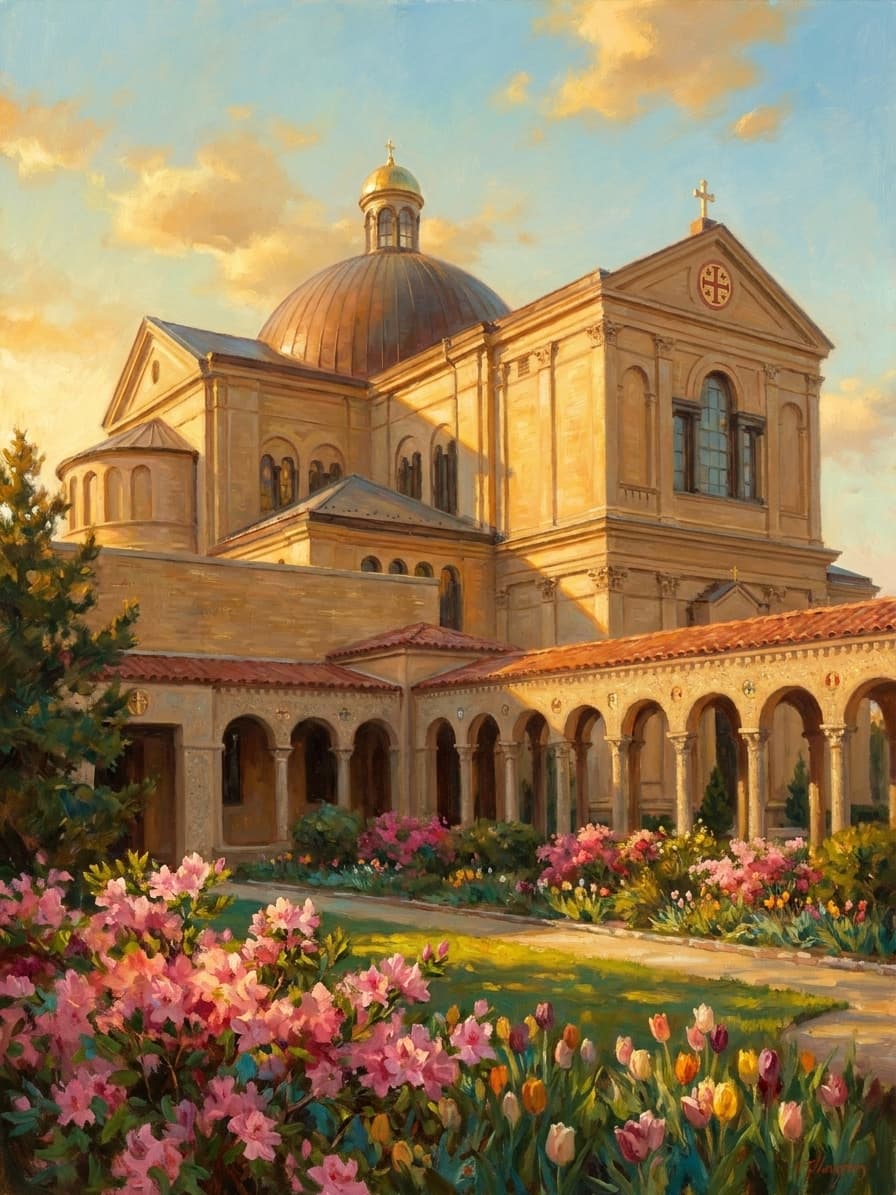
Visitors experience a peaceful spiritual oasis featuring indoor Holy Land shrine replicas, subterranean catacombs, and expansive formal rose gardens. Guided tours offer deep historic and theological insights into Franciscan custody of sacred sites.
Highlights
- Replica of the Holy Sepulchre Aedicule containing an authentic stone from Jerusalem.
- Subterranean Roman Catacombs housing genuine early Christian martyr relics.
- Rosary Portico showcasing the Hail Mary prayer in nearly 200 languages.
- Sprawling 42-acre grounds with blooming tulip terraces and outdoor shrines.
Things to Know
- Subterranean catacomb areas feature narrow passages and low lighting.
- Free guided tours run Tuesday through Sunday at scheduled hourly intervals.
Location
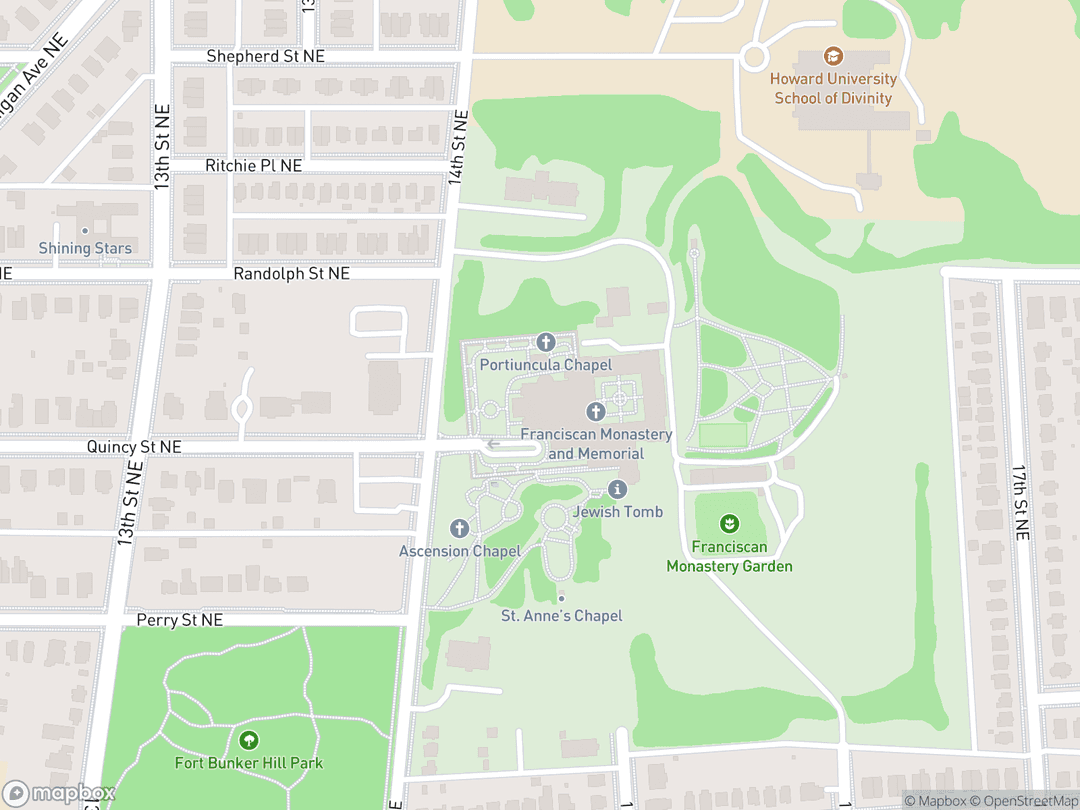
1400 Quincy Street N.E., Washington, D.C. 20017
Hours: Church open daily 9:00 AM – 4:00 PM; Gardens open daily 9:00 AM – 4:45 PM.
Getting There: Located 0.6 miles east of Brookland-CUA Metro Station (Red Line) or via WMATA bus routes H6 and H8.
Get DirectionsTips for Your Visit
Springtime Garden Visits
Visit in April or May when thousands of tulips, roses, and azaleas bloom across the upper and lower garden terraces.
Monthly Organ Concerts
Attend free public organ recitals on the second Sunday of the month from September through May at 4:00 PM.
About
The Franciscan Monastery of the Holy Land in America stands atop Mount Saint Sepulchre in Washington, D.C., as a premier Roman Catholic pilgrimage site. Rooted in Abrahamic history, the sanctuary connects believers directly to the geographic cradle of Christian faith across Jerusalem, Bethlehem, and Nazareth.
Entrusted by the Holy See in 1342 to safeguard sacred sites in the Middle East, the Franciscan Friars established this American sanctuary in 1899. Designed by Italian architect Aristide Leonori, the complex allows pilgrims to experience full-scale replicas of Holy Land shrines and Roman catacombs.
Gallery
Symbolic Elements
The temple's exterior features intricate carvings, each rich with spiritual meaning:

Jerusalem Cross
The primary emblem of the monastery whose central cross and four crosslets symbolize Christ and the four Gospels.
Tau Cross
An ancient symbol carved above the entrance that Saint Francis adopted to represent salvation and Franciscan humility.

14-Pointed Star
Embedded in the Nativity Grotto floor to mirror Bethlehem's star and represent the genealogy of Christ.
Rosary Language Tiles
Hand-painted ceramic tiles reciting Marian prayers across world languages to symbolize universal Catholic unity.
Porziuncola Chapel
A replica of the Assisi sanctuary representing the cradle and spiritual rebirth of the Franciscan movement.

Catacomb Loculi
Subterranean wall burial niches modeled after ancient Roman Christian cemeteries to recall early martyr devotion.

Aedicule Shrine
An architecturally accurate scale model of Jerusalem's tomb structure representing the Resurrection.
Interesting Facts
The monastery serves as the official United States headquarters for the Franciscan Custody of the Holy Land. (Tier A)
An authentic piece of limestone from Christ's tomb chamber in Jerusalem is enshrined inside the main replica. (Tier A)
Fr. Godfrey Schilling raised construction funds by collecting ten cents per month from working-class Catholic families. (Tier B)
The catacombs house the complete 1,700-year-old skeletal remains of early Christian martyr Saint Benignus. (Tier A)
Concrete pioneer John Joseph Earley perfected his exposed-aggregate technique while building the Rosary Portico. (Tier B)
The Rosary Portico displays the Hail Mary in rare dialects including Ge'ez, Aramaic, Cherokee, and Navajo. (Tier B)
Architect Aristide Leonori surveyed Ottoman Palestine with tape measures and compasses to ensure dimensional precision. (Tier B)
The soaring masonry interior produces a dramatic acoustic reverberation lasting five to seven seconds. (Tier B)
An active garden guild donates thousands of pounds of fresh organic produce annually to local food banks. (Tier A)
Common Questions
Are the catacombs under the monastery real?
The corridors are architecturally recreated Roman catacombs, but they house authentic ancient relics including Saint Benignus.
Is there an admission fee to visit the monastery?
Admission to the church, gardens, and guided catacomb tours is completely free to the public.
Does the church contain real fragments from Jerusalem?
Yes, the Holy Sepulchre replica embeds an authentic piece of stone extracted directly from Christ's tomb in Jerusalem.
How many languages are displayed in the Rosary Portico?
The ceramic tiles along the portico present the Hail Mary prayer in nearly 200 ancient and modern languages.
Featured Stories
Crowdfunded One Dime at a Time
1890s
Determined to build a Holy Land sanctuary without incurring debt, Father Godfrey Schilling launched an innovative fundraising campaign. He invited working-class Catholic families across North America to contribute just ten cents per month through the Crusader's Almanac publication. This massive grassroots effort successfully funded the land purchase and church construction.
Source: Franciscan Monastery Historical Archives
Precision Surveying in Ottoman Palestine
1897
Before groundbreaking began in Washington, Italian architect Aristide Leonori traveled throughout Ottoman-controlled Palestine equipped with cameras, tape measures, and compasses. He painstakingly surveyed the Church of the Holy Sepulchre and Bethlehem's Nativity Grotto to ensure every replica in the American capital matched exact historical dimensions.
Source: Liturgical Arts Journal Architectural Studies
Enshrining Ancient Relics in the Nation's Capital
1929
In 1929, papal authorities granted permission to transfer sacred early Christian remains from Rome to the monastery's catacombs. Among these was the intact, 1,700-year-old skeleton of Saint Benignus of Armagh, which was brought to Washington and permanently entombed behind glass inside the subterranean vaults.
Source: Archdiocese of Washington Historical Records
Timeline
Commissariat Established
Father Charles Vassani establishes the U.S. Commissariat of the Holy Land in New York.
MilestoneCornerstone Laid
Friars break ground on Mount Saint Sepulchre in Washington, D.C.
component.timeline.groundbreakingInaugural Dedication Mass
The Memorial Church opens to the public on the Feast of the Stigmata of St. Francis.
DedicationRosary Portico Construction
John Joseph Earley begins creating the exposed-aggregate concrete portico arcades.
EventSolemn Church Consecration
The sanctuary is formally consecrated during its silver jubilee celebration.
DedicationAncient Relics Enshrined
The complete skeletal remains of Saint Benignus are interred in the catacombs.
EventPorziuncola Replica Built
A full-scale replica of St. Francis's Assisi chapel is constructed in the gardens.
EventNational Register Listing
The complex is formally added to the National Register of Historic Places.
MilestonePipe Organ Installation
A custom 2,319-pipe Lively-Fulcher organ is installed in the main church.
Renovation125th Anniversary Celebration
Cardinal Wilton Gregory leads solemn anniversary liturgies with Franciscan leadership.
MilestoneHistory by Decade
1880s — The Holy Land Vision
Franciscan friars in New York conceived the idea of creating a Holy Land pilgrimage site in North America. Father Godfrey Schilling and Very Reverend Charles Vassani sought to bring sacred Middle Eastern shrines within reach of American faithful unable to travel abroad.
1890s — Land Acquisition and Construction
The friars acquired the hilltop McCeeney Estate in rural Brookland, Washington, D.C., in 1897. Architect Aristide Leonori designed the Neo-Byzantine Memorial Church, which opened with its inaugural Mass on September 17, 1899.
1900s–1910s — Expansion of Outdoor Shrines
Construction expanded across the 42-acre grounds to include the subterranean catacombs and the Rosary Portico. Craftsman John Joseph Earley developed innovative concrete techniques to create the surrounding cloistered arcades.
1920s–1940s — Consecration and Pilgrimage Surge
The Memorial Church was formally consecrated on September 17, 1924, during its silver jubilee. Ancient Roman relics were interred in 1929, and the sanctuary became a popular wartime pilgrimage site for families praying for peace.
1950s–1990s — Preservation and National Landmark
As the surrounding Brookland neighborhood evolved into 'Little Rome,' the monastery maintained its quiet monastic presence. On January 17, 1992, the entire complex was listed on the National Register of Historic Places.
2000s–Present — Musical Revival and Community Outreach
In 2002, a custom 2,319-pipe Lively-Fulcher organ was installed, launching a monthly concert series. Today, the monastery continues its spiritual mission while donating fresh produce to local food pantries through its active garden guild.
Architecture & Facilities
The Memorial Church of the Holy Sepulchre represents a Neo-Byzantine master plan inspired by Constantinople's Hagia Sophia and Jerusalem's Basilica of the Holy Sepulchre. Its central floor plan forms a Crusader Cross topped by copper-sheathed domes, while the attached friary exhibits refined Neo-Romanesque brickwork.
Building Materials
Exterior Facade
Buff-colored brick walls accented with stone trim and decorative terracotta details.
Rosary Portico
Exposed-aggregate concrete engineered by John Joseph Earley to mirror European marble.
Roofing & Domes
Custom copper sheathing crowning the primary central dome and smaller surrounding cupolas.
Catacomb Passages
Textured aggregate cement formulated to simulate ancient Roman volcanic tufa rock vaults.
Interior Features
Holy Sepulchre Aedicule
Scale reproduction of Christ's tomb chamber featuring an embedded stone fragment from Jerusalem.
Mount Calvary Chapel
Elevated chapel wing containing life-sized statuary depicting the Crucifixion scene.
Grotto of the Nativity
Subterranean sanctuary reproducing Bethlehem's cave with an embedded 14-pointed floor star.
Subterranean Catacombs
Twisting underground burial corridors housing authentic early Christian martyr relics.
Temple Grounds
Spanning 42 acres atop Mount Saint Sepulchre, the grounds feature formal rose terraces, lower valley gardens, full-scale outdoor shrines, and active vegetable plots operated by the garden guild.
Additional Facilities
Includes a visitor center, gift shop, Franciscan friary, greenhouse, and retreat grounds.
Religious Significance
Within Catholic theology, physical pilgrimage serves as a powerful instrument of spiritual renewal. By recreating the geography of salvation history, the monastery enables believers to encounter the mysteries of Christ's life, death, and resurrection in the nation's capital.
To provide an accessible American pilgrimage destination and support the Franciscan Custody of the Holy Land.
Sacred Ordinances
Holy Sacrifice of the Mass
Daily Eucharistic liturgies celebrated according to the Roman Rite in the main sanctuary.
The Way of the Cross
Devotional pilgrimage walking through indoor and outdoor Stations of the Cross.
Marian Rosary Prayer
Meditation on Christ's life supported by the multilingual chapels of the Rosary Portico.
Liturgy of the Hours
Daily chanted monastic prayer offered continuously by the resident Franciscan friars.
Franciscan Stewardship
For over eight centuries, Franciscan friars have served as guardians of Christian holy places in the Middle East, a sacred mission reflected directly in this American sanctuary.
Sources & Research
Every fact on Temples.org is backed by verified Sources & Research. Each piece of information is rated by source tier and confidence level.
View All Sources (8)
| Field | Source | Tier | Retrieved |
|---|---|---|---|
| About & Historical Background | Franciscan Monastery of the Holy Land in America (opens in a new tab) | A | 2026-02-15 |
| Visitor Insights & Shrines | Franciscan Monastery of the Holy Land in America (opens in a new tab) | A | 2026-02-15 |
| Architecture & Rosary Portico | The Cultural Landscape Foundation (opens in a new tab) | B | 2026-02-15 |
| Architectural Description & Replicas | Liturgical Arts Journal (opens in a new tab) | B | 2026-02-15 |
| Subterranean Catacombs & Relics | Catholic Review (opens in a new tab) | B | 2026-02-15 |
| Historic Preservation & Listing | DC Preservation League (opens in a new tab) | B | 2026-02-15 |
| Lively-Fulcher Pipe Organ | Sonja Kahler Organ Registry (opens in a new tab) | B | 2026-02-15 |
| Community Outreach & Gardens | The Washington Post (opens in a new tab) | B | 2026-02-15 |