Visitor Insights
Visiting Oakland California Temple
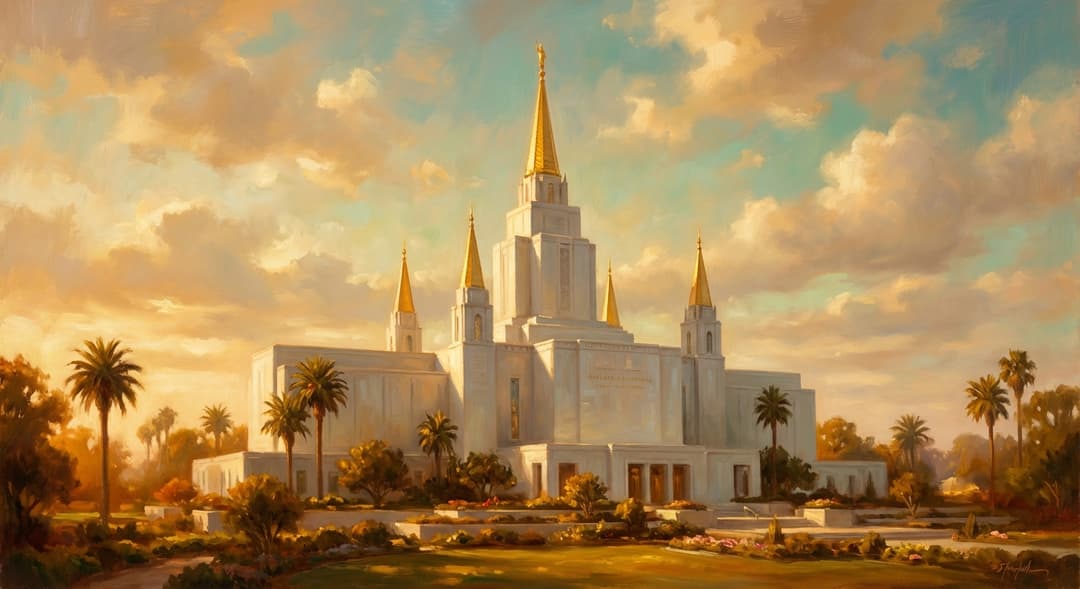
The Oakland Temple offers a unique visitor experience due to its publicly accessible rooftop gardens. Unlike most temples where the upper levels are restricted, visitors here can ascend exterior staircases to the second-story terrace, which offers breathtaking panoramic views of the San Francisco Bay, the Golden Gate Bridge, and the city skyline. The grounds also feature a Visitors' Center with interactive exhibits and a reproduction of Thorvaldsen's Christus statue.
Highlights
- Rooftop Garden Terrace (Publicly Accessible)
- Panoramic Bay Area Views
- Visitors' Center with Christus Statue
- Cascading Water Features
Things to Know
- Modest dress is requested for the grounds.
- Photography is permitted on the grounds and roof terrace, but not inside.
- The site is built on a hill; comfortable walking shoes are recommended.
Location
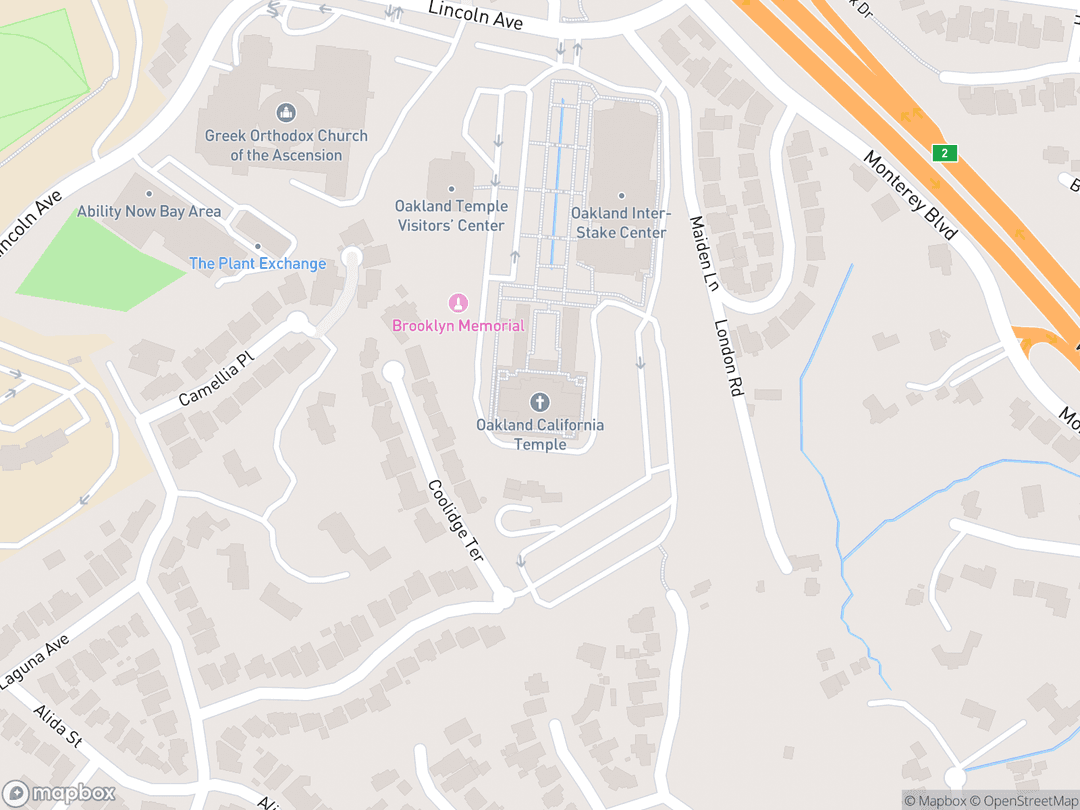
4770 Lincoln Ave, Oakland, CA 94602, United States
Hours: Grounds open daily from 9:00 AM to 9:00 PM.
Getting There: Located off Highway 13 (Warren Freeway) at the Lincoln Avenue exit. Ample free parking is available on site.
Get DirectionsTips for Your Visit
Sunset Views
Visit roughly 30 minutes before sunset to see the sun dip behind the Golden Gate Bridge and watch the temple lights turn on.
Rooftop Access
Don't miss the exterior staircases leading to the roof garden. It is one of the few temples in the world with this feature.
About
The Oakland California Temple stands as a prominent landmark in the East Bay, visible from much of the San Francisco Bay Area. Situated on an 18.1-acre site known locally as "Temple Hill," the structure is unique among Latter-day Saint temples for its Modern Contemporary design with distinct Asian influences, reflecting the diverse cultures of the Pacific Rim. Its five gold-leafed spires and massive granite friezes create a striking silhouette against the Oakland hills, serving as a visual beacon for ships entering the Golden Gate and aircraft approaching the airport.
The temple's history is rooted in a 1924 prophecy by Elder George Albert Smith. While staying at the Fairmont Hotel in San Francisco, he looked across the bay and told a local church leader that he could envision a "white temple of the Lord high upon those hills." This vision guided the eventual acquisition of the site in the 1940s, long before the construction of the nearby Warren Freeway made the location easily accessible. Dedicated in 1964 by President David O. McKay, it was the 13th operating temple of the Church and the second built in California.
Architecturally, the building departs from the neo-Gothic and colonial styles of its predecessors. Architect Harold W. Burton designed a structure that features a central celestial room with ordinance rooms clustered around it, a layout that influenced subsequent temple designs. The exterior is clad in Sierra White granite from Raymond, California, and features two 35-foot sculpted panels depicting Christ teaching in the Holy Land and in the Americas.
In 2018, the temple underwent a significant renovation to upgrade mechanical systems and improve seismic resilience. The entire structure was placed on base isolators, allowing it to move independently of the ground during an earthquake—a critical update given its proximity to the Hayward Fault. Rededicated in 2019 by President Dallin H. Oaks, the Oakland California Temple continues to serve as a spiritual center and a place of peace, inviting visitors to walk its rooftop gardens and enjoy panoramic views of the bay.
Gallery
Symbolic Elements
The temple's exterior features intricate carvings, each rich with spiritual meaning:

The Five Spires
The arrangement of one central spire surrounded by four corner spires represents the Savior presiding over the gathering of Israel from the four corners of the earth.

Sculpted Friezes
Two 35-foot granite panels depict Christ teaching in the Holy Land (north) and appearing to the people of the Americas (south), symbolizing the unity of scripture.

The Beacon
The temple's prominent lighting and hilltop location fulfill the prophecy of it being an 'ensign' or standard to the nations, guiding travelers by sea and air.

Living Water
A stream feature flows from the front of the temple grounds toward the entrance, symbolizing the 'living water' of the Gospel flowing out to the world.

Upturned Eaves
The pagoda-style upturned rooflines on the spires and gates symbolize a reaching upward toward heaven, bridging Eastern architectural language with Western religious function.

Perforated Spires
The lace-like perforation of the granite spires allows light to shine through them at night, symbolizing the light of revelation and the glory of God.

Rooftop Garden
The accessible second-story terrace represents a higher plane of thought and communion with nature, offering a perspective above the noise of the world below.
Interesting Facts
The temple serves as an official visual navigation waypoint for ships entering the Golden Gate and planes approaching Oakland International Airport.
The site was identified in a vision by George Albert Smith in 1924, forty years before the temple was built and long before the adjacent freeway was planned.
It is one of the only Latter-day Saint temples in the world where the public is invited to walk onto the roof terrace.
During the 2018 renovation, the entire building was lifted to install base isolators, allowing it to 'float' during an earthquake.
The grounds include an Inter-stake Center that seats thousands, making 'Temple Hill' a major community gathering place.
Architect Harold Burton designed the ordinance rooms without exterior windows to create a sanctuary, using the perforated spires to let the building glow.
The massive granite friezes were so heavy that a custom 'cradle' lifting system had to be invented to hoist them without drilling holes.
A memorial service for U.S. President Herbert Hoover was held in the adjacent center shortly before the temple's dedication.
The water feature running from the front of the grounds symbolizes 'living water' offered by Christ.
The exterior is faced with Sierra White granite from Raymond, California, known for its brilliant white appearance.
Common Questions
Can the public go on the roof of the Oakland Temple?
Yes. The Oakland Temple is unique in that it features a rooftop garden terrace accessible via exterior staircases. The public is welcome to walk up to the terrace to enjoy the gardens and the spectacular views of the Bay Area.
Why does the temple look Asian in style?
Architect Harold W. Burton intentionally designed the temple with a Modern Contemporary style featuring Asian motifs to reflect the diverse cultures of the San Francisco Bay Area and the Pacific Rim. This includes the upturned eaves and the layout of the spires.
Is the temple safe during earthquakes?
Yes. During the major renovation completed in 2019, the temple was seismically retrofitted. The entire structure was placed on base isolators (rollers), which allow the building to move independently of the ground during a seismic event, significantly increasing its safety.
What do the five spires represent?
While primarily an architectural choice, the five spires (one tall central spire surrounded by four corner spires) are often interpreted as representing Jesus Christ (the center) presiding over the gathering of Israel from the four corners of the earth.
Can I enter the temple building itself?
Access to the interior of the temple is reserved for members of the Church with a current temple recommend. However, the grounds, the Visitors' Center, and the rooftop terrace are open to the general public.
Related Stories
Explore the rich history, traditions, and people connected to this sacred site.
Featured Stories
The Prophecy at the Fairmont
1924
In 1924, Elder George Albert Smith, then an Apostle, stopped at the Fairmont Hotel in San Francisco. Gazing across the bay toward the undeveloped East Bay hills, he turned to local stake president W. Aird Macdonald and shared a powerful vision.
He declared, 'Brother Macdonald, I can almost see in vision a white temple of the Lord high upon those hills, an ensign to all the world travelers as they sail through the Golden Gate into this wonderful harbor.' This prophecy guided the Church's acquisition of the site nearly two decades later, securing the location long before urban development reached the area.
Source: Church History Department
The Impossible Friezes
1963–1964
The temple features two massive 35-foot granite bas-relief panels, or friezes, depicting the ministry of Christ. These solid stone pieces were so heavy and complex that the stone supplier initially claimed it was impossible to install them without drilling holes into the artwork for hooks.
Refusing to mar the art, the construction team devised a custom 'cradle' lifting system. This innovative engineering solution allowed them to hoist the massive granite slabs into place gently and precisely, preserving the integrity of the sacred depictions that now adorn the north and south faces.
Source: Church of Jesus Christ Temples
A Beacon for the Bay
Present Day
The Oakland Temple was designed to be seen. Its lighting system and strategic positioning make it a registered visual landmark for maritime and aviation navigation in the Bay Area. Pilots and ship captains use the illuminated spires as a reference point when entering the harbor or approaching the airport.
This practical utility mirrors its spiritual intent as an 'ensign to the nations.' For millions of Bay Area residents and travelers, the glowing white temple on the hill serves as a constant, silent reminder of peace and higher purpose amidst the bustle of metropolitan life.
Source: Temple Hill Visitor Site
The Hill That Waited
1942–1943
Before Temple Hill held a temple, it was a 14.5-acre hillside parcel above Oakland. During World War II, government restrictions interrupted plans for a luxury-home subdivision, and the owner offered the property to a member of the local temple-site committee for $18,000.
The owner held the offer while Church leaders inspected the site. Early in 1943, local leaders completed the purchase, securing the hill that would later become the Temple Hill complex.
Source: Religious Studies Center (BYU)
When Oakland Came Inside
1964 and 2019
Twice in its history, the Oakland California Temple has opened its interior to the wider Bay Area before a dedication or rededication. In late 1964, almost 400,000 people toured the newly completed building during a public open house, and more than 123,000 visitors attended another open house after the 2019 renovation.
The second gathering culminated on June 16, 2019, when President Dallin H. Oaks rededicated the 55-year-old temple in three sessions. Together, the two occasions show a landmark that periodically welcomes its neighbors to see the craftsmanship, art, and purpose within.
Source: The Church of Jesus Christ of Latter-day Saints
President McKay at the Dedication
November 17, 1964
In late summer 1964, Church president David O. McKay suffered a severe stroke that affected his ability to walk and speak. Despite concerns from his family and physicians, he traveled to Oakland for the first dedicatory service of the new temple.
The Church's historical account records that McKay arrived in a wheelchair, then rose, walked to the podium, and offered the dedicatory prayer. The moment joined the temple's opening with the long ministry of the leader who had approved the site more than two decades earlier.
Source: The Church of Jesus Christ of Latter-day Saints
A Temple Designed for the Age of Film
1964
Architect Harold W. Burton designed Oakland as a thoroughly modern temple. It was among the first in the Church to use filmed instruction rather than a live presentation, and Burton created a windowless, theater-like setting to support that experience.
The decision also embraced the new possibilities of mid-century air conditioning and artificial lighting, producing the building's striking, continuous granite exterior. Windows were added to a main-floor waiting area during the 2019 renovation while preserving Burton's larger vision.
Source: The Church of Jesus Christ of Latter-day Saints
The Waterfall That Returned
1964–2019
Water once fell from Oakland's second-level garden terrace into a reflecting pool at the temple entrance. The waterfall was part of Burton's original design, but irreparable leaks forced it to close in 1969, and the pool became a flower bed for decades.
Modern materials and technology made restoration possible during the 2018-19 renovation. Visitors approaching the entrance can again pass beneath cascading water, encountering an architectural feature that had been absent for most of the temple's life.
Source: The Church of Jesus Christ of Latter-day Saints and the Religious Studies Center (BYU)
A Christmas Tradition Built by Neighbors
Late 1970s–Present
By the late 1970s, Christmas lights on Temple Hill had become a public tradition. A 2020 local account traced the display to roughly 10,000 lights installed by local Latter-day Saints and described a then-current display of more than 100,000 LED lights.
The same account described more than 100 volunteers from local congregations preparing the lights reachable by ladder, while trained staff used lifts for the tall palms. The scale and technology have changed over time, but the tradition continues to prepare a free seasonal display for Oakland neighbors.
Source: Temple Hill
Timeline
The Prophecy
Elder George Albert Smith prophesies of a 'white temple' on the East Bay hills while looking out from the Fairmont Hotel.
MilestoneSearch Committee
A local committee is formed to identify a suitable site for a future temple.
MilestoneSite Acquisition
The Church purchases the 14.5-acre site (later expanded) in the Oakland hills.
MilestonePurchase Announced
President Heber J. Grant officially announces the purchase of the temple site during General Conference.
component.timeline.announcementConstruction Announced
President David O. McKay announces plans to construct the Oakland California Temple.
component.timeline.announcementGroundbreaking
A groundbreaking ceremony is held to commence construction.
component.timeline.groundbreakingCornerstone Laying
The cornerstone is laid as construction nears completion.
MilestoneDedication
President David O. McKay dedicates the temple in multiple sessions.
DedicationHoover Memorial
A memorial service for President Herbert Hoover is held in the adjacent Inter-stake Center shortly before the dedication.
EventSeismic Closure
The temple closes for renovation and upgrades following the Loma Prieta earthquake.
RenovationRededication
Following renovations and the addition of a Visitors' Center, the temple is rededicated.
DedicationMajor Renovation
The temple closes for extensive seismic retrofitting, including the installation of base isolators.
RenovationPublic Open House
Tens of thousands tour the renovated interior prior to rededication.
EventRededication
President Dallin H. Oaks rededicates the temple.
Dedication60th Anniversary
The temple marks six decades of operation as a beacon in the Bay Area.
MilestoneHistory by Decade
1920s–1940s — Vision and Acquisition
The history of the Oakland Temple begins not with construction, but with vision. In 1924, Elder George Albert Smith prophesied of a white temple on the East Bay hills. This prophetic guidance led a local committee to search for a site in 1934. By 1942, the Church had purchased the 14.5-acre site, a move officially announced by President Heber J. Grant in 1943. At the time, the site was relatively isolated, but the subsequent construction of the Warren Freeway proved the wisdom of the location.
1960s — Construction and Dedication
President David O. McKay announced the temple in 1961, and ground was broken in 1962. Construction proceeded rapidly on the unique design by Harold W. Burton. The temple was completed and dedicated on November 17, 1964. It stood as a modern marvel, incorporating Asian architectural influences to reflect the local culture, and immediately became a landmark for the entire Bay Area.
1980s–1990s — Resilience and Renewal
Following the Loma Prieta earthquake in 1989, the temple closed for renovation and seismic upgrades, though it had sustained little damage. It reopened in 1990 and was rededicated. During this era, the site was expanded to include a dedicated Visitors' Center and a Family History Center, solidifying "Temple Hill" as a resource for the broader community.
2010s — Seismic Retrofit
Recognizing the need for modern safety standards near the Hayward Fault, the temple closed in February 2018 for a massive renovation. The most significant undertaking was placing the entire building on base isolators, allowing it to move independently of the ground during seismic activity. The interior was also refreshed to restore original mid-century modern details while lightening the color palette. President Dallin H. Oaks rededicated the temple on June 16, 2019.
Architecture & Facilities
Modern Contemporary with Asian Influence, the Oakland California Temple rises from the East Bay hills with five ornamental towers evoking the pagoda forms of Far Eastern architecture, clad in Sierra white granite and crowned with gold-leafed finials visible across the San Francisco Bay.
Building Materials
Exterior
Reinforced concrete faced with Sierra White granite from Raymond, California.
Spires
Five gold-leafed spires with lace-like perforations; the central spire reaches 170 feet.
Interior Features
Woodwork
Features white oak and teak, echoing the Asian-influenced exterior design.
Layout
The first temple to utilize a central celestial room with ordinance rooms clustered around it.
Temple Grounds
18.1 acres of public gardens, fountains, and a unique publicly accessible rooftop terrace.
Additional Facilities
The Temple Hill complex includes a Visitors' Center with a reproduction of Thorvaldsen's Christus statue, a Family History Center, and a large Inter-stake Center that seats thousands and serves as a community gathering place. The publicly accessible rooftop garden terrace offers panoramic views of the San Francisco Bay, the Golden Gate Bridge, and the city skyline.
Religious Significance
The Oakland California Temple is a house of the Lord, a holy sanctuary where Latter-day Saints participate in sacred ordinances that unite families for eternity.
To provide a place of peace and revelation where members can make formal promises to God.
Sacred Ordinances
Endowment
A course of instruction depicting the journey of the soul and God's plan for humanity.
Sealing
The ordinance that unites husbands, wives, and children as families forever.
Initiatory
A ceremonial washing and anointing that symbolizes spiritual cleanliness.
Baptism for the Dead
Vicarious baptisms performed on behalf of deceased ancestors.
The Gathering of Israel
The five-spire design symbolizes the Savior gathering God's children from the four corners of the earth, a core theological tenet of the faith.
Similar Temples
Sources & Research
Every fact on Temples.org is backed by verified Sources & Research. Each piece of information is rated by source tier and confidence level.
View All Sources (8)
| Field | Source | Tier | Retrieved |
|---|---|---|---|
| Historic Open House and Dedication | The Church of Jesus Christ of Latter-day Saints (opens in a new tab) | A | 2026-08-10 |
| Rededication Coverage | Official Church Newsroom (opens in a new tab) | A | 2026-02-13 |
| 2019 Public Open House | The Church of Jesus Christ of Latter-day Saints (opens in a new tab) | A | 2026-08-10 |
| Visitor Information | Temple Hill (Official Visitor Site) (opens in a new tab) | B | 2026-02-13 |
| Architectural Analysis | Religious Studies Center (BYU) (opens in a new tab) | B | 2026-02-13 |
| Temple Design and Restoration History | Religious Studies Center (BYU) (opens in a new tab) | B | 2026-08-10 |
| Construction Details | Church of Jesus Christ Temples (opens in a new tab) | C | 2026-02-13 |
| Christmas Lights Tradition | Temple Hill (opens in a new tab) | C | 2026-08-10 |