Visitor Insights
Visiting West Berkeley Shellmound & Sacred Site
The West Berkeley Shellmound is a sanctified ancestral burial ground and an active place of prayer undergoing community-led environmental remediation. Visitors are invited to observe the perimeter with quiet reverence, read educational interpretive markers, and honor ongoing Indigenous rematriation efforts.
Highlights
- Active prayer circles and community vigils honoring ancestral Lisjan lineages
- Perimeter interpretive markers detailing the 5,700-year history of Huchiun
- Historic meeting point of freshwater Strawberry Creek and the saltwater Bay
- Symbol of the largest urban Indigenous Land Back repatriation in California
Things to Know
- The parcel is private sacred tribal trust land undergoing restoration planning
- Visitors must remain on public sidewalks and never disturb soils or plant installations
- No digging, artifact hunting, or disruptive recreational activities are permitted
- Financial solidarity can be contributed directly through the voluntary Shuumi Land Tax
Location
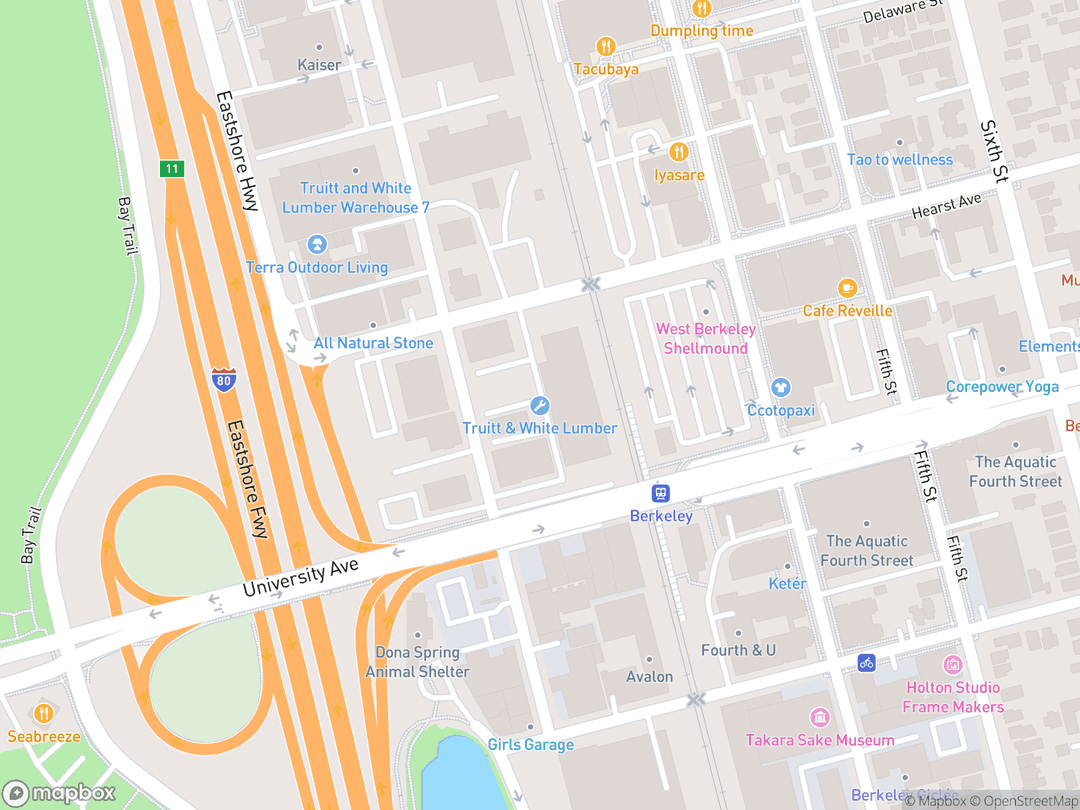
1900 4th Street, Berkeley, CA 94710, USA
Hours: Perimeter viewing accessible daily from dawn to dusk
Getting There: Located two blocks from the Berkeley Amtrak Capitol Corridor Station, accessible via AC Transit bus routes 51B and 72, and situated directly off the University Avenue exit from Interstate 80.
Get DirectionsTips for Your Visit
Approach in Quiet Reverence
Treat the perimeter with the quiet dignity appropriate for an ancient cemetery and ceremonial threshold.
Follow Public Walkways
Remain entirely on paved municipal sidewalks along 4th Street, University Avenue, and Hearst Avenue.
Support Rematriation
Engage with the educational materials distributed by the Sogorea Te' Land Trust to understand Indigenous land stewardship.
About
The West Berkeley Shellmound and Sacred Site, designated archaeologically as CA-ALA-307, marks the earliest known continuous human settlement on the shores of San Francisco Bay. Established circa 3700 BCE by ancestral Chochenyo-speaking Lisjan Ohlone peoples, this monumental sacred mound served as a vital ceremonial center, ancestral burial ground, and cosmologically aligned threshold connecting earthly life to ancestral realms for thousands of years.
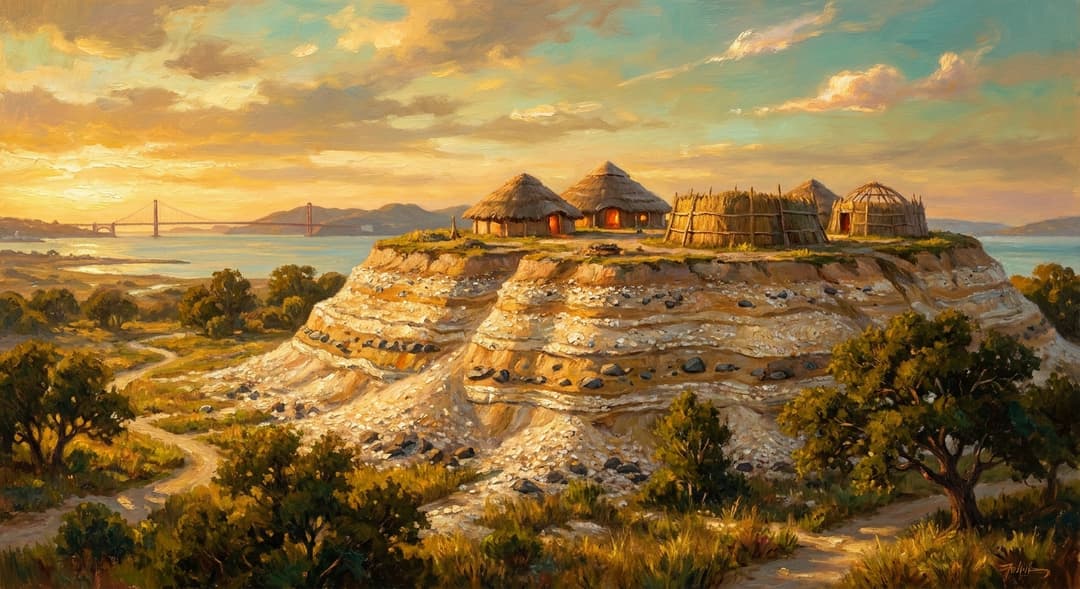
Rather than an accidental accumulation of domestic refuse, the shellmound was a deliberately engineered architectural earthwork constructed from billions of marine shells, calcified strata, and estuarine soils. Over forty-five centuries, Ohlone builders interred their ancestors within this protective matrix, sanctifying the ground and creating elevated roundhouse platforms that commanded panoramic views of the Golden Gate strait.
Despite intense 19th-century resource extraction and mid-20th-century paving for commercial parking, the profound spiritual foundations survived subterranean compression. In April 2024, an historic Land Back victory transferred legal title to the Indigenous women-led Sogorea Te' Land Trust, inaugurating a multi-year ecological restoration to remove asphalt, daylight Strawberry Creek, and reestablish an active ceremonial park.
Interesting Facts
Radiocarbon testing dates the foundation of the shellmound to circa 3700 BCE, pre-dating the Great Pyramids of Giza. (Tier B)
Archaeologist Nels Nelson identified the West Berkeley Shellmound as the oldest among 425 shellmounds documented around the Bay in 1909. (Tier B)
The site represents Huchiun, the earliest continuously inhabited human settlement discovered along the San Francisco Bay perimeter. (Tier A)
The April 2024 acquisition marks the largest and highest-value urban Indigenous land rematriation in California history. (Tier A)
Title to the sacred ground is held by the Sogorea Te' Land Trust, an urban Indigenous women-led organization. (Tier A)
The sheer structural weight of the ancient mound over millennia pressed basal ancestral crypts deep into protective estuarine clays. (Tier B)
For more than six decades, the primary ceremonial parcel served as a customer parking lot for Spenger's Fresh Fish Grotto. (Tier B)
In the 19th century, settlers mined thousands of cubic yards of shell deposits to pave municipal roads and tennis courts. (Tier C)
Upcoming restoration plans will uncover Strawberry Creek from century-old underground concrete storm pipes to flow freely into the Bay. (Tier A)
Common Questions
Why is the West Berkeley Shellmound considered a sacred site rather than a refuse midden?
It was intentionally engineered as an ancestral necropolis, ceremonial roundhouse platform, and cosmologically aligned shrine.
Are ancestral human remains still present beneath the current ground surface?
Yes, thousands of years of compressive mass forced deep burial layers below sea level where they remain intact.
What is planned for the future of the 2.2-acre parcel?
The Sogorea Te' Land Trust plans to remove the asphalt, daylight Strawberry Creek, and construct an interpretive ceremonial park.
Can the general public enter the property today?
Access onto the lot is currently restricted for safety and restoration planning, though the perimeter is publicly viewable.
Featured Stories
The Sovereign Defense of Huchiun
April 2021
When corporate developers invoked state housing statutes to construct a multi-story condominium complex over the sacred burial grounds, Lisjan leaders mounted relentless spiritual and legal resistance. Corrina Gould and tribal community allies organized continuous prayer circles and legal defenses across years of litigation. Their perseverance captured global preservation attention, demonstrating that ancestral resting sites possess an unyielding sacred character beyond commercial valuation.
Source: Sogorea Te' Land Trust
The Return of the Land
April 30, 2024
After nearly two centuries of colonial dispossession and asphalt paving, the sacred soil of CA-ALA-307 returned to Indigenous stewardship through a mediated $27 million settlement. Lisjan women leaders, backed by thousands of municipal contributors through the Shuumi Land Tax, achieved legal closing of escrow on the 2.2-acre parcel. This momentous rematriation catalyzed international inspiration for urban Indigenous self-determination and spiritual reclamation.
Source: City of Berkeley Landmark Records
Mapping the Ancient Bay
1907
University of California archaeologist Nels Nelson traversed the tidal marshes of San Francisco Bay by foot and boat to map monumental earthworks before industrial expansion obliterated them. At West Berkeley, his meticulous stratigraphic profiles revealed ten distinct cultural horizons containing fire-cracked hearths and abalone-draped burials. Nelson recognized CA-ALA-307 as the ancient foundational matrix of human civilization along the estuarine coastline.
Source: National Trust for Historic Preservation
Timeline
Inception of Huchiun Village
Ancestral Lisjan Ohlone establish a permanent fishing settlement and ceremonial mound at Strawberry Creek.
MilestoneMonumental Mound Accretion
Centuries of ceremonial depositions create elevated earthworks and sanctified ancestral burial matrices.
EventRegional Ceremonial Network
The mound functions as a premier astronomical observation platform and smoke-signal beacon for the Bay.
MilestoneSpanish Colonial Disruption
Spanish military and Franciscan missionaries arrive, forcibly displacing villagers to coastal missions.
EventEarly Settler Mining
Anglo-American settlers mine calcium-rich shell strata for chicken grit, farm fertilizer, and road surfacing.
EventNels Nelson Archaeological Survey
University of California archaeologist Nels Nelson surveys and maps CA-ALA-307 as the Bay's oldest shellmound.
MilestoneAsphalt Paving for Commercial Parking
Remaining mound elevations are graded flat and paved as a parking lot for Spenger's Fresh Fish Grotto.
EventCity Landmark Designation
The Berkeley Landmarks Preservation Commission officially designates the three-block site as Landmark #228.
MilestoneState and National Register Eligibility
The California State Historical Resources Commission formally lists CA-ALA-307 on the California Register.
MilestoneMost Endangered Historic Place
The National Trust for Historic Preservation names the shellmound one of America's 11 Most Endangered Historic Places.
MilestoneHistoric Land Back Rematriation
Escrow closes on an historic $27 million mediated acquisition, transferring full title to the Sogorea Te' Land Trust.
MilestoneHistory by Decade
3700 BCE–1000 BCE — Foundational Accretion
These mounds were intentional monuments where generations lived upon the sanctified resting places of their forebears.
Ancestral Lisjan Ohlone communities established continuous seasonal and permanent habitation along the estuary where Strawberry Creek met San Francisco Bay. Over three millennia, families deposited billions of calcified shells, creating stratified horizontal platforms for ceremonial life and ancestral burial crypts.
1000 BCE–1770s — Thriving Estuarine Center
Huchiun flourished as a major trade and spiritual center within a vast network of more than 400 Bay Area shellmounds. High platforms hosted sacred dances, smoke signaling, and communal feasts, while maintaining an ecological reciprocity that nourished both human society and marine habitats.
1770s–1850s — Colonial Disruption and Missionization
Spanish military expeditions and Franciscan missionaries systematically disrupted indigenous village life, forcibly moving Lisjan villagers to Mission Dolores and Mission San José. Despite immense demographic devastation, surviving Ohlone families maintained oral traditions, sacred language ties, and ancestral memory of Huchiun.
1850s–1950s — Settler Industrialization and Desecration
The California Gold Rush brought rapid settler expansion to West Berkeley, transforming Indigenous ceremonial earthworks into quarry grounds for chicken feed, road asphalt, and tennis court gravel. Railroad expansion and urban grading leveled the visible heights of the monument, culminating in asphalt paving for restaurant parking.
1950s–2010s — Preservation Battles and Cultural Reassertion
Mid-century salvage excavations by UC Berkeley unearth dozens of human burials, awakening widespread awareness of the site's ongoing sanctity. Ohlone leaders partnered with heritage organizations to secure formal City of Berkeley Landmark designation in 2000 and National Register eligibility in 2003.
2010s–2026 — Rematriation and Ecological Rebirth
Faced with high-density commercial development proposals, the Confederated Villages of Lisjan led a nationwide defense that resulted in listing as one of America's 11 Most Endangered Historic Places. In April 2024, the Sogorea Te' Land Trust completed an historic Land Back acquisition, initiating plans to daylight Strawberry Creek and construct a ceremonial park.
Architecture & Facilities
The West Berkeley Shellmound represents California Archaic and Late Period monumental vernacular earthwork architecture, engineered from stratified biocultural matrices rather than quarried stone. Built over 4,500 years, the monument was carefully formed using self-compacting marine shells, alluvial silts, hearth residues, and clay beds to create an elevated sacred plateau overlooking the Golden Gate opening.
Building Materials
Pacific Oyster & Clam Shell Matrix
Billions of compacted mollusk shells created an alkaline biocultural concrete that preserved organic materials and bone.
Alluvial Strawberry Creek Silt
Fine fluvial sediments deposited by stream runoff provided leveling strata between ceremonial occupations.
Fire-Cracked Hearthstone
Igneous and sandstone cooking cobbles formed stable structural lenses across ten cultural layers.
Tule Reed & Willow Superstructure
Woven marsh vegetation formed framing and exterior thatch for roundhouses constructed atop the plateau.
Interior Features
Subterranean Ancestral Crypts
Sanctified burial chambers embedded deep within compressed shell strata and lined with protective abalone nacre.
Ceremonial Roundhouse Plateau
The broad flat summit designed for community governance, seasonal ceremonies, and consecrated prayers.
Sacred Fire Platform
An elevated open hearth utilized for celestial observation and intertribal regional smoke signaling.
Riparian Confluence Gateway
The natural threshold where Strawberry Creek flowed across marshlands to meet the bay waters.
Temple Grounds
A preserved 2.2-acre urban parcel currently undergoing master planning to remove commercial asphalt, daylight the underground culverted Strawberry Creek, and install native riparian plants alongside an interpretive earthen memorial mound.
Additional Facilities
Current site planning includes a future cultural interpretive pavilion, a ceremonial dance ground, and educational gathering circles managed by the Sogorea Te' Land Trust.
Religious Significance
To the Lisjan Ohlone people, the West Berkeley Shellmound is not an archaeological relic of a bygone era, but an eternally living sacred temple and ancestral cemetery. It embodies the sacred covenant linking modern Indigenous stewards to the Creator and the original forebears who consecrated the Bay shoreline.
To serve as an enduring spiritual axis, ancestral resting ground, and ceremonial threshold connecting earthly life with the cosmos.
Sacred Ordinances
Ancestral Interment & Red Ochre Consecration
Interring community ancestors wrapped in ceremonial regalia and dusted with mineral ochre to bless future generations.
Ceremonial Prayer & Dance Gatherings
Conducting cyclical prayers, songs, and dances inside earthen roundhouses to maintain cosmic and ecological balance.
Shell & Food Offering Reciprocity
Returning the physical gifts of marine life to sacred earthworks to acknowledge harmony between humanity and nature.
Cosmology and the Western Gateway
The geographic alignment of the mound directly opposite the Golden Gate strait holds profound theological meaning in Ohlone cosmology. As the sun sets through the ocean gap, it illuminates the westward path traversed by human spirits departing into the ancestral afterlife, establishing the mound as an indispensable celestial gateway.
Rematriation as Spiritual Healing
The return of the land to the Sogorea Te' Land Trust represents the restoration of maternal guardianship and spiritual harmony. Through rematriation, the living descendants resume their sacred duty to care for the buried ancestors, heal the wounded earth, and revitalize indigenous ceremonies upon native soil.
Similar Temples
Sources & Research
Every fact on Temples.org is backed by verified Sources & Research. Each piece of information is rated by source tier and confidence level.
View All Sources (10)
| Field | Source | Tier | Retrieved |
|---|---|---|---|
| About & Historical Background | Sogorea Te' Land Trust (opens in a new tab) | A | 2026-03-30 |
| Historic Preservation & Endangered Status | National Trust for Historic Preservation (opens in a new tab) | B | 2026-03-30 |
| Sacred Site Defense & Cultural History | Sacred Land Film Project (opens in a new tab) | B | 2026-03-30 |
| Municipal Landmark Registry & Planning | City of Berkeley Planning Department (opens in a new tab) | A | 2026-03-30 |
| Indigenous Land Defense & Shellmound Advocacy | Confederated Villages of Lisjan (opens in a new tab) | A | 2026-03-30 |
| Environmental & Legal Case Analysis | California Association of Environmental Professionals (opens in a new tab) | B | 2026-03-30 |
| Indigenous Women's Leadership & Stewardship | Women's Earth Alliance (opens in a new tab) | B | 2026-03-30 |
| Archaeological Survey & Stratigraphic Data | The Megalithic Portal (opens in a new tab) | B | 2026-03-30 |
| Bay Area Shellmound Network History | KQED Public Media (opens in a new tab) | B | 2026-03-30 |
| Historical Geography & Urban Cartography | Daniel Brownstein Historical Geography (opens in a new tab) | C | 2026-03-30 |