Visitor Insights
Visiting Washington Buddhist Vihara
The Washington Buddhist Vihara offers a serene contemplative atmosphere within a historic residential avenue. Guests are warmly invited to join weekly Vipassanā meditation sits, Dhamma talks, and quiet personal reflection in the main shrine room.
Highlights
- Authentic Theravāda shrine hall featuring consecrated Buddha relics from Sri Lanka
- Weekly public Dhamma talks and guided mindfulness meditation offered in English
- Comprehensive research library housing complete editions of the Pali Canon
Things to Know
- Remove shoes and headwear prior to entering the carpeted shrine room
- Dress modestly with shoulders and knees covered, avoiding revealing attire
- Never point the soles of your feet toward the Buddha image or seated monks
Location
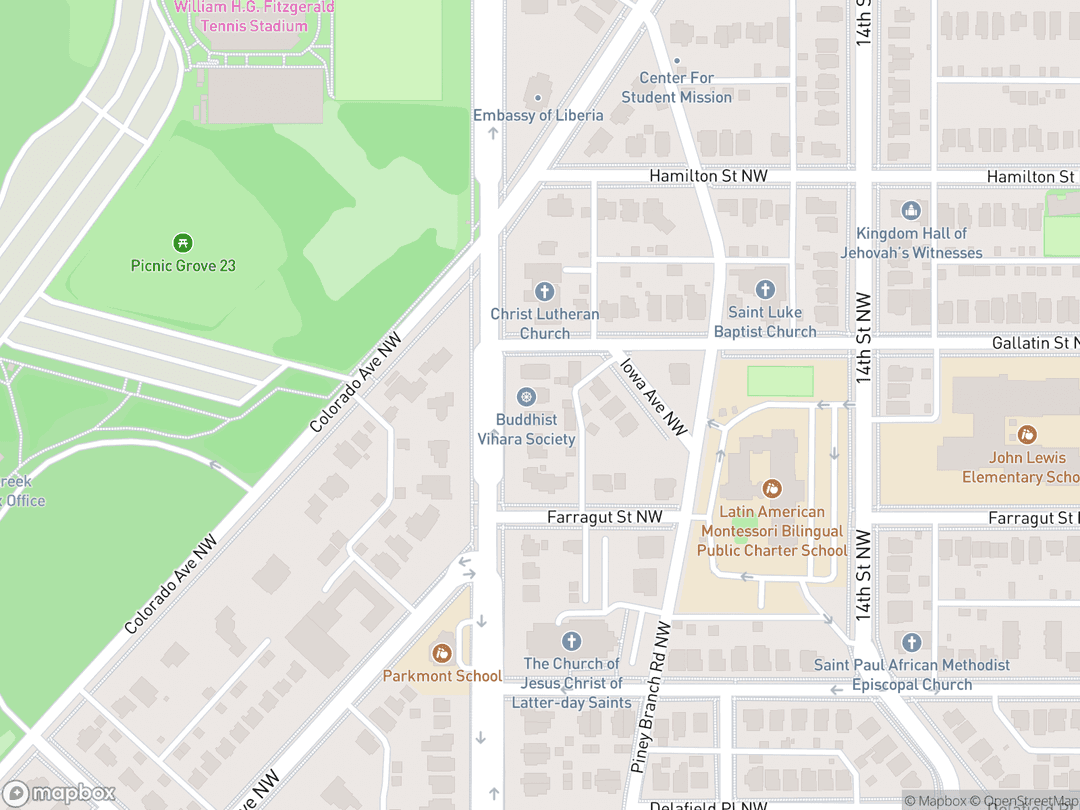
5017 16th Street NW, Washington, DC 20011, United States
Hours: Open daily from 9:00 AM to 9:00 PM for private meditation and offerings
Getting There: Take the Washington Metro Red Line to Silver Spring or Green Line to Petworth, connecting to Metrobus routes S2 or S4 along 16th Street NW.
Get DirectionsTips for Your Visit
Etiquette with Monastics
Greet monastics with a slight bow and palms pressed together at chest level in the añjali gesture.
Sunday Dhamma Services
Attend the weekly Sunday public service at 3:00 PM for chanting, guided meditation, and accessible scriptural discussion.
Quiet Demeanor
Silence all mobile phones upon entry to respect resident monks and meditating guests.
About
The Washington Buddhist Vihara stands as a historic bridge connecting ancient Dharmic spirituality with modern Western religious life. Established in 1965, it holds the distinction of being the first permanent Theravāda Buddhist monastery founded in the United States. Rooted in the shared Dharmic recognition of saṃsāra, karma, and liberating dharma, the monastery provides an authentic sanctuary for inner purification and contemplation.
Unlike traditions centered on divine intervention, the Vihara represents the venerable Theravāda school, adhering strictly to the ancient Pali Canon. It honors Gautama Buddha as a human teacher who illuminated the Four Noble Truths and the Noble Eightfold Path. Liberation is cultivated through self-reliance, moral discipline, and meditative insight rather than external dogma.
Housed in an adapted domestic mansion along Washington's historic 16th Street NW, the Vihara operates as a residential monastery, research library, and community center. It welcomes monastic residents and lay practitioners alike, offering accessible meditation instruction, philosophical lectures, and traditional devotional observances to all seekers.
Interesting Facts
The Washington Buddhist Vihara is the oldest permanent Theravāda Buddhist monastery established in the United States. (Tier A)
The 16th Street NW building was purchased directly from the Royal Embassy of Thailand at a preferential rate in 1967. (Tier A)
World-renowned meditation teacher Bhante Gunaratana developed 'Mindfulness in Plain English' while leading this temple. (Tier A)
From its 1966 inception, the temple maintained an official policy requiring public lectures and meditation to be conducted in English. (Tier A)
Historical records show that approximately half of the temple's registered congregation has consistently comprised non-Asian American practitioners. (Tier B)
Bhante Gunaratana served as the first official Buddhist Chaplain at American University during the Vietnam War era. (Tier B)
The rural Bhavana Society Forest Monastery in West Virginia was originally conceived and planned inside this urban vihara. (Tier A)
The temple's official seal was designed in Colombo in 1965 by famed Sri Lankan artist S.A.D. Subasinghe. (Tier B)
Abbot Ven. Maharagama Dhammasiri Thero represented the Theravāda tradition in direct dialogue with Pope Francis in 2015. (Tier A)
Common Questions
Are non-Buddhists allowed to visit the Vihara?
Yes, visitors of all backgrounds and faiths are welcome to meditate, study, or attend weekly services.
Is there an admission fee for meditation classes?
No, all Dhamma teachings and meditation sessions are offered freely in accordance with Buddhist tradition.
What language are services conducted in?
Public services, Dhamma talks, and guided meditations are conducted in English, alongside traditional Pali chanting.
What should I wear when visiting the temple?
Visitors should dress in modest clothing that covers both the shoulders and knees.
Featured Stories
A Vision Born in a Public Park
May 1964
While touring the United States in 1964, Most Venerable Madihe Pannasiha Mahanayaka Thero celebrated the festival of Vesak alongside Sri Lankan embassy staff in a public park in Washington, D.C. Moved by the complete absence of a permanent Theravāda sanctuary in the capital, he vowed to establish an enduring monastery. Returning to Colombo, he rallied lay patrons across Sri Lanka to fund the transatlantic purchase of the 16th Street estate.
Source: Buddhist Vihara Society Historical Archives
The Relic Casket Arrives on 16th Street
October 1966
When Venerable Bope Vinitha Thero completed his scholarly research at Harvard University, he traveled to Washington carrying an ancient consecrated relic casket and a Buddha image. Without an established temple building of their own, the pioneer monastics initially gathered with American seekers inside All Souls Church on 16th Street. Their devotion attracted both diplomat families and curious neighbors, securing the support needed to acquire a permanent freehold.
Source: Journal of Buddhist Ethics Historical Survey
Mindfulness Written on the Avenue of Churches
June 1992
Inside the quiet library rooms at 5017 16th Street NW, Venerable Dr. Henepola Gunaratana synthesized decades of meditation lectures given to American students into a practical manuscript. His clear presentation stripped away esoteric jargon to focus directly on bare attention and breath awareness. The resulting book, 'Mindfulness in Plain English', became an international touchstone that brought classical Vipassanā into modern global consciousness.
Source: Bhavana Society Commemorative History
Timeline
Mansion Construction
A stately brick residential mansion is erected along the upper 16th Street corridor.
MilestoneCapital Visit of Ven. Madihe Pannasiha
Ven. Madihe Pannasiha Thero visits Washington and resolves to establish America's first Theravāda vihara.
MilestoneFormal Resolution in Colombo
The Sasana Sevaka Society formalizes financial backing and establishes the American mission.
MilestoneSociety Incorporation
The Buddhist Vihara Society incorporates in D.C., with Ven. Bope Vinitha Thero arriving as first resident monk.
DedicationPermanent Property Acquisition
The Society purchases 5017 16th Street NW from the Royal Embassy of Thailand.
MilestoneArrival of Bhante Gunaratana
Ven. Dr. Henepola Gunaratana arrives to serve as General Secretary and resident teacher.
MilestoneSupport for Thai Community
The Vihara shelters visiting Thai monks, assisting the establishment of Wat Thai Washington, D.C.
EventDoctoral Defense and Presidency
Bhante Gunaratana earns his Ph.D. from American University and assumes presidency of the Society.
MilestonePan-Buddhist Council Co-Founding
The Vihara co-founds the International Buddhist Committee of Greater Washington for unified Vesak observances.
EventMindfulness in Plain English
Bhante Gunaratana publishes his renowned meditation primer based on decades of urban teaching.
MilestoneGolden Jubilee and Papal Dialogue
Ven. Maharagama Dhammasiri Thero participates in an interfaith summit with Pope Francis as the Vihara marks 50 years.
component.timeline.anniversaryLion of Wisdom Center Opening
The Vihara establishes a rural meditation center in Maryland for intensive residential retreats.
RenovationHistory by Decade
1920s–1950s — Residential Origins on the Avenue
Constructed in the 1920s as a stately private residence, the detached brick mansion was designed to fit into the prosperous fabric of upper 16th Street Heights. Known historically as the Avenue of the Churches, the corridor gradually became home to grand religious landmarks and international diplomatic holdings. The property later passed into the ownership of the Government of Thailand, serving diplomatic residential purposes until the mid-1960s.
1960s — Founding America's First Theravāda Vihara
The gift of Truth excels all other gifts.
Inspired by Ven. Madihe Pannasiha Thero's 1964 visit, the Buddhist Vihara Society formally incorporated in 1966. Ven. Bope Vinitha Thero arrived as resident director, leading initial meditation gatherings at nearby All Souls Church. In 1967, the Society purchased 5017 16th Street NW from the Royal Embassy of Thailand, dedicating the building as the first permanent Theravāda monastery on American soil.
1970s — A Pan-Buddhist Refuge and Academic Hub
Following the passage of the 1965 Immigration Act, new Asian immigrant families found immediate shelter and solace within the Vihara's walls. The temple hosted Thai, Lao, Burmese, and Cambodian communities while they organized their own national centers. Concurrently, resident monk Bhante Gunaratana earned graduate degrees at American University, bridging classical monastic training with Western philosophy.
1980s — Fostering Forest Monasticism
As American interest in intensive meditation surged, the Vihara became an incubator for full monastic ordination in the West. Bhante Gunaratana co-founded the Bhavana Society in 1983, establishing a forest monastery in West Virginia for rigorous wilderness practice. In 1986, the Vihara co-founded the International Buddhist Committee, creating a unified annual Vesak celebration uniting all Buddhist traditions.
1990s — Plain-English Dhamma and Diaspora Education
Under the leadership of Ven. Maharagama Dhammasiri Nayaka Thero, the temple balanced local immigrant needs with public Western outreach. The Vihara formalized its Sunday Dhamma School for diaspora youth while offering plain-English meditation sits that drew hundreds of Washingtonians. In 1992, Bhante Gunaratana published 'Mindfulness in Plain English', cementing the monastery's legacy in modern contemplative thought.
2000s–Present — Interfaith Dialogue and Digital Outreach
The Vihara expanded its humanitarian reach following the 2004 tsunami and engaged deeply in civic and interfaith initiatives. Abbot Dhammasiri Thero represented the Theravāda tradition at the Vatican with Pope Francis in 2015 during the temple's Golden Jubilee. In 2017, the Vihara established the Lion of Wisdom Meditation Center in Maryland, extending its monastic lineage to rural retreat grounds.
Architecture & Facilities
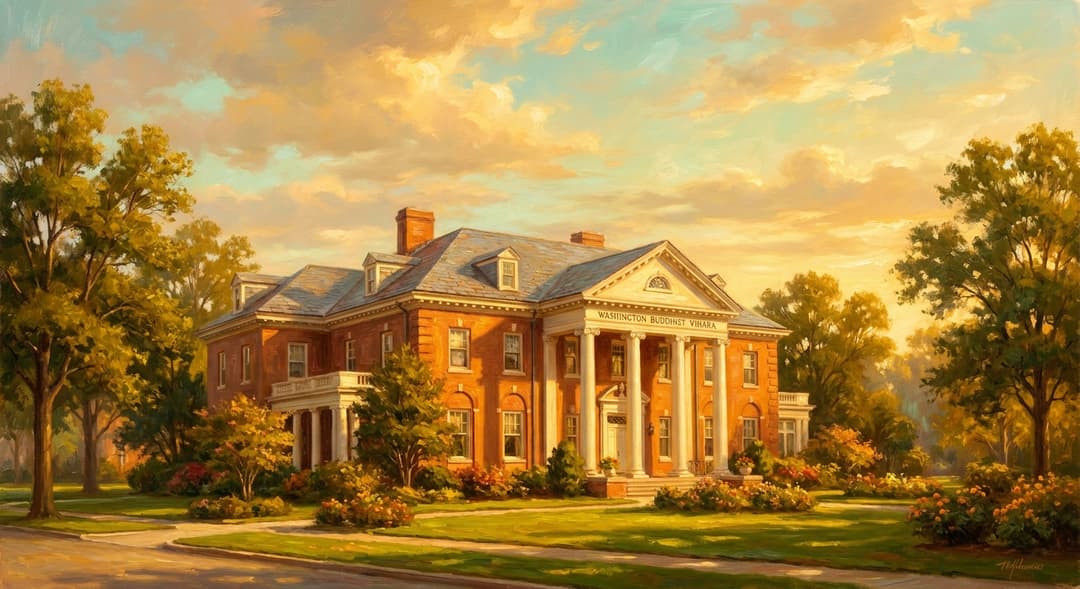
The Washington Buddhist Vihara exemplifies adaptive domestic architecture, repurposing an early-20th-century American Colonial Revival residential mansion into a contemplative Theravāda Buddhist monastery. Rather than altering the historic streetscape with imported architectural forms, the monastery maintains quiet domestic modesty that aligns with the monastic ideal of simplicity.
Building Materials
Exterior Masonry
Load-bearing red brick masonry forms the resilient exterior envelope of the three-story residence.
Roofing Slate
Natural gray slate tiles cover the pitched hipped roof structure in classic mid-Atlantic fashion.
Interior Hardwood
Polished American oak hardwood flooring runs throughout the meditation hall and public reception spaces.
Altar Appointments
Polished brass and hand-carved Sri Lankan teak form the multi-tiered shrine display and relic platforms.
Interior Features
Buddha Mandiraya
The main floor shrine hall accommodates group meditation facing a gilded Buddha image and floral altar.
Dhatu Karanduwa Chamber
A consecrated reliquary alcove houses sacred bodily relics of the Buddha brought from Sri Lanka in 1966.
Dhamma Research Library
A specialized reading room holds complete editions of the Pali Canon alongside Western Buddhist scholarship.
Sanghadāna Dining Hall
A basement refectory allows lay devotees to offer ceremonial mid-day meals to resident monks.
Temple Grounds
The property features a modest front lawn with a concrete walkway leading from 16th Street NW, framed by mature shade trees and ornamental shrubs that evoke an Asian monastic park.
Additional Facilities
Upper floors house spartan residential monastic quarters (kutis) reserved strictly for ordained monks, while administrative offices occupy the main floor.
Religious Significance
As part of the wider Dharmic philosophical family, Buddhism shares ancient foundations with Hinduism and Jainism, including the understanding of karma, rebirth, and liberation. The Washington Buddhist Vihara specifically preserves the ancient Theravāda lineage, holding the Pali Canon as its doctrinal guide.
The Vihara exists to sustain the living lineage of the Buddha's Sangha, provide authentic Pali teachings, and guide sincere practitioners toward liberation from suffering through moral discipline and insight meditation.
Sacred Ordinances
Tisarana and Panca Sila
Taking refuge in the Buddha, Dhamma, and Sangha, followed by the formal commitment to observe five ethical precepts.
Vipassanā Bhāvanā
Cultivating direct penetrative insight into the impermanent, unsatisfactory, and non-self nature of all phenomena.
Sanghadāna
The ritual offering of food and requisites to ordained monastics to cultivate generosity and support the Sangha.
Pirit Chanting
Traditional recitation of protective suttas in the ancient Pali language to bestow blessings and mental peace.
The Dharmic Heritage
Theravāda Buddhism developed out of the classical spiritual culture of the ancient Gangetic plains. In common with all Dharmic traditions, it diagnoses cyclic existence (saṃsāra) as burdened by delusion and driven by intentional action (karma). It points practitioners away from worldly clinging toward transcendent liberation (nibbāna), achieved through the purification of the mind and non-violence (ahiṃsā).
Theravāda and the Pali Canon
Theravāda—literally the 'Teaching of the Elders'—relies exclusively on the Pali Canon (Tipiṭaka), preserved intact across Sri Lanka and Southeast Asia. The historical Buddha Gautama is revered as an enlightened human guide rather than a cosmic deity. Monastic practitioners strictly observe the 227 rules of the Vinaya Piṭaka, perpetuating an unbroken spiritual lineage dating back over 2,500 years.
Sources & Research
Every fact on Temples.org is backed by verified Sources & Research. Each piece of information is rated by source tier and confidence level.
View All Sources (8)
| Field | Source | Tier | Retrieved |
|---|---|---|---|
| About & Historical Background | Washington Buddhist Vihara (opens in a new tab) | A | 2026-03-30 |
| Historical Timeline | Bhavana Society Forest Monastery (opens in a new tab) | A | 2026-03-30 |
| Founding & Incorporation Records | Government of the District of Columbia (opens in a new tab) | A | 2026-03-30 |
| Theravāda Monastic Lineage | Buddhist Publication Society (opens in a new tab) | A | 2026-03-30 |
| Interfaith Diplomatic Delegation | America Magazine (opens in a new tab) | B | 2026-03-30 |
| Academic Chaplaincy Records | American University (opens in a new tab) | B | 2026-03-30 |
| American Buddhism History | The Pluralism Project at Harvard University (opens in a new tab) | B | 2026-03-30 |
| Architecture & Neighborhood Survey | DC Historic Preservation League (opens in a new tab) | B | 2026-03-30 |