Visitor Insights
Visiting Cathedral Basilica of Our Lady of Peace
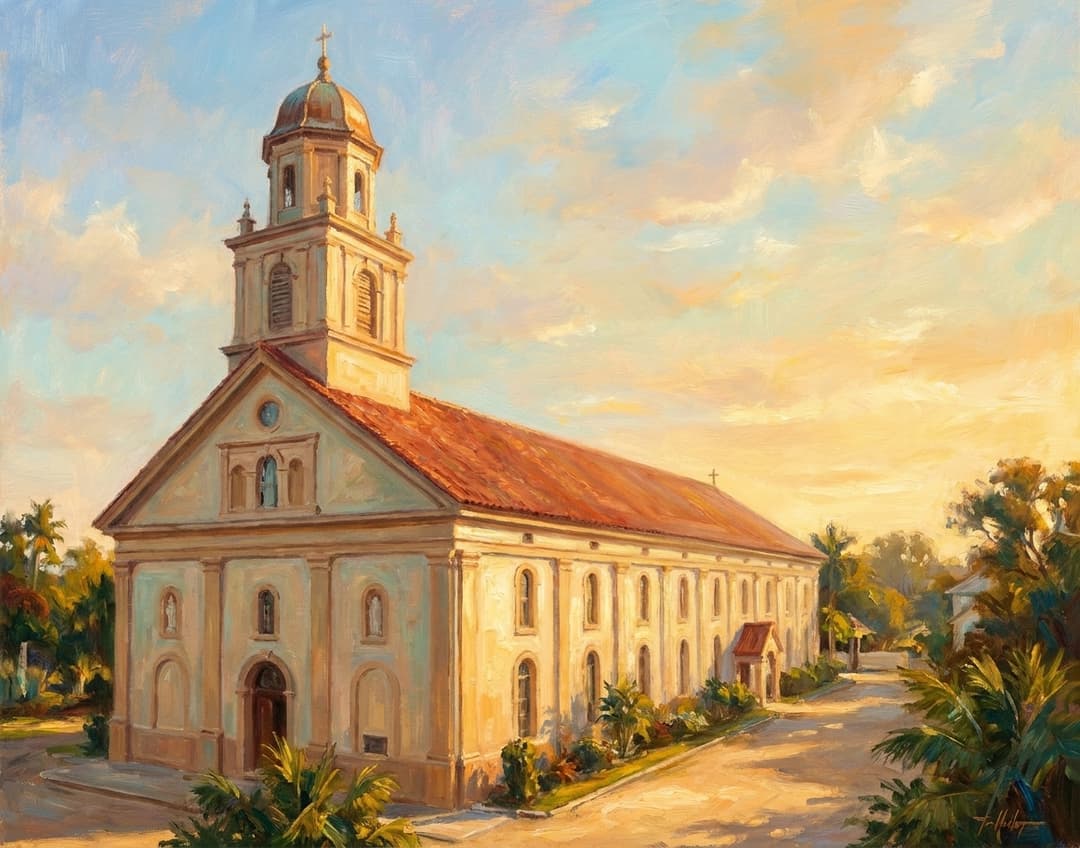
The Cathedral Basilica of Our Lady of Peace welcomes worshippers and travelers into a cool, contemplative refuge in the heart of downtown Honolulu. Visitors may venerate the reliquaries of Saints Damien and Marianne during quiet weekday hours.
Highlights
- Enshrined mortal remains of Saint Marianne Cope within a handcrafted native koa wood reliquary.
- First-class relic and historic ordination sanctuary of Saint Damien of Molokaʻi.
- Massive 1843 load-bearing walls crafted from hand-cut oceanic coral limestone.
- Historic 1934 Aeolian-Skinner Opus 916 pipe organ towering above the rear choir loft.
Things to Know
- Please maintain reverent silence and refrain from touring during scheduled Holy Mass.
- Pedestrian access is most convenient from Fort Street Mall; vehicle parking downtown is commercial.
- Modest attire suitable for an active house of worship is encouraged.
Location
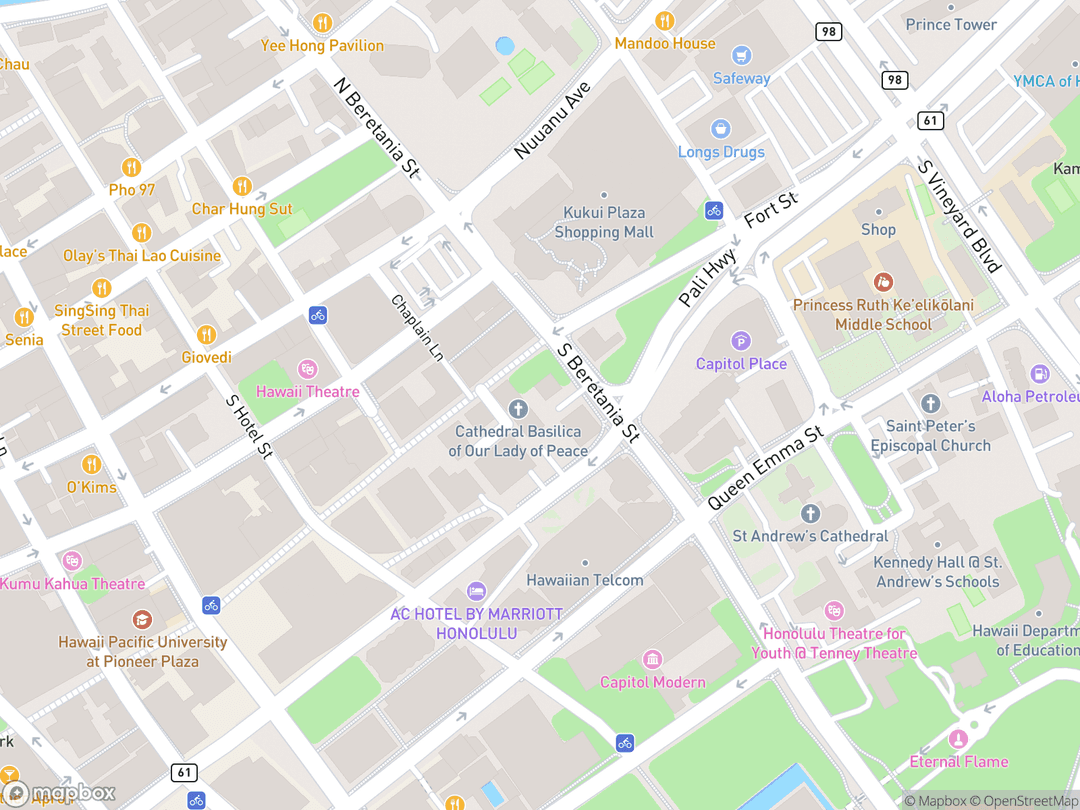
1184 Bishop Street, Honolulu, HI 96813, United States
Hours: Open daily from 6:30 AM to 5:00 PM for private prayer and public liturgies
Getting There: Located at 1184 Bishop Street along the pedestrian-only Fort Street Mall, accessible via TheBus lines traversing Hotel and Bishop Streets.
Get DirectionsTips for Your Visit
Mid-Morning Contemplation
Visit between 9:00 AM and 11:30 AM on weekdays to admire the Munich stained glass in natural sunlight without interrupting daily liturgies.
Honoring Hawaiian Saints
Kneelers and commemorative prayer intention cards are available directly adjacent to the side shrines of Saints Damien and Marianne.
About
Rooted in the Abrahamic heritage of sacred sanctuaries and the Christian theology of the Incarnation, the Cathedral Basilica of Our Lady of Peace serves as the mother church and episcopal see of the Roman Catholic Diocese of Honolulu. Established under land granted by King Kamehameha III following the 1839 Edict of Toleration, the cathedral stands as a enduring monument to religious freedom in the Hawaiian Islands.
Dedicated on August 15, 1843, by the Congregation of the Sacred Hearts of Jesus and Mary, the sanctuary is the oldest continuously functioning Roman Catholic cathedral in the United States. Its walls were raised from approximately 1,500 ocean coral blocks quarried by Native Hawaiian divers from the harbor reefs of Honolulu.
The basilica is internationally venerated as the ordination site of Saint Damien of Molokaʻi in 1864 and enshrines the complete mortal remains of Saint Marianne Cope. Elevated to a Minor Basilica by Pope Francis in 2014, it remains a vibrant center of apostolic liturgy, urban charity, and Pacific Catholic pilgrimage.
Gallery
Symbolic Elements
The temple's exterior features intricate carvings, each rich with spiritual meaning:

Statue of Our Lady of Peace
Cast in bronze, this image represents the patroness of the basilica holding an olive branch signifying divine reconciliation.

Reliquary of Saint Damien
A carved koa pedestal encases the right heel bone relic of the heroic missionary to Kalaupapa.

Tomb of Saint Marianne Cope
This bronze and Hawaiian koa sarcophagus contains the complete mortal remains of Mother Marianne of Molokaʻi.

The Episcopal Cathedra
This carved mahogany chair bearing the diocesan crest designates the bishop's teaching authority within apostolic succession.

The Basilican Umbraculum
A striped silk umbrella signifies the basilica's immediate spiritual communion with the Pope in Rome.

The Basilican Tintinnabulum
A ceremonial mounted bell marks the historic privilege of heralding papal processions into the basilica.

Sacred Hearts Insignia
The pierced hearts of Jesus and Mary honor the French religious order that established the Hawaiian mission.

Exposed Coral Masonry Reveal
An unplastered wall section deliberately displays the living oceanic limestone blocks hewn from Honolulu reefs.
Interesting Facts
Our Lady of Peace is recognized as the oldest continuously functioning Roman Catholic cathedral in the United States (Tier A).
Over 1,500 ocean coral blocks were cut by Kanaka Maoli divers from offshore reefs to erect the cathedral walls (Tier A).
Saint Damien of Molokaʻi prostrated himself on the cathedral floor to receive Holy Orders on May 21, 1864 (Tier A).
The complete mortal remains of Saint Marianne Cope were permanently translated to the cathedral nave in 2014 (Tier A).
The thick coral walls survived the devastating Chinatown fires of 1886 and 1900 while surrounding blocks burned (Tier B).
King Kamehameha III provided royal protection and confirmed the church site following the 1839 Edict of Toleration (Tier A).
The cathedral courtyard served as the 19th-century gathering place where immigrant Portuguese musicians popularized the ukulele (Tier B).
Its Opus 916 Aeolian-Skinner pipe organ is one of the premier romantic pipe instruments in the Pacific basin (Tier B).
The cathedral is one of only two American cathedrals holding the primary tombs or major relics of two canonized resident saints (Tier A).
The exterior facade has transitioned through three historic iterations from Neoclassical coral to Gothic Revival to Spanish Mission (Tier B).
Common Questions
Why is the cathedral considered the oldest in the United States?
While older parishes exist, this building has operated uninterruptedly as a functioning Catholic cathedral since its 1843 dedication.
Are both Saint Damien and Saint Marianne enshrined inside?
Yes, the cathedral houses a major bone relic of Saint Damien and the complete bodily remains of Saint Marianne.
Can the public visit outside of Mass times?
The basilica remains open daily from morning until late afternoon for private prayer, quiet visits, and reliquary veneration.
What materials were used to construct the building?
The primary structural walls consist of ocean reef coral blocks held together by mortar prepared from burned limestone.
Featured Stories
The Ordination of Saint Damien
May 21, 1864
On a warm Pentecost eve, young Belgian missionary Jozef De Veuster knelt inside the freshly built coral sanctuary to be ordained a priest by Bishop Maigret. Taking the name Father Damien, he arose from the altar to begin an extraordinary pastoral ministry that culminated in his selfless service among the isolated patients of Kalaupapa. His heroic sacrifice transformed this Pacific sanctuary into an international landmark of Christian charity.
Source: Congregation of the Sacred Hearts of Jesus and Mary Archives
Mother Marianne and the Sisters of Saint Francis
November 8, 1883
Responding to an urgent royal plea for medical caregivers, Mother Marianne Cope and six Franciscan sisters arrived in Honolulu harbor after a arduous transcontinental journey from New York. Their first act on Hawaiian soil was to process directly into the cathedral for a solemn Mass of Thanksgiving before the high altar. Her return in 2014, when her mortal remains were permanently enshrined here, fulfilled an enduring spiritual homecoming.
Source: Sisters of Saint Francis of the Neumann Communities
Deliverance from the Great Chinatown Fire
1900
When a controlled municipal burn raged out of control in January 1900, an uncontrollable wall of flame consumed nearly thirty-eight acres of downtown Honolulu. As wooden tenements burned around Fort Street, townspeople took shelter behind the cathedral's damp coral ramparts while priests prayed before the Blessed Sacrament. A sudden shift in coastal wind spared the church, leaving its coral fortress untouched amidst acres of smoldering ash.
Source: Diocese of Honolulu Historical Annals
Timeline
Arrival of Catholic Missionaries
The Picpus Fathers arrive aboard La Comète to inaugurate the Catholic faith in the Hawaiian Kingdom.
MilestoneEdict of Toleration
King Kamehameha III establishes religious freedom for Catholics across the Hawaiian Islands.
MilestoneGroundbreaking
Ground is broken on the patronal feast of Our Lady of Peace for the permanent cathedral.
component.timeline.groundbreakingCornerstone Blessing
Bishop Étienne Rouchouze blesses the cornerstone as native divers harvest reef coral blocks.
MilestoneCathedral Dedication
Bishop Louis-Désiré Maigret solemnly dedicates the completed coral cathedral on the Feast of the Assumption.
DedicationOrdination of Father Damien
Saint Damien de Veuster is ordained a priest within the cathedral sanctuary.
MilestoneArrival of Mother Marianne Cope
The Franciscan Sisters celebrate a Mass of Thanksgiving before serving patients at Kalaupapa.
MilestoneGreat Chinatown Fire
The cathedral survives unscathed as surrounding downtown districts are destroyed by fire.
EventSpanish Mission Remodeling
The exterior facade is reconstructed in the California and Spanish Mission Revival style.
RenovationDiocese of Honolulu Established
Pope Pius XII elevates the church to the official cathedral see of the new diocese.
MilestoneNational Register Listing
The cathedral structure is placed on the National Register of Historic Places.
MilestoneElevation to Minor Basilica
Pope Francis decrees the historic cathedral a Minor Basilica.
MilestoneHistory by Decade
1820s–1830s — Arrival and Religious Persecution
Religious freedom is granted to all subjects of the kingdom of whatever persuasion.
Following their arrival in 1827 aboard the French ship La Comète, the Picpus Fathers received a plot of land from Governor Boki on Fort Street. However, political friction and Protestant royal advisors soon led to state-mandated expulsions of the Catholic clergy and persecution of native converts. Religious liberty was formally secured on July 17, 1839, when King Kamehameha III enacted the landmark Edict of Toleration under diplomatic pressure.
1840s — Royal Toleration and Coral Construction
Construction began in July 1840 with the support of the Hawaiian crown. Native divers plunged into the waters of Honolulu Harbor and Kakaʻako to extract massive limestone blocks directly from oceanic reefs. Bishop Louis-Désiré Maigret dedicated the classical structure on August 15, 1843, establishing the first permanent Catholic cathedral in the mid-Pacific.
1860s–1880s — Saints in the Sanctuary
On May 21, 1864, young missionary Jozef De Veuster was ordained to the priesthood within the sanctuary, embarking on his heroic mission as Father Damien of Molokaʻi. Two decades later, Mother Marianne Cope and her Franciscan sisters knelt here in prayer before departing for the Hansen's disease settlement at Kalaupapa. The cathedral also welcomed thousands of Azorean and Madeiran Catholic immigrants whose musical culture gave rise to the ukulele.
1900s–1920s — Urban Fires and Facade Transformations
In 1900, the massive Chinatown fire swept through downtown Honolulu, stopping short of the cathedral's non-combustible coral masonry walls. To modernize the exterior, a Gothic Revival entry was constructed in 1906, but it was replaced in 1929 by the current Spanish Mission Revival facade designed under Bishop Alencastre. These updates provided the church with its distinctive arched portico and stucco exterior.
1940s–1970s — Wartime Shelter and Diocesan See
During the attack on Pearl Harbor on December 7, 1941, the cathedral served as an emergency coordination center and urban refuge for terrified civilians. Earlier that year, Pope Pius XII elevated Hawaiʻi from a missionary vicariate to the Roman Catholic Diocese of Honolulu, making Our Lady of Peace an official diocesan cathedral. In 1972, its architectural and cultural preeminence was recognized on the National Register of Historic Places.
2000s–Present — Canonizations and Basilica Elevation
The 21st century witnessed the canonization of Father Damien in 2009 and Mother Marianne in 2012 by Pope Benedict XVI. Saint Marianne's mortal remains were permanently enshrined in the nave in 2014, the same year Pope Francis designated the cathedral a Minor Basilica. Comprehensive conservation efforts continue to preserve the 1843 coral core for future generations of worshippers.
Architecture & Facilities
The Cathedral Basilica of Our Lady of Peace exhibits a distinctive architectural fusion of 1840s French vernacular coral Neoclassicism, interior Romanesque Revival timber vaulting, and a 1929 Spanish Mission Revival exterior facade adorned with decorative cast-stone bas-reliefs and red Spanish roof tiles.
Building Materials
Ocean Coral Limestone Blocks
Dense marine limestone blocks quarried by Hawaiian divers from ocean reefs form the two-foot-thick load-bearing walls.
Hawaiian Koa Wood
Lustrous native koa hardwood is utilized throughout the nave for liturgical furnishings, pews, and saints' reliquary shrines.
Volcanic Basalt Boulders
Hewn black volcanic basalt boulders provide a resilient sub-grade perimeter foundation anchored into coastal sediment.
Burned Coral Lime Mortar
Traditional hydraulic mortar produced from calcined reef coral securely binds the monumental wall blocks together.
Interior Features
The Main Sanctuary and Chancel
The elevated marble platform accommodates the altar of sacrifice, ambo, and the mahogany episcopal cathedra.
Saint Marianne Cope Shrine
A consecrated side chapel enshrining the bronze and koa sarcophagus holding Saint Marianne's mortal remains.
Saint Damien of Molokaʻi Shrine
A devotional station featuring a carved pedestal displaying the major heel bone relic of the apostle to Molokaʻi.
Choir Loft and Organ Gallery
The rear mezzanine gallery houses the 1934 Aeolian-Skinner Opus 916 pipe organ and chorister seating.
Temple Grounds
The cathedral fronts the paved pedestrian corridor of Fort Street Mall, featuring a central parvis plaza with a historic bronze statue of Our Lady of Peace marking the 1827 mission site.
Additional Facilities
Adjoining diocesan parish offices, a historical heritage exhibit gallery, and private reconciliation rooms flanking the narthex.
Religious Significance
Within Abrahamic sacred geography and Christian theology, the cathedral represents the dwelling place of God among humanity, centering upon the altar of Christ's sacrifice. As the episcopal mother church of Hawaiʻi, it embodies unbroken apostolic succession in the Pacific and serves as a living sanctuary of the communion of saints.
The cathedra of the Bishop of Honolulu, a papal Minor Basilica, and the principal Pacific pilgrimage shrine honoring Saints Damien and Marianne of Molokaʻi.
Sacred Ordinances
The Holy Sacrifice of the Mass
The daily celebration of the Eucharist commemorating the Paschal Mystery of Christ.
Sacrament of Holy Orders
The sacramental ordination of priests and deacons into apostolic succession.
Veneration of Sacred Relics
Honoring the bodily remains of canonized saints as temples of the Holy Spirit.
Sacrament of Reconciliation
The liturgical confession of sins and reception of divine absolution.
The Episcopal Cathedra and Apostolicity
The cathedral derives its title from the bishop's throne (cathedra), which symbolizes the teaching office and pastoral authority of the ordinary. In Catholic ecclesiology, the cathedra connects the local community of Oʻahu with the universal Church through the lineage of the Apostles descending to the Pope in Rome.
Shrine of the Hawaiian Saints
The cathedral is uniquely sanctified by physical association with two canonized heroes of charity. Saint Damien knelt upon its floor to receive Holy Orders, and Saint Marianne prayed before its altar prior to embarking for the leper settlements. Their presence reminds the faithful that authentic worship bears fruit in radical mercy toward society's outcasts.
Sources & Research
Every fact on Temples.org is backed by verified Sources & Research. Each piece of information is rated by source tier and confidence level.
View All Sources (8)
| Field | Source | Tier | Retrieved |
|---|---|---|---|
| About & Historical Background | National Catholic Register (opens in a new tab) | A | 2026-03-31 |
| Sanctuary Relics & Veneration | EWTN Religious Catalogue & Archive (opens in a new tab) | A | 2026-03-31 |
| Papal Elevation & Basilica Decree | Cathedral Basilica Parish Archives (opens in a new tab) | A | 2026-03-31 |
| Historical Timeline & Ordination | Congregation of the Sacred Hearts of Jesus and Mary (opens in a new tab) | A | 2026-03-31 |
| Architectural Preservation & Restoration | Mason Architects, Inc. (opens in a new tab) | B | 2026-03-31 |
| Engineering & Historic Coral Construction | American Society of Civil Engineers Hawaii Section (opens in a new tab) | B | 2026-03-31 |
| Historical Foundations & Missionary Era | Encyclopedia.com (opens in a new tab) | B | 2026-03-31 |
| Visitor Insights & Access | Wanderlog Travel Guide (opens in a new tab) | D | 2026-03-31 |