Visitor Insights
Visiting Laie Hawaii Temple
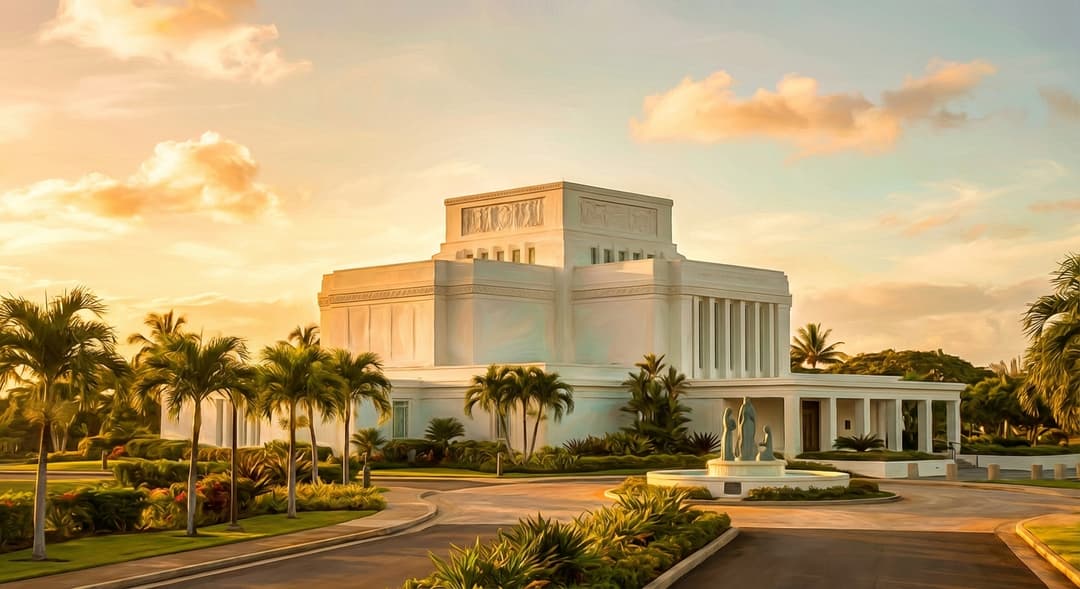
The Laie Hawaii Temple grounds are among the most beautiful in the world, featuring cascading pools, tropical gardens, and a large Visitors' Center. While the interior of the temple is reserved for Church members, the grounds and Visitors' Center are open to the public and offer a peaceful retreat on Oahu's North Shore.
Highlights
- The Maternity Fountain (statue of a mother and children)
- Exterior Friezes depicting scriptural history
- Cascading reflecting pools
- Interactive exhibits in the Visitors' Center
Things to Know
- Modest dress is requested for the Visitors' Center.
- Photography is permitted on the grounds but not inside.
- Located adjacent to the Polynesian Cultural Center.
Location
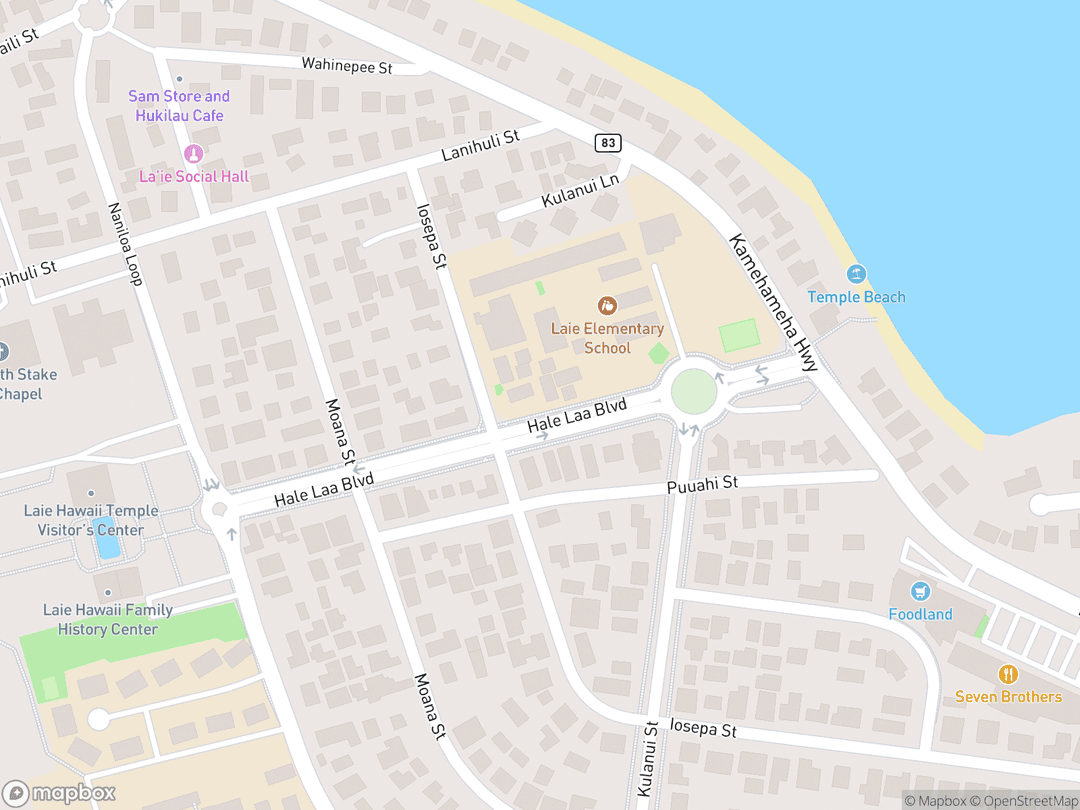
55-600 Naniloa Loop, Laie, Hawaii 96762, United States
Hours: Grounds open daily from dawn to dusk. Check churchofjesuschrist.org for interior operating hours.
Getting There: Located on the North Shore of Oahu, approximately a 60-minute drive from Honolulu via the Likelike or Pali Highways.
Get DirectionsAbout
The Laie Hawaii Temple stands as a monument to the gathering of Israel in the Pacific Isles. Dedicated in 1919, it holds the distinction of being the first Latter-day Saint temple constructed outside the continental United States. Its gleaming white exterior, set against the lush green mountains of Oahu and the blue expanse of the Pacific Ocean, has earned it the nickname "The Taj Mahal of the Pacific." Unlike the Gothic-revival spires of its predecessors, the Laie Temple features a unique architectural blend of Prairie Style and Ancient American motifs, designed to harmonize with the tropical landscape and the heritage of the Polynesian people.
The structure itself is a testament to ingenuity and faith. Constructed during the scarcity of World War I, the temple was built using native crushed lava rock and coral reinforced with steel and concrete—a necessity to withstand the humid climate and termites. The design, created by architects Hyrum C. Pope and Harold W. Burton, eschews a central spire for a flat-roofed, cruciform plan reminiscent of ancient temples found in Central America, symbolizing a solid, immovable connection to the earth and the history of the Americas.
For over a century, this sacred edifice has served as a spiritual anchor for Saints throughout the Pacific. From its prophetic announcement by a young Joseph F. Smith in 1864 to its miraculous construction involving a stranded ship of lumber, the temple's history is woven with stories of divine intervention. Today, following extensive renovations in 1978 and 2010, it continues to serve as a "House of the Lord," offering a place of peace, learning, and eternal ordinances for the people of Hawaii and the Pacific Rim.
Gallery
Symbolic Elements
The temple's exterior features intricate carvings, each rich with spiritual meaning:

The Maternity Fountain
Located in the front gardens, this sculpture depicts a Hawaiian mother holding a giant clam shell, pouring water down to her children. It symbolizes the concept that 'the woman is the fountain of life' and emphasizes the temple's focus on eternal family units.

The Missing Spire
Unlike most temples, the lack of a spire emphasizes a connection to the earth and the ancient history of the Americas and Polynesia. It suggests that the gospel's roots are deep in the soil of the isles, offering a 'solid, immovable' witness.

Hale La'a Boulevard
The temple sits at the terminus of a long, palm-lined avenue. This physical approach is designed to symbolize the spiritual journey and preparation required to leave the world behind and enter the presence of God.
Exterior Friezes
Four large friezes surround the upper temple, depicting the dispensations of time: the Old Testament (West), New Testament (South), Book of Mormon (North), and the Latter-day Restoration (East).

Crushed Coral & Lava
The very walls of the temple are formed from the island itself. The concrete was made using crushed native lava rock and coral, symbolizing that the temple is an integral part of the Hawaiian landscape.

Greek Cross Plan
The floor plan follows a Greek Cross shape, a departure from the Salt Lake Temple style. This geometric symmetry represents balance, order, and the gathering of people from the four corners of the earth.
Interesting Facts
The 'Lumber Miracle': When WWI caused a lumber shortage, a ship ran aground nearby and sold its cargo—the exact wood needed—to the Church.
It was the first temple built outside the continental United States, marking the beginning of global temple expansion.
Known as the 'Taj Mahal of the Pacific' for its symmetry, white exterior, and reflecting pools.
The temple survived the attack on Pearl Harbor (35 miles away) completely untouched, despite its high visibility.
Joseph F. Smith prophesied the temple's location in 1864, over 50 years before construction began.
It is a 'sister temple' to the Cardston Alberta Temple, designed by the same architects in the same Prairie/Pre-Columbian style.
Built of crushed lava rock and coral concrete because wood was too susceptible to tropical termites.
Laie was designated a 'City of Refuge' (Pu'uhonua) in the 1860s, mirroring ancient Hawaiian sanctuary traditions.
The four exterior friezes were sculpted by J. Leo Fairbanks and depict God's dealings with humanity across history.
The temple sits at the end of Hale La'a Boulevard, symbolizing the spiritual journey required to enter God's presence.
Common Questions
Can tourists enter the Laie Hawaii Temple?
The interior of the temple is reserved for members of the Church in good standing. However, the beautiful grounds, the Visitors' Center, and the foyer area of the Visitors' Center are open to the general public and are a popular tourist destination.
Why does the temple look different from others?
Designed by Pope and Burton, the temple utilizes the Prairie Style blended with Ancient American motifs. It lacks a traditional spire, symbolizing a solid, immovable connection to the earth, similar to ancient temples found in Central America.
What is the statue in the front fountain?
The 'Maternity Fountain' depicts a Hawaiian mother holding a giant clam shell, pouring water down to her children. It symbolizes the concept that 'the woman is the fountain of life' and emphasizes the temple's focus on eternal families.
How is the temple related to the Polynesian Cultural Center?
The Polynesian Cultural Center (PCC) is located directly adjacent to the temple. It was founded by the Church to help students at the nearby BYU-Hawaii work their way through school and to preserve Polynesian cultures. Many visitors see both in one trip.
What materials were used to build the temple?
Due to World War I shortages, the temple was built using native crushed lava rock and coral reinforced with steel and concrete. This material choice was also practical for resisting termites and rot in the tropical climate.
Related Stories
Explore the rich history, traditions, and people connected to this sacred site.
Featured Stories
The Lumber Miracle
1917
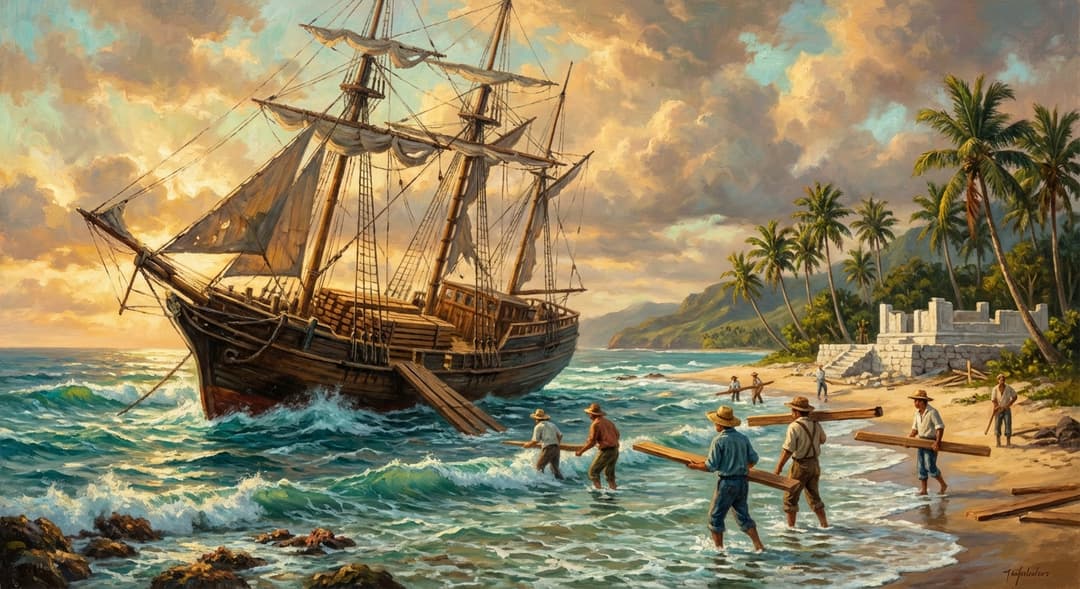
During the height of World War I, construction on the temple ground to a halt due to a severe shortage of lumber in the Hawaiian Islands. The contractor, Ralph Woolley, prayed fervently for a solution, as the forms for the concrete walls could not be built without specific timber.
Just days later, the schooner R.P. Rithet ran aground on a coral reef near the temple site. The captain, needing to lighten the ship's load to refloat it, offered to sell his cargo to the local community. The cargo turned out to be the exact type and quantity of lumber needed to complete the temple construction.
Source: LDS Living / Church History
A Prophecy Fulfilled
1864
Fifty years before construction began, a young missionary named Joseph F. Smith—who would later become the President of the Church—visited Laie. Overcome by the spirit, he pointed to the specific hill where the temple now stands and declared to the local Saints that a House of the Lord would one day grace that site.
This prophecy sustained the Hawaiian Saints for decades as they labored to build the community of Laie into a 'City of Refuge.' When President Smith returned in 1915 to dedicate the site, he fulfilled his own prophetic words spoken half a century earlier.
Source: History of the Saints
Sanctuary in War
1941
On December 7, 1941, the tranquility of the Pacific was shattered by the attack on Pearl Harbor, located just 35 miles from the temple. Despite its brilliant white exterior making it a highly visible landmark from the air and sea, the temple remained untouched throughout the conflict.
During the war years, the temple ceased evening sessions to comply with strict blackout regulations enforced across the island. It stood as a silent, white beacon of peace during one of the most turbulent periods in the history of the Pacific.
Source: Newsroom
Timeline
Prophetic Vision
Joseph F. Smith, then a young missionary, points to the site and prophesies that a temple will one day stand there.
MilestoneLand Purchase
The Church purchases the 6,000-acre Laie plantation to serve as a gathering place for Hawaiian Saints.
MilestoneSite Dedication
President Joseph F. Smith dedicates the temple site at the conclusion of a sacrament meeting.
component.timeline.groundbreakingConstruction Begins
Work commences on the temple using reinforced concrete made from local crushed lava and coral.
component.timeline.constructionThe Lumber Miracle
A stranded ship, the R.P. Rithet, provides critical lumber needed for construction forms during a wartime shortage.
component.timeline.miracleDedication
President Heber J. Grant dedicates the Laie Hawaii Temple on Thanksgiving Day.
DedicationPearl Harbor Attack
The temple, located just 35 miles from Pearl Harbor, ceases evening sessions to comply with blackout regulations.
EventRemodeling Closure
The temple closes for extensive remodeling and the addition of new ordinance rooms.
RenovationRededication
President Spencer W. Kimball rededicates the expanded temple.
DedicationSeismic Renovation
The temple closes for seismic upgrades and restoration to return the interior to its original progressive-style elegance.
RenovationRededication
President Thomas S. Monson rededicates the restored temple.
DedicationCentennial Anniversary
The temple celebrates 100 years of operation, marking a century of service in the Pacific.
MilestoneHistory by Decade
1860s–1910s — The Gathering Place
I saw this land... and I felt impressed to dedicate this land for the erection of a temple to God.
The history of the Laie Temple begins long before its dedication. In 1865, the Church purchased the 6,000-acre Laie plantation to create a permanent gathering place for Hawaiian Saints. This "City of Refuge" (Pu'uhonua) became a center of spiritual and temporal strength. In 1915, President Joseph F. Smith dedicated the site, and construction began shortly after, utilizing innovative reinforced concrete techniques to withstand the tropical climate.
1920s–1960s — A Spiritual Beacon
Following its 1919 dedication, the temple became the spiritual hub for Saints across the entire Pacific, including New Zealand, Samoa, and Tonga. It survived the economic hardships of the Great Depression and the perils of World War II. In the 1950s and 60s, the establishment of the Church College of Hawaii (now BYU-Hawaii) and the Polynesian Cultural Center solidified Laie as a unique educational and cultural capital.
1970s–Present — Restoration and Renewal
As the Church grew, the temple required expansion. Extensive remodeling in the 1970s added new ordinance rooms and facilities. In 2008, the temple closed again for a major seismic upgrade and restoration project. This renovation sought to return the interior to the original elegance of the Pope & Burton design, restoring murals and architectural details that had been altered in previous years. It was rededicated in 2010 by President Thomas S. Monson.
Architecture & Facilities
Prairie School / Ancient American design inspired by Frank Lloyd Wright's horizontal aesthetic and pre-Columbian Mesoamerican temple motifs, featuring strong horizontal bands, textured concrete friezes depicting indigenous patterns, and a frieze-wrapped exterior unique among Latter-day Saint temples.
Building Materials
Exterior
Reinforced concrete made from crushed native lava rock and coral, originally painted cream/yellow but now stark white.
Friezes
Cast concrete sculptures by J. Leo Fairbanks depicting the four dispensations of the gospel.
Interior Features
Ordinance Rooms
Features progressive-style murals depicting the creation and the world, restored to their original 1919 splendor.
Celestial Room
A serene space featuring native woods and furnishings that reflect the dignity of the Prairie style.
Temple Grounds
11 acres of lush tropical gardens, cascading reflecting pools, and a long palm-lined approach (Hale La'a Boulevard).
Additional Facilities
Adjacent to the temple is a dedicated Visitors' Center with interactive exhibits, a temple model, and historical displays. The temple is also located next to the Polynesian Cultural Center (PCC) and BYU-Hawaii, creating a unique educational, cultural, and spiritual campus on Oahu's North Shore.
Religious Significance
The Laie Hawaii Temple stands as a bridge between heaven and earth, designed to be a 'House of the Lord' where the distractions of the world are left behind.
The temple serves as a place of instruction and ordinance, where faithful members make covenants with God and participate in ceremonies that unite families for eternity.
Sacred Ordinances
Baptism for the Dead
Vicarious baptisms performed on behalf of ancestors who died without the opportunity to accept the gospel.
Sealing
Marriages that are solemnized not just for 'time' but for 'all eternity,' binding family generations together.
Endowment
A course of instruction about God's plan for humanity and the making of sacred covenants.
Initiatory
A ceremonial washing and anointing that prepares members to receive the endowment.
A Gathering Place
Laie was established as a literal gathering place for the Saints of the Pacific. The temple fulfills the prophetic vision of gathering Israel from the isles of the sea.
Similar Temples
Sources & Research
Every fact on Temples.org is backed by verified Sources & Research. Each piece of information is rated by source tier and confidence level.
View All Sources (4)
| Field | Source | Tier | Retrieved |
|---|---|---|---|
| General Temple Info | The Church of Jesus Christ of Latter-day Saints (opens in a new tab) | A | 2026-02-13 |
| Newsroom History | Church Newsroom (opens in a new tab) | A | 2026-02-13 |
| Architectural Context | BYU Studies (opens in a new tab) | B | 2026-02-13 |
| Miracles & Stories | LDS Living (opens in a new tab) | B | 2026-02-13 |