Visitor Insights
Visiting Holy Rosary Catholic Church
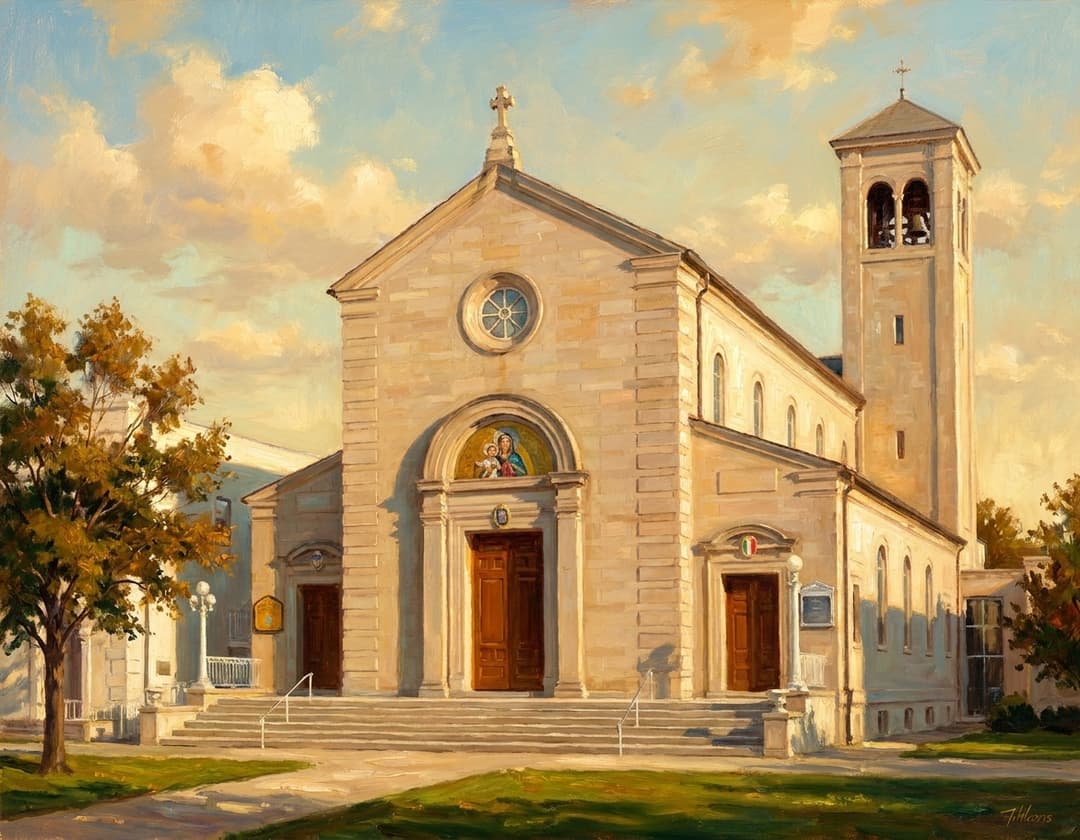
Holy Rosary Catholic Church welcomes visitors and pilgrims to experience its English Gothic interior and Austrian stained glass windows. Guests are invited to attend scheduled bilingual liturgies or pray quietly before the Blessed Sacrament. Morning sunlight provides the finest illumination across the historic nave.
Highlights
- Monumental 22-foot Brady high altar sculpted from imported European marble.
- Rare one-ton Portuguese flesh-colored onyx crucifix crowning the reredos.
- Hand-crafted Austrian stained glass windows designed by a local Idaho artist.
- Open timber ceiling featuring decorative English scissor trusses.
Things to Know
- Modest attire covering shoulders and knees is encouraged inside the sanctuary.
- Silent deportment should be maintained to respect worshippers in Eucharistic Adoration.
- Interior photography is welcome outside of scheduled liturgies without flash.
Tips for Your Visit
Morning Illumination
Visit between 9:00 AM and 11:30 AM to witness radiant natural sunlight illuminating the southern stained glass.
Eucharistic Reverence
The illuminated red sanctuary lamp indicates the reserved Blessed Sacrament, calling all visitors to respectful quiet.
About
Holy Rosary Catholic Church stands firmly within the monotheistic lineage descending from Abraham. As a consecrated Christian house of worship, the sanctuary gathers the faithful to proclaim the Gospel and celebrate the New Covenant established by Jesus Christ.
Rooted in Roman Catholic sacramental theology, the church serves as the dwelling place of the Real Presence of Christ in the Holy Eucharist. The parish honors the Virgin Mary through its patronal dedication to the Holy Rosary, elevating human senses toward heaven through stained glass, marble, and sacred music.
Consecrated in 1949 and designed by Hummel, Hummel & Jones, the edifice served agricultural homesteaders, railroad pioneers, and mid-century nuclear scientists. Today, it remains an active bilingual parish anchor and is listed on the National Register of Historic Places.
Gallery
Symbolic Elements
The temple's exterior features intricate carvings, each rich with spiritual meaning:
Pointed Lancet Arches
The upward-reaching Gothic window arches visually direct the worshipper's mind toward celestial contemplation.
Flesh-Colored Onyx Corpus
The translucent onyx crucifix embodies the reality of the Incarnation and Christ's sacrificial redemption.
Marble Tabernacle
Set into the high altar, the tabernacle serves as the dwelling place for the Eucharistic Real Presence.

Exposed Scissor Trusses
The open timber ceiling symbolizes the Barque of Peter safely ferrying souls across worldly waters.

Crenelated Bell Tower
The fortified parapet walls represent the Church Militant standing firm against spiritual adversity.

Auspice Maria Monogram
Entwined Marian monograms throughout the nave remind the congregation of the Virgin Mary's maternal protection.
Integrated Rectory Wing
The attached dwelling reflects the pastoral ideal of the shepherd living immediately beside the altar.
Bilingual Altar Appointments
Hand-carved chancel railings express the communion of saints across diverse linguistic and cultural traditions.
Interesting Facts
The inaugural tolling of the massive belfry bell cracked the tower masonry, forcing its permanent silencing (Tier B).
The parish originated in 1912 aboard the Chapel Car St. Peter, a custom rail coach serving pioneer families (Tier A).
The sanctuary centerpiece is a 2,000-pound crucifix sculpted from rare translucent Portuguese flesh-colored onyx (Tier B).
Holy Rosary was the first Catholic church in Idaho designed with an integrated attached rectory wing (Tier B).
Architects Hummel, Hummel & Jones were the successors to the firm that designed the Idaho State Capitol dome (Tier B).
The southern stained glass lancets were sketched by an Idaho Falls artist who studied fashion in Paris (Tier B).
The monumental 22-foot marble reredos was gifted through the estate of former Idaho Governor James H. Brady (Tier A).
The church celebrated its very first Holy Mass on Easter Sunday in 1949 to signify congregational renewal (Tier A).
Rapid mid-century congregation growth was spurred by nuclear scientists arriving at the Idaho National Laboratory (Tier B).
An electronic carillon was dedicated in 1977 to replace the silenced bronze bell without endangering the masonry (Tier B).
Common Questions
Can non-Catholic visitors tour Holy Rosary Church?
Respectful guests of all backgrounds are welcome to tour the sanctuary outside of scheduled Masses.
When are weekend Masses celebrated?
Weekend liturgies include English Mass on Sunday morning and Spanish Masses on Saturday evening and Sunday afternoon.
Why was the belfry bell permanently silenced?
Vibrations from the heavy bronze bell cracked the upper masonry during its inaugural ringing in 1949.
Who created the stained glass windows?
Idaho Falls artist Suzanne Fonnesbeck designed the southern windows, which Austrian glassblowers then crafted.
Is Holy Rosary part of a larger parish today?
Holy Rosary is unified with Christ the King Church under Pope Saint John Paul II Parish.
Featured Stories
The Silent Giant of the Belfry
May 1949
Following the church's dedication, an enormous cast bronze bell was hoisted into the belfry and rung for the first time. Its immense acoustic resonance shook the tower so violently that it fractured the freshly laid stone masonry. Parish leaders immediately silenced the bell to protect the building, leaving it mute until an electronic carillon was installed decades later.
Source: Bonneville County Historical Records
The Rolling Church on the Snake River
October 1912
Before a permanent church could be funded, Catholic liturgy arrived in Idaho Falls aboard the Chapel Car St. Peter. This specialized rail car carried a consecrated altar, compact wooden pews, and missionary priests directly to local agricultural sidings. The rolling sanctuary baptized dozens of children and united sixty homesteading families to form a lasting parish.
Source: Catholic Church Extension Society Archives
Parisian Artistry on the Idaho Frontier
April 1949
Parishioner Suzanne Duval Fonnesbeck brought classical European techniques to eastern Idaho after studying fashion illustration in Paris. She drew intricate theological cartoons for the south nave lancets, which were shipped across the Atlantic to Austrian glass studios. Master artisans hand-blew and leaded the windows, turning bright desert sunlight into prayerful color.
Source: Suzanne Fonnesbeck Estate Papers
Timeline
Frontier Mass in Eagle Rock
Missionary priests on horseback offered the earliest recorded Masses in local railroad bunkhouses.
MilestoneSacramental Registers Opened
The Diocese of Boise established official sacramental records for the growing Upper Snake River Catholic community.
MilestonePioneer Altar Donation
Early civic benefactors donated ornate side altars to equip a temporary chapel in town.
EventArrival of Chapel Car St. Peter
A converted passenger rail car arrived on city sidings to minister to sixty homesteading families.
EventParish Establishment
Holy Rosary was formally chartered as an independent parish under the Diocese of Boise.
MilestoneFirst Parochial Building Dedicated
Bishop Daniel Gorman dedicated a two-story brick hall serving as an interim chapel and parochial school.
DedicationArchitectural Drafting
Boise architects Hummel, Hummel & Jones completed blueprints for a permanent English Gothic sanctuary.
MilestoneSanctuary Construction
Arrington Construction Company erected load-bearing brick walls and the square belfry tower.
component.timeline.groundbreakingFirst Liturgy on Easter Sunday
Parishioners assembled inside the newly finished stone church for its inaugural Easter liturgy.
MilestoneSolemn Consecration
The Bishop of Boise solemnly dedicated the church and consecrated the monumental Brady marble altar.
DedicationMemorial Carillon Installation
The parish installed the Mark Stevens Memorial Carillon to restore chimes to the neighborhood.
RenovationNational Register of Historic Places
The church and rectory complex received official listing on the National Register of Historic Places.
MilestoneHistory by Decade
1880s–1890s — Frontier Masses in Eagle Rock
During the frontier era of Eagle Rock, circuit-riding priests visited on horseback and rail to celebrate Mass in private cabins. As agricultural canals expanded throughout the Upper Snake River Valley, Catholic homesteaders united to petition the Diocese of Boise for steady sacramental leadership.
1900s–1910s — Railcar Chapels and Parish Charter
The parish gained vital momentum in 1912 when the Catholic Extension Society sent its railcar chapel to Idaho Falls. By 1917, the growing community was formally chartered under the patronage of the Holy Rosary, securing property along 9th Street for future expansion.
1920s–1930s — The Parochial Hall and Depression Era
In 1920, the parish dedicated a two-story brick hall that housed both a temporary chapel and Holy Rosary Parochial School. Through the hardships of the Great Depression, families sustained their building fund penny by penny, determined to build a permanent church.
1940s — Constructing the English Gothic Landmark
In 1947, Boise architects Hummel, Hummel & Jones designed a monumental English Gothic church with an integrated rectory. Local builder Arrington Construction Company completed the brick edifice, which opened on Easter Sunday in 1949 featuring a 22-foot imported marble altar.
1950s–1960s — The Atomic Boom and Parish Division
The founding of the National Reactor Testing Station west of Idaho Falls brought scientists and military engineers into the parish pews. To accommodate this rapid demographic surge, Holy Rosary supported the founding of Christ the King Church on 17th Street in 1967.
1970s–1990s — Cultural Growth and Chimes
During the 1970s, the parish expanded ministries to support incoming Hispanic families, introducing regular Spanish-language Masses. In 1977, the congregation dedicated an electronic carillon in the bell tower, safely restoring musical chimes to the neighborhood.
2000s–Present — Historic Listing and Pastoral Union
Holy Rosary Catholic Church was placed on the National Register of Historic Places in 2002 for its architectural merit. In recent years, the community consolidated with Christ the King under Pope Saint John Paul II Parish, completing a major interior sanctuary restoration in 2016.
Architecture & Facilities
Holy Rosary Catholic Church represents the Late English Gothic Revival style, embodying the restrained massing and proportions of traditional British parish churches. Built with steel-reinforced brick walls, low-sprung pointed arches, cut cast stone dressings, and an attached corner bell tower, the design emphasizes solemn permanence rather than vertical ornamentation.
Building Materials
Textured Face Brick
Deep red-brown face brick forms the exterior load-bearing walls and stepped buttresses.
Cast Stone Tracery
Light-colored cast stone accents the compound pointed portals, copings, and window tracery.
European Marbles
Polished Italian, French, and Portuguese marbles comprise the 22-foot high altar and reredos.
Portuguese Onyx
Rare flesh-colored translucent onyx forms the central one-ton sculptural crucifix.
Interior Features
Central Nave
A wide, column-free basilica nave covered by open timber scissor trusses resting on corbels.
Sanctuary and Chancel
A raised liturgical platform dominated by the monumental Brady reredos and tabernacle.
Fonnesbeck South Lancets
Austrian mouth-blown stained glass windows depicting the scriptural mysteries of the Rosary.
Sisters North Windows
Vibrant stained glass apertures presenting saintly patronages and traditional Marian emblems.
Temple Grounds
The church occupies an urban corner parcel highlighted by mature deciduous shade trees, well-kept lawns, and concrete sidewalks that link the church to the parochial school.
Additional Facilities
The grounds feature an architecturally continuous two-story rectory wing, the historic parochial school facility, and modern parish administrative offices.
Religious Significance
Holy Rosary Catholic Church grounds its worship in the Abrahamic confession of one God, fully revealed through the Incarnation of Jesus Christ. As a consecrated Catholic sanctuary, the building is organized around the altar of sacrifice, where the faithful celebrate the Paschal mystery.
To serve as a consecrated house of liturgical sacrifice, Eucharistic adoration, and communal prayer under the patronage of the Virgin Mary.
Sacred Ordinances
The Holy Mass
The Eucharistic liturgy wherein bread and wine are transubstantiated into the Body and Blood of Christ.
The Sacrament of Reconciliation
The confession of sins to an ordained priest to obtain divine pardon and reconciliation with the Church.
Eucharistic Adoration
Exposition of the Blessed Sacrament for prolonged private contemplation and communal benediction.
The Holy Rosary
A meditative Marian devotion reflecting upon the principal mysteries of Christ's life and redemption.
The Eucharistic Real Presence
In Catholic doctrine, the church sanctuary is sanctified by the Real Presence of Christ, who remains physically reserved within the tabernacle beneath the watchful sanctuary lamp.
Marian Patronage and Intercession
Named for the Holy Rosary, the parish honors Mary as the Mother of God whose maternal intercession directs every Christian soul toward the teachings of her Divine Son.
Sources & Research
Every fact on Temples.org is backed by verified Sources & Research. Each piece of information is rated by source tier and confidence level.
View All Sources (8)
| Field | Source | Tier | Retrieved |
|---|---|---|---|
| About & Historical Background | Pope Saint John Paul II Parish (opens in a new tab) | A | 2026-03-31 |
| Diocesan Administration & Parish History | Roman Catholic Diocese of Boise (opens in a new tab) | A | 2026-03-31 |
| Parish School Heritage & Origins | Holy Rosary Catholic School (opens in a new tab) | A | 2026-03-31 |
| Liturgical Life & Sacraments | United States Conference of Catholic Bishops (opens in a new tab) | A | 2026-03-31 |
| National Register Nomination & Architecture | National Park Service (opens in a new tab) | B | 2026-03-31 |
| State Architectural Records | Idaho State Historical Society (opens in a new tab) | B | 2026-03-31 |
| Pioneer Chapel Car Ministry | Catholic Church Extension Society (opens in a new tab) | B | 2026-03-31 |
| Bonneville County Historic Preservation Records | Bonneville County Historical Society (opens in a new tab) | B | 2026-03-31 |