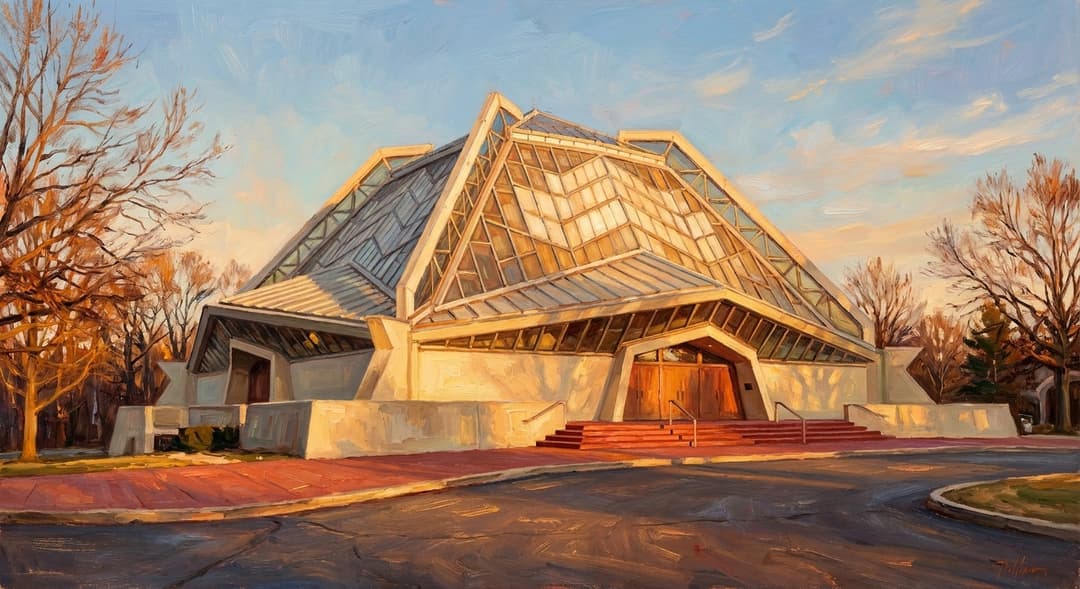
Visitor Insights
Visiting Beth Sholom Congregation
Beth Sholom warmly welcomes community members and respectful visitors seeking prayer, study, or cultural fellowship. Daily services occur morning and evening in the chapel, while full Sabbath services fill the main sanctuary each Saturday. Visitors should note modest dress standards and the prohibition of electronic devices during the Sabbath.
Highlights
- Monumental hand-hammered bronze Torah Ark crafted by Ascalon Studios
- Vibrant stained-glass window cycles depicting the Twelve Tribes of Israel
- Dedicated Sephardic Minyan celebrating historic Mediterranean liturgical rites
- Vibrant daily prayer quorums and adult educational study circles
Things to Know
- Male visitors must wear a head covering (kippah), provided at the sanctuary entrance.
- Electronic devices and photography are strictly prohibited from sundown Friday through Saturday night.
- Modest clothing covering shoulders and knees is required for all worship spaces.
- Only certified kosher food approved by rabbinic leadership is permitted inside the building.
Tips for Your Visit
Shabbat Services
Arrive by 9:00 AM on Saturday mornings to experience the full liturgical service and communal kiddush.
Sanctuary Seating
In accordance with Orthodox practice, men and women sit in separate sections divided by the central wooden mechitzah.
Sephardic Minyan
Experience the unique melodies and Mediterranean ritual traditions in the dedicated Sephardic chapel.
About
Beth Sholom Congregation and Talmud Torah stands as the premier Modern Orthodox synagogue in the Greater Washington metropolitan area. Tracing its venerable lineage to Eastern European immigrants who gathered in downtown Washington in 1908, the congregation has evolved across more than a century while preserving its devotion to traditional halakha and vibrant communal life.
Rooted firmly in the Abrahamic monotheistic heritage, Beth Sholom functions as a sacred sanctuary (Mikdash Me'at), a dedicated hall of study (Beit Midrash), and a lively gathering place (Beit Knesset). Its present suburban campus in Potomac harmonizes timeless rabbinic liturgy with modern civic leadership, welcoming worshippers of both Ashkenazi and Sephardi traditions.
The synagogue's modern Potomac complex reflects the philosophy of Torah Umadda, seamlessly uniting rigorous observance with active contemporary engagement. Featuring monumental liturgical art by Ascalon Studios and fostering a pioneering communal spirit, Beth Sholom remains an enduring pillar of Jewish devotion and regional continuity.
Gallery
Symbolic Elements
The temple's exterior features intricate carvings, each rich with spiritual meaning:

Holy Ark (Aron Kodesh)
Framed in rich walnut with hand-hammered bronze doors, the Ark houses sacred Torah scrolls on the eastern sanctuary wall.

Eternal Light (Ner Tamid)
Suspended perpetually above the Ark, this lamp evokes the continuous altar flame of the ancient Temple in Jerusalem.

Tablets of the Covenant (Luchot HaBrit)
Stylized backlit tablets crown the Holy Ark, representing the Ten Commandments revealed at Mount Sinai.

Reading Table (Bimah)
Elevated at the center of the sanctuary, the bimah emphasizes the communal and democratic reading of the Torah.
Ritual Partition (Mechitzah)
Handcrafted wooden fretwork partitions create the requisite halakhic separation between men and women while preserving clear sightlines.
Twelve Tribe Windows
Vertical stained-glass panels symbolize the biblical sons of Jacob and the multifaceted unity of the Jewish people.
Halakhic Boundary (Eruv)
A continuous physical boundary enclosing the neighborhood allows observant families to carry items on the Sabbath.
Interesting Facts
The congregation was founded in 1908 by Ukrainian immigrants who originally conducted services in Yiddish (Tier A).
Beth Sholom has occupied four distinct sanctuaries across Washington, D.C. and Montgomery County during its century of life (Tier A).
The congregation spearheaded the design and installation of the multi-mile Potomac Eruv in 1989 (Tier A).
All liturgical furnishings and stained glass in the sanctuary were custom fabricated by Ascalon Studios in 2001 (Tier B).
Beth Sholom became the very first Orthodox congregation in Greater Washington to elect a female president in 2005 (Tier B).
Rabbanit Hadas Fruchter served as assistant spiritual leader from 2016 to 2019 after graduating from Yeshivat Maharat (Tier A).
The synagogue maintains both an Ashkenazi main sanctuary and a thriving Sephardic minyan (Tier A).
Its former landmark Shepherd Park building was preserved and transitioned into the Ethiopian Evangelical Church in 1994 (Tier B).
The synagogue's commercial kitchens have served as a community commissary for local kosher culinary ventures (Tier C).
Common Questions
What denomination does Beth Sholom Congregation belong to?
Beth Sholom is an active Modern Orthodox synagogue adhering to traditional halakha while engaging contemporarily.
Can non-members and visitors attend Shabbat services?
Visitors of all backgrounds are welcome to observe services provided they respect dress and decorum guidelines.
Why are men and women seated separately during prayer?
Separate seating divided by a mechitzah is a halakhic practice intended to foster sacred devotion and modesty.
Are cameras or smartphones allowed on the Sabbath?
The use of electronic devices is strictly prohibited inside the synagogue and on grounds from Friday sunset to Saturday night.
Featured Stories
Pioneering the Potomac Eruv
September 1, 1989
In the late 1980s, Rabbi Joel Tessler and congregational leaders spearheaded the complex legal and municipal campaign to install the multi-mile Potomac Eruv. By transforming the public suburban domain into a shared private realm under halakha, young families could finally carry personal items and push strollers on the Sabbath. This visionary initiative converted rural Potomac into one of the most vibrant Sabbath-observant Jewish communities in North America.
Source: Beth Sholom Institutional Archives
Crafting the Sacred Center
September 1, 2001
When expanding the main sanctuary for the new millennium, Beth Sholom commissioned Ascalon Studios to design a cohesive liturgical interior. Renowned sculptor David Ascalon hand-hammered ornate bronze panels and assembled radiant stained-glass windows that flood the sanctuary with celestial light. The resulting installation remains an enduring masterwork of American synagogue liturgical artistry.
Source: Ascalon Studios Archive
A Landmark for Women's Leadership
June 1, 2005
Beth Sholom achieved regional history in 2005 by electing the very first female congregational president among Orthodox synagogues in Greater Washington. Demonstrating how Modern Orthodoxy can champion inclusion within halakhic boundaries, the community later welcomed Rabbanit Hadas Fruchter as assistant spiritual leader. This trailblazing path affirmed Beth Sholom's reputation as a thoughtful leader in modern religious life.
Source: Washington Jewish Week Records
Timeline
Congregational Founding
Ukrainian Jewish immigrants from Volhynia organize the Voliner Anshe Sfard society in Washington, D.C.
MilestoneCemetery Acquisition
The young congregation secures permanent cemetery grounds at National Capital Hebrew Cemetery.
MilestoneMerger with Har Zion
Voliner Anshe Sfard merges with Har Zion Congregation, officially adopting the name Beth Sholom.
MilestonePetworth Sanctuary Dedication
The congregation opens an 800-seat neoclassical limestone synagogue at 8th and Shepherd Streets NW.
DedicationShepherd Park Dedication
Beth Sholom consecrates a monumental 2,000-seat complex on Eastern Avenue along the Maryland border.
DedicationPotomac Land Purchase
Congregational trustees acquire rural acreage along Seven Locks Road to accommodate suburban growth.
MilestonePotomac Eruv Consecrated
A continuous halakhic perimeter is completed across Potomac, enabling Sabbath mobility for families.
MilestonePhase I Potomac Dedication
The congregation officially relocates from the District, opening its new daily chapel and school wing.
DedicationPhase II Groundbreaking
Construction begins on the monumental main sanctuary, expanded social halls, and banquet kitchens.
component.timeline.groundbreakingAscalon Sanctuary Installation
Ascalon Studios completes the hand-wrought Holy Ark, stained-glass program, and central bimah.
MilestoneFirst Female President Elected
Beth Sholom becomes the first Orthodox congregation in Greater Washington to elect a female president.
MilestoneRabbinic Leadership Transition
Rabbi Nissan Antine is elevated to Senior Rabbi following the retirement of Rabbi Emeritus Joel Tessler.
MilestoneHistory by Decade
1900s–1920s — Immigrant Foundations in Downtown D.C.
Our founders brought with them sacred Torah scrolls and an unyielding commitment to preserve ancestral traditions in their new homeland.
In 1908, Eastern European Jewish immigrants hailing from the historic Volhynia region established Voliner Anshe Sfard in downtown Washington. Initially convening in private parlors and storefronts, the congregation nurtured traditional liturgical melodies and established permanent burial grounds. By the 1920s, the growing community had emerged as a stable anchor for orthodox immigrant life in the nation's capital.
1930s–1940s — Consolidation and the Petworth Edifice
As families moved north along the 16th Street corridor, Voliner Anshe Sfard joined forces with Har Zion Congregation in 1936 to become Beth Sholom Congregation and Talmud Torah. On August 14, 1938, the unified community dedicated an impressive neoclassical limestone synagogue at 8th and Shepherd Streets NW in Petworth. During World War II, the synagogue served hundreds of civil servants and military personnel stationed across wartime Washington.
1950s–1960s — Shepherd Park and Civic Engagement
Surging post-war growth prompted the dedication of a massive 2,000-seat sanctuary in Shepherd Park along Eastern Avenue in 1954. During the turbulent 1960s, Beth Sholom partnered with community organizations like Neighbors, Inc. to champion racial integration and fair housing. The congregation earned regional admiration as an open-hearted neighborhood anchor during an era of rapid demographic change.
1970s–1980s — Suburban Migration and the Potomac Eruv
Continuing demographic shifts led Beth Sholom to purchase property along Seven Locks Road in Potomac in 1975, constructing an initial satellite chapel. Under Rabbi Joel Tessler's spiritual leadership, the congregation spearheaded the establishment of the Potomac Eruv in 1989. This legal enclosure catalyzed suburban Jewish residential life, drawing hundreds of young families to settle within walking distance of the synagogue.
1990s–2000s — Potomac Campus Construction and Consecration
Beth Sholom sold its historic Shepherd Park building to the Ethiopian Evangelical Church and dedicated Phase I of its Potomac campus in November 1994. In 1999, the community broke ground on Phase II, culminating in the 2001 consecration of a grand sanctuary fitted with custom liturgical woodwork and stained glass by Ascalon Studios. In 2005, the synagogue elected the region's first female Orthodox president, demonstrating progressive leadership within tradition.
2010s–2020s — Inclusive Leadership and Modern Flourishing
Rabbi Nissan Antine assumed the role of Senior Rabbi in 2013, continuing the synagogue's dedication to intellectual inquiry and community warmth. Between 2016 and 2019, Rabbanit Hadas Fruchter served as assistant spiritual leader, delivering weekly sermons and expanding adult Talmud study. Today, Beth Sholom thrives as the largest Orthodox congregation in Greater Washington, sustaining daily quorums, Sephardic services, and multi-generational education.
Architecture & Facilities
Modern suburban ecclesiastical design characterized by warm buff brick massing, articulated timber ceilings, and integrated liturgical metalwork tailored to traditional halakhic prayer.
Building Materials
Maryland Buff Brick
Warm-toned regional masonry covers exterior facades to harmonize with surrounding woodlands.
Precast Architectural Stone
Textured precast stone bands accent the perimeter windows and exterior entrance porticos.
Hand-Hammered Bronze
Custom forged bronze panels adorn the Holy Ark and bimah with sacred scriptural motifs.
Antique Stained Glass
Mouth-blown art glass transitions from violet to radiant amber across perimeter window bays.
Interior Features
Main Sanctuary
Column-free tiered prayer hall oriented toward Jerusalem, seating hundreds around a raised central bimah.
Daily Beit Midrash
Intimate wood-paneled chapel utilized for morning and evening prayer quorums and communal study.
Sephardic Minyan Hall
Dedicated prayer chamber arranged according to Mediterranean and Middle Eastern ritual customs.
Banquet Social Hall
Expansive multi-purpose hall served by separate commercial dairy and meat kosher kitchens.
Temple Grounds
A multi-acre landscaped campus featuring mature Maryland hardwoods, expansive pedestrian plazas, and safe perimeter walkways connecting directly to neighborhood residential avenues.
Additional Facilities
Features the Beth Sholom Early Childhood Center, multi-sensory classrooms, secure outdoor play yards, and dual commercial kosher catering facilities.
Religious Significance
Within the Abrahamic family of faiths, the synagogue stands as an earthly sanctuary where the gathered assembly communes with the singular Creator. Beth Sholom embodies this profound monotheistic heritage, functioning as a holy place of petition, moral study, and community brotherhood.
To serve as a Mikdash Me'at (sanctuary in miniature) where sacred Torah precepts and communal prayers sanctify everyday life in accordance with halakha.
Sacred Ordinances
Tefillah (Daily Prayer)
Communal morning, afternoon, and evening prayer services replacing ancient Jerusalem Temple offerings.
Kriat HaTorah (Torah Reading)
Public chanting of handwritten parchment scrolls on the Sabbath, Mondays, Thursdays, and festivals.
Sephardi Liturgical Rites
Distinctive prayer services celebrating the liturgical traditions and cantillation of Mediterranean and Eastern Jewry.
Torah Study (Talmud Torah)
Daily and weekly educational seminars delving into the Hebrew Bible, Talmud, and rabbinic law.
The Modern Orthodox Synthesis
Beth Sholom actively champions Torah Umadda—the synthesis of traditional Jewish religious practice with contemporary scientific, cultural, and civic engagement. Worshippers observe strict halakhic standards while contributing vibrantly to wider civic and intellectual life.
Sources & Research
Every fact on Temples.org is backed by verified Sources & Research. Each piece of information is rated by source tier and confidence level.
View All Sources (9)
| Field | Source | Tier | Retrieved |
|---|---|---|---|
| About & Historical Background | Beth Sholom Congregation and Talmud Torah (opens in a new tab) | A | 2026-03-30 |
| Architecture & Liturgical Design | Architizer Architectural Database (opens in a new tab) | B | 2026-03-30 |
| Petworth & Shepherd Park History | WETA Boundary Stones Local History (opens in a new tab) | B | 2026-03-30 |
| Synagogue Architecture & Modernism | Michael Z. Wise Architectural Journalism (opens in a new tab) | B | 2026-03-30 |
| Mid-Atlantic Jewish Architectural Heritage | College of Charleston Jewish Studies (opens in a new tab) | B | 2026-03-30 |
| Communal Leadership & Rabbanit Appointment | The Times of Israel (opens in a new tab) | C | 2026-03-30 |
| Montgomery County Community & Clergy | Washington Jewish Week (opens in a new tab) | C | 2026-03-30 |
| Regional Synagogue Profiles | Jmore Baltimore Jewish Living (opens in a new tab) | C | 2026-03-30 |
| Traditional Jewish Community Life | South Philadelphia Shtiebel (opens in a new tab) | C | 2026-03-30 |