Visitor Insights
Visiting Avi Kwa Ame (Spirit Mountain) & Grapevine Canyon
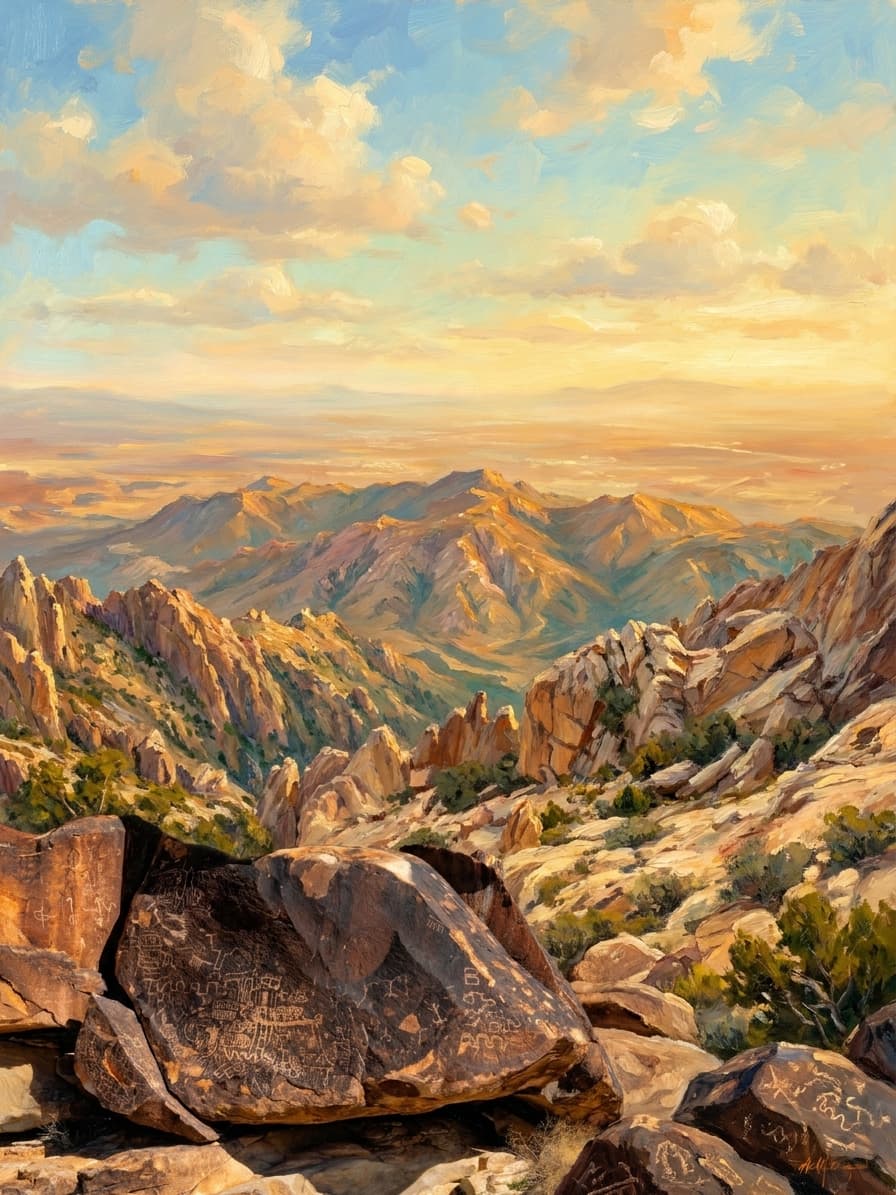
Avi Kwa Ame offers a profound spiritual journey into ancient desert rock art and sacred mountain vistas. Visitors to Grapevine Canyon walk a short trail to view over 700 petroglyph panels etched into canyon walls. Reverence, silence, and strict leave-no-trace practices are required to protect this living sacred space.
Highlights
- Viewing over 700 ancient petroglyph panels at the mouth of Grapevine Canyon
- Experiencing the dramatic granite batholith of Spirit Mountain rising above the desert
- Exploring dense, ancient Joshua tree forests within the national monument
- Walking along the spring-fed riparian corridor surrounded by wild desert grapevines
Things to Know
- Never touch or apply water or chalk to petroglyph rock art panels
- No drinking water or restrooms available at the Grapevine Canyon trailhead
- Unpaved Christmas Tree Pass Road requires cautious driving
- Extreme summer heat makes autumn through spring the safest visiting period
Location
Newberry Mountains, Clark County, Nevada 89046, USA
Hours: Open 24 hours daily; daylight visits strongly recommended.
Getting There: Access via Christmas Tree Pass Road off NV-163 or US-95 near Searchlight and Laughlin, Nevada.
Get DirectionsTips for Your Visit
Protect the Sacred Art
Do not touch, trace, or climb on rock art panels because hand oils accelerate stone decay.
Bring Water and Supplies
Carry at least one gallon of water per person as no drinking facilities exist on site.
Visit in Cool Seasons
Plan your trip between October and April when desert temperatures are mild and comfortable.
Drive Carefully
Christmas Tree Pass is an unpaved gravel road suitable for standard cars in dry weather.
About
Avi Kwa Ame, known in English as Spirit Mountain, is a dramatic granite batholith rising 5,642 feet above the Mojave Desert in southern Nevada. To ten Yuman-speaking Tribal Nations as well as the Hopi and Southern Paiute, this sacred peak is the literal birthplace of humanity and physical axis of creation.
Adjacent Grapevine Canyon features a perennial spring and over 700 petroglyph carvings etched into dark desert varnish across 250 panels. These rock art panels serve as historical records, spiritual markers, and ceremonial maps created by ancestral Patayan and Mojave artisans.
Encompassing 506,814 acres, Avi Kwa Ame National Monument was designated in 2023 to preserve this living cultural landscape under tribal co-stewardship. The sanctuary integrates granite spires, ancient Joshua tree forests, and sacred song cycle trails that map ancestral knowledge across the Southwest.
Gallery
Symbolic Elements
The temple's exterior features intricate carvings, each rich with spiritual meaning:

Spirit Mountain Peak
The 5,642-foot granite summit represents the axis mundi and literal creation birthplace in Yuman cosmology.
Grapevine Canyon Petroglyphs
Over 700 rock art panels etched into dark canyon walls record ancient history, rituals, and spiritual maps.
Desert Bighorn Sheep Panel
Carved bighorn motifs symbolize physical endurance, ritual spiritual power, and ancestral desert life.

Perennial Desert Spring
Freshwater emerging from granite canyon walls represents life renewal and the blood of the Earth.

Ancient Joshua Tree Forest
Nine-hundred-year-old Joshua trees embody ancestral presence and physical resilience across the desert basin.

Song Cycle Trails
Bird Songs and Salt Songs function as poetic geographic maps guiding sacred pilgrimages across centuries.

Dark Desert Varnish
Microscopic manganese patina on granite walls served as the natural canvas for ancient Indigenous carvers.
Interesting Facts
Avi Kwa Ame is revered as the common creation birthplace by ten distinct Yuman-speaking Tribal Nations. (Tier A)
In 1999, Spirit Mountain became Nevada's very first site listed as a Traditional Cultural Property on the National Register. (Tier A)
Encompassing 506,814 acres, Avi Kwa Ame National Monument was the largest monument created during the Biden administration. (Tier A)
The monument protects the Wee Thump Joshua Tree Wilderness, home to trees over 900 years old. (Tier B)
Traditional Indigenous Bird Songs function as meter-by-meter poetic navigation guides across the desert. (Tier A)
Christmas Tree Pass earned its name from a local 20th-century tradition of decorating roadside trees with holiday ornaments. (Tier B)
The 700 petroglyphs were created by chipping away a paper-thin layer of dark manganese oxide varnish. (Tier B)
Grapevine Canyon was named for native Arizona wild grapevines thriving around its subterranean spring. (Tier A)
Federal conservators used microscopic tools in 2010 to restore petroglyphs defaced during a paintball attack. (Tier A)
National monument designation in 2023 protected the sacred creation viewshed from industrial wind farm development. (Tier A)
Common Questions
What does Avi Kwa Ame mean?
Avi Kwa Ame translates to Spirit Mountain in the Mojave language.
Are visitors allowed to hike to the top of Spirit Mountain?
While Grapevine Canyon is open to visitors, climbing Spirit Mountain summit is discouraged out of respect for its sacred status.
Can I touch the petroglyphs at Grapevine Canyon?
No, touching rock art is strictly forbidden because natural skin oils accelerate rock degradation.
Is there an entry fee to visit Grapevine Canyon?
No entry fee is required to visit Grapevine Canyon or Avi Kwa Ame National Monument.
What is the best time of year to visit?
The best visiting season is between October and April when desert temperatures remain mild.
Featured Stories
The Birthplace of Creation
Ancient Oral Tradition
In Mojave tradition, the Creator Mutavela and his successor Mastamho forged the universe at Spirit Mountain. Mastamho carved the Colorado River and instructed human beings in natural law before transforming into a sea eagle. Today, tribal members return to the mountain to honor this sacred origin and connect with ancestral spirit power.
Source: Fort Mojave Indian Tribe & Oral History Records
Restoring the Sacred Panels
March 2010
When a severe vandalism attack defaced 30 petroglyph panels in Grapevine Canyon with paintballs in 2010, the community rallied in defense of the site. Federal conservators used delicate microscopic tools and specialized solvents to lift paint pigments without altering the ancient rock patina. The painstaking restoration preserved thousands of years of sacred rock art for future generations.
Source: National Park Service Cultural Resources Division
The Twelve-Tribe Coalition for Avi Kwa Ame
March 21, 2023
Facing proposals for industrial wind farms that would disrupt the creation viewshed, twelve Indigenous nations formed an unprecedented alliance. Their persistent advocacy culminated in Presidential Proclamation 10533, establishing a 506,814-acre national monument. The victory established historic tribal co-stewardship rights over their most sacred natural sanctuary.
Source: Avi Kwa Ame National Monument Coalition
Timeline
Patayan Cultural Era Begins
Ancestors of modern Yuman tribes begin carving extensive petroglyph panels at Grapevine Canyon.
MilestoneGrapevine Canyon NRHP Listing
Grapevine Canyon Petroglyphs are officially added to the National Register of Historic Places.
EventTraditional Cultural Property Designation
Spirit Mountain becomes Nevada's first site listed as a Traditional Cultural Property on the National Register.
MilestoneSpirit Mountain Wilderness Created
Congress establishes the 33,500-acre Spirit Mountain Wilderness Area to protect high-elevation habitat.
EventHigh-Resolution Rock Art Mapping
Archaeologists complete detailed digital mapping of 250 petroglyph panels in Grapevine Canyon.
EventVandalism Incident and Restoration
Federal conservators successfully restore 30 petroglyph panels damaged by paintballs.
RenovationTribal Coalition Monument Campaign Launch
Twelve Tribal Nations unite to formally petition for a 500,000-acre national monument.
EventInterior Department Honor Commitment
Federal officials announce support for permanent protections at the White House Tribal Nations Summit.
EventPresidential Proclamation Signed
President Joe Biden establishes the 506,814-acre Avi Kwa Ame National Monument.
DedicationCo-Stewardship Framework Activated
BLM, NPS, and affiliated Tribal Nations begin formal collaborative management operations.
MilestoneHistory by Decade
Pre-1100 CE — Archaic & Early Traditions
Nomadic hunter-gatherers utilized the Newberry Mountains and Grapevine Canyon spring during the Desert Archaic period. Early rock art motifs established the canyon as a vital ritual stop along desert travel corridors.
1100s–1800s — Patayan & Yuman Era
Ancestral Patayan artisans etched over 700 petroglyph panels across Grapevine Canyon. Spirit Mountain anchored the spiritual geography and oral traditions of ten Yuman-speaking Tribal Nations.
1850s–1890s — Territorial Conflict & Preservation
Westward mining expansion brought conflict and encroachment to the Newberry Mountains. Tribal leaders preserved secret sacred pilgrimages and oral song cycles to safeguard their creation birthplace.
1980s–1990s — Historic Property Recognition
Grapevine Canyon was listed on the National Register in 1984. In 1999, tribal advocacy secured Spirit Mountain as Nevada's first Traditional Cultural Property.
2000s–2010s — Wilderness & Conservation Battles
Congress designated the Spirit Mountain Wilderness in 2002. Renewable energy development proposals prompted a decade of intense tribal campaign efforts to defend the creation viewshed.
2020s — National Monument Designation
A 12-tribe coalition successfully achieved national monument status in March 2023. Presidential Proclamation 10533 protected 506,814 acres under enduring tribal co-stewardship.
Architecture & Facilities
Avi Kwa Ame represents a natural sacred architecture formed by an ancient granite batholith uplifted by tectonic forces and sculpted by wind and water over millions of years. The soaring jagged peaks, natural amphitheatres, and dark-varnished canyon walls serve as a divine sanctuary where physical geology embodies sacred Indigenous cosmology.
Building Materials
Uplifted Granite Batholith
Coarse-grained crystalline granite forms the steep spires, boulders, and canyon walls of the Newberry Mountains.
Manganese Oxide Desert Varnish
A paper-thin microscopic patina deposited by micro-bacteria coats granite surfaces to create a dark etching canvas.
Quartz Hammerstones
Ancient artisans utilized dense quartz stones to peck away varnish and reveal light granite underneath.
Perennial Spring Deposits
Natural mineral deposits mark the freshwater spring flowing continuously through Grapevine Canyon.
Interior Features
Grapevine Canyon Mouth
A soaring natural granite entrance gallery holding over 700 individual petroglyph carvings.
Spring Riparian Alcove
A sheltered desert oasis filled with wild Arizona grapevines, desert willow, and Fremont cottonwoods.
Spirit Mountain Summit Sanctuary
The high-elevation granite peak recognized as the primary spiritual focus and creation dwelling site.
Archaeological Rock Shelters
Natural granite overhangs and alcoves used for centuries as ritual stopovers and shelter.
Temple Grounds
The 506,814-acre sanctuary includes sweeping desert basins, dramatic mountain ranges, and dense ancient Joshua tree forests spanning the Mojave and Sonoran transition zones.
Additional Facilities
Grapevine Canyon Trailhead includes a gravel parking area, interpretive display panels, and established pedestrian trails leading into the canyon.
Religious Significance
Avi Kwa Ame is venerated as the primary origin site and physical center of creation for Yuman-speaking peoples and neighboring southwestern tribes.
Serves as the eternal home of spiritual creators, origin of human life, and sacred geographic anchor for tribal songs and identity.
Sacred Ordinances
Song Cycle Pilgrimage
Singing ancestral Bird Songs and Salt Songs to navigate physical and spiritual journeys across sacred landscapes.
Origin Ceremonies
Ritual offerings and prayers conducted at the mountain base to honor creation ancestors and seek spiritual renewal.
Spring Purification
Ritual washing and reflection at natural desert springs considered the sacred living blood of the Earth.
The Axis Mundi of Yuman Cosmology
Spirit Mountain is regarded as the physical and spiritual center of the universe where divine creators taught humanity moral law, language, and stewardship before returning to the spiritual realm.
Geographic Song Maps
Indigenous song cycles contain precise topographic descriptions that allow practitioners to memorize hundreds of miles of desert pathways using Spirit Mountain as the primary orientation point.
Similar Temples
Sources & Research
Every fact on Temples.org is backed by verified Sources & Research. Each piece of information is rated by source tier and confidence level.
View All Sources (5)
| Field | Source | Tier | Retrieved |
|---|---|---|---|
| National Register Criteria & Designation | National Register of Historic Places (opens in a new tab) | B | 2026-02-15 |
| Indigenous Cosmology & Oral Traditions | Fort Mojave Indian Tribe (opens in a new tab) | A | 2026-02-15 |
| Geological & Topographic Survey Data | United States Geological Survey (opens in a new tab) | B | 2026-02-15 |
| Cultural Preservation & Song Cycles | Hualapai Tribe (opens in a new tab) | A | 2026-02-15 |
| Conservation & Monument Campaign | Friends of Nevada Wilderness (opens in a new tab) | B | 2026-02-15 |