Visitor Insights
Visiting Pueblo Bonito
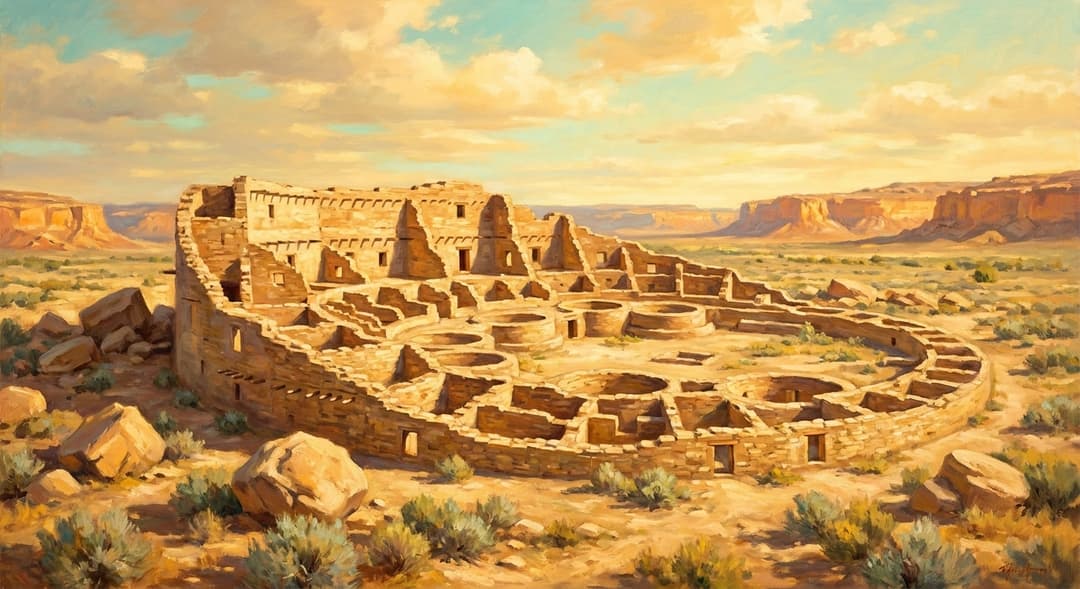
Visiting Pueblo Bonito offers an extraordinary journey into ancient North American architecture and astronomy. A self-guided loop trail allows visitors to walk through authentic multi-story room blocks and stand beside monumental subterranean kivas within Chaco Canyon.
Highlights
- Explore the vast semi-circular central plaza bisected by the true North-South wall.
- View intricate core-and-veneer sandstone masonry and historic wooden support beams.
- Inspect Great Kiva A and Great Kiva B subterranean ceremonial chambers.
- Walk past distinctive T-shaped ceremonial doorways framed against the canyon wall.
Things to Know
- Access requires driving 13 to 20 miles on unpaved dirt county roads that can become impassable during rain.
- High-clearance vehicles are strongly recommended, and no fuel or food is sold inside the park.
- Respect this sacred ancestral site by remaining on designated walking paths at all times.
Location
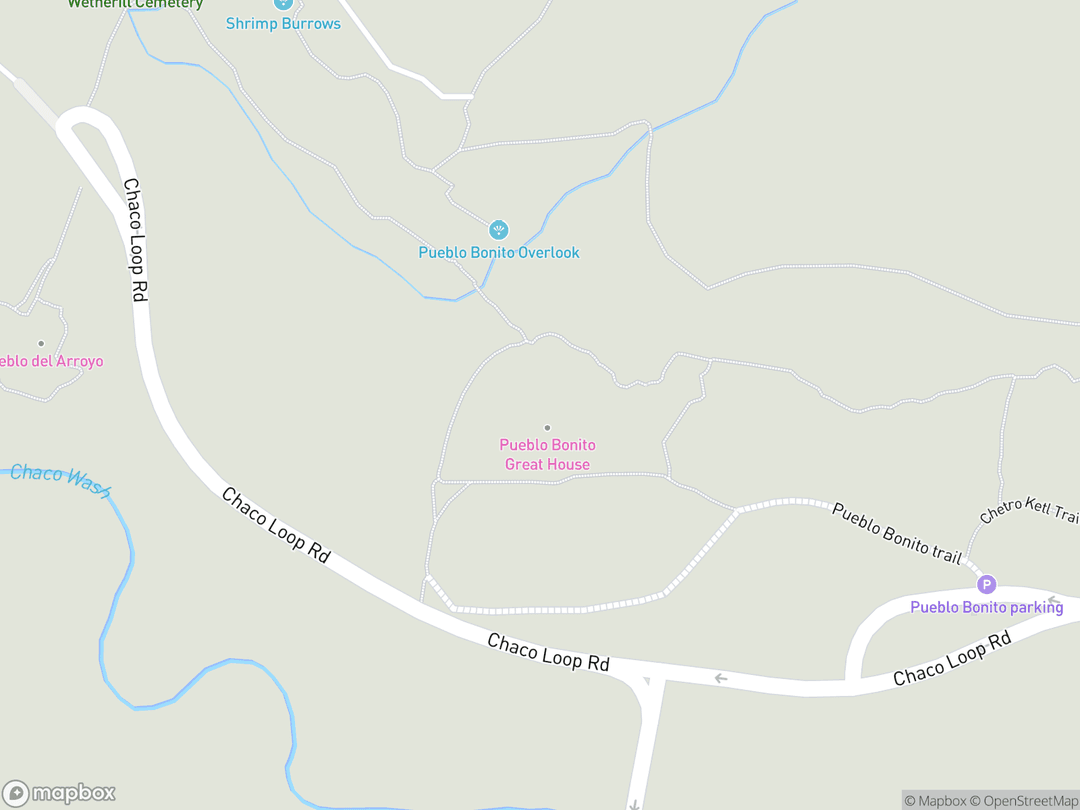
Chaco Culture National Historical Park, CR 7900, Nageezi, NM 87037
Hours: Park trails are open daily from sunrise to sunset year-round. Visitor Center open 9:00 AM to 5:00 PM.
Getting There: Located in northwestern New Mexico via CR 7900 / NM-57 off US Highway 550 near Nageezi.
Get DirectionsTips for Your Visit
Vehicle Preparation
Ensure your vehicle has plenty of fuel and check road conditions with park rangers prior to driving unpaved access roads.
Hydration and Sun Protection
Bring ample drinking water, wide-brim hats, and sun defense, as desert sun in Chaco Canyon can be intense year-round.
Sacred Site Etiquette
Treat all structural walls, kiva rims, and rock surfaces as sacred ancestral land by never leaning or climbing on them.
About
Pueblo Bonito is the grandest and most renowned Ancestral Puebloan Great House in Chaco Canyon. Constructed in distinct stages between 828 CE and 1125 CE, this monumental multi-story complex served as the spiritual, ceremonial, and trade epicentre for the entire Chacoan world.
Enclosing over six hundred rooms and dozens of subterranean circular kivas, Pueblo Bonito was precisely aligned to solar and lunar cycles. Its architecture reflects sophisticated mathematical engineering, core-and-veneer stone masonry, and deep cosmological symbolism rooted in modern Pueblo emergence traditions.
Designated a UNESCO World Heritage Site in 1987 as part of Chaco Culture National Historical Park, Pueblo Bonito remains a deeply sacred ancestral sanctuary for Hopi, Zuni, Acoma, Laguna, and Rio Grande Pueblo descendant communities.
Gallery
Symbolic Elements
The temple's exterior features intricate carvings, each rich with spiritual meaning:

Sipapu Emergence Hole
A small floor portal inside kivas symbolizing the ancestral point of human emergence into the physical world.

Great Kivas
Subterranean circular sanctuaries designed with four roof posts that represent the cosmic pillars supporting the sky.

True Meridian Bisection Wall
A central stone wall aligned within fifteen arcminutes of true north, dividing the complex into dual cosmic sectors.

Astronomical Solstice Windows
Precisely positioned interior corner windows designed to capture solstitial solar rays during winter and summer seasonal shifts.

T-Shaped Ceremonial Doorways
Iconic portal doorways associated with rain spirits and threshold transitions between sacred and public spaces.
Core-and-Veneer Masonry
An advanced architectural technique of layering ashlar stone faces over dense rubble cores for lasting strength.

Turquoise Sky Stone Caches
Sacred deposits of blue turquoise offered in ceremonial crypts to symbolize water, sky, and spiritual vitality.

Scarlet Macaw Solar Iconography
Feathers and remains of tropical macaws traded from Mesoamerica, serving as vivid symbols of solar heat and fire.
Interesting Facts
Pueblo Bonito remained the largest multi-story housing structure in North America until the late nineteenth century. (Tier A)
Over two hundred thousand pine beams were carried by hand forty miles without wheels or pack animals. (Tier A)
Chemical testing proved cylinder jars held cacao imported twelve hundred miles from Mesoamerica. (Tier A)
The center masonry wall aligns within fifteen arcminutes of true astronomical North-South. (Tier B)
Ancient Puebloans constructed wooden buttresses to brace Threatening Rock long before its 1941 fall. (Tier B)
Burial Room 33 held over fifty-six thousand turquoise beads, representing the Southwest's richest burial. (Tier A)
DNA testing proved an elite matrilineal dynasty maintained sacred authority for three centuries. (Tier A)
Architectural mapping confirmed Pueblo Bonito housed roughly six hundred and fifty rooms rather than eight hundred. (Tier B)
Common Questions
What is the meaning of Pueblo Bonito?
Pueblo Bonito means 'Beautiful Town' in Spanish, while Navajo traditions know the canyon region as Tse Biyaa Anii'ahi.
How old is Pueblo Bonito?
Initial construction began around 828 CE, with major expansion phases continuing through 1125 CE.
Which indigenous groups are descended from Chacoan people?
Modern Hopi, Zuni, Acoma, Laguna, and Rio Grande Pueblo nations are direct cultural descendants of Chaco Canyon.
Why was Pueblo Bonito abandoned?
Severe regional megadroughts around 1126 CE prompted systematic departure and outward migration toward major river basins.
Can visitors go inside Pueblo Bonito today?
Yes, visitors can walk self-guided loop trails through interior plaza areas and multi-story rooms year-round.
Featured Stories
The Transport of Two Hundred Thousand Forest Beams
1050
Between 1020 and 1110 CE, Ancestral Puebloan master builders constructed Pueblo Bonito's multi-story ceilings using over two hundred thousand heavy timber logs. Sourced from Ponderosa forests in the Chuska and San Mateo mountains over forty miles away, every beam was felled with stone axes and carried entirely by human hands without draft animals or wheeled carts. This monumental communal effort highlights the supreme sacred devotion and organizational genius of Chacoan society.
Source: National Park Service Research Archives
The Matrilineal Dynasty of Room 33
1100
In 1896, excavators uncovered Room 33, a hidden interior vault containing two male leaders resting above a floor carpeted with fifty-six thousand carved turquoise beads, jet ornaments, and sea shells. Modern DNA analysis revealed that individuals buried in this crypt over a period of three centuries shared identical mitochondrial DNA. This discovery proves that a elite matrilineal dynasty held central spiritual authority at Pueblo Bonito for over three hundred years.
Source: American Museum of Natural History
The Pre-Columbian Cacao Connection
1110
Chemical analysis of cylindrical pottery jars discovered inside Pueblo Bonito revealed chemical traces of theobromine, the distinct marker of cacao. Because cacao trees only grow in tropical climates over twelve hundred miles to the south, these vessels provide definitive evidence of vibrant trade networks connecting Chaco Canyon with Mesoamerican cultures. Ritual cacao drinks were prepared and consumed during high sacred gatherings within Pueblo Bonito's central plaza.
Source: University of New Mexico Archaeological Studies
Timeline
Initial Arc Construction
Ancestral Puebloan builders erect the earliest crescent-shaped row of single-story rooms and pit structures using Type I masonry.
First Major Beam Harvesting
Tree-ring records confirm heavy timber harvesting from high mountain ranges for ceiling beam construction.
Vertical Expansion Phase
Masons expand the central rear arc into multi-story residential and storage room blocks.
Introduction of Core-and-Veneer Masonry
Classic Chacoan builders initiate monumental expansion using core-and-veneer stone techniques and southward extending wings.
Peak Four-Story Elevation
Hand-banded ashlar masonry raises the northern curved perimeter wall to four and five stories high.
True Meridian Alignment
Masons complete the straight southern East-West wall and the internal North-South wall bisecting the plaza.
Exotic Trade Deposition Height
Elite ceremonial burials in Room 33 receive extensive deposits of turquoise, scarlet macaws, and ritual cacao vessels.
Onset of Systemic Depopulation
Severe prolonged regional drought halts construction as inhabitants systematically seal rooms and migrate outward.
Military Survey Recording
Lieutenant James H. Simpson records the first written account of the site under its Spanish name Pueblo Bonito.
Hyde Expedition Excavations
George H. Pepper and Richard Wetherill excavate over 190 rooms, recovering thousands of artifacts.
National Monument Establishment
President Theodore Roosevelt establishes Chaco Canyon National Monument to protect the archaeological ruins from looting.
Threatening Rock Collapse
A massive thirty thousand ton sandstone cliff slab collapses, crushing thirty rear rooms along the north wall.
UNESCO World Heritage Inscription
UNESCO officially designates Chaco Culture National Historical Park a World Heritage Site.
History by Decade
820s–850s — Genesis of Old Bonito
Construction began around 828 CE as a single-story crescent of rooms arranged around central pit-houses. Early masons used tabular sandstone set in thick mud mortar, laying the structural footprint for a community oriented toward seasonal agricultural rhythms.
920s–970s — Vertical Growth & Kiva Integration
During the tenth century, Old Bonito expanded both horizontally and vertically, reaching three stories along its northern arc. Subterranean kivas were integrated into the room matrix, establishing the site as a regional gathering place for surrounding communities.
1020s–1070s — The Golden Age of Core-and-Veneer Engineering
The eleventh century brought a revolutionary transformation with core-and-veneer masonry techniques. Builders elevated the massive back wall to five stories and hauled over two hundred thousand high-altitude timbers from distant mountain ranges to support expansive multi-story roofs.
1080s–1120s — Cosmic Geometry & Mesoamerican Trade
By 1100 CE, Pueblo Bonito achieved its full D-shaped geometry, featuring a precise North-South meridian wall and Great Kivas. Elite burial chambers were stocked with exotic trade goods including Mesoamerican cacao, scarlet macaws, and tens of thousands of turquoise beads.
1126–1150s — Great Drought & Ancestral Migration
A decade-long megadrought in the San Juan Basin halted all construction around 1126 CE. Inhabitants systematically sealed ceremonial rooms and migrated toward the San Juan River, Mesa Verde, and Rio Grande regions, passing down oral histories of the site.
1890s–1980s — Scientific Exploration & Heritage Protection
Excavations by the Hyde Expedition and National Geographic Society revealed Pueblo Bonito's immense architectural complexity. Federal protection followed in 1907, culminating in 1987 with UNESCO World Heritage designation recognizing its outstanding universal value.
Architecture & Facilities
Pueblo Bonito epitomizes Classic Chacoan Great House architecture, characterized by a monumental D-shaped semicircular footprint, terraced multi-story room blocks stepping down into an expansive enclosed plaza, and sophisticated core-and-veneer sandstone masonry integrated with astronomical alignments.
Building Materials
Tabular Sandstone
Locally quarried sandstone blocks hand-shaped and laid in decorative horizontal ashlar veneer patterns.
Mud Mortar
Dense mortar made from local alluvial clay and sand used for wall binding and protective exterior plaster.
Structural Ponderosa Timbers
Over two hundred thousand high-altitude pine and fir beams hauled by hand over forty miles without draft animals.
Gypsum Plaster
Multiple coats of smooth gypsum plaster applied to seal structural interior walls against weathering.
Interior Features
Central Meridian Plaza
A wide dual-part plaza separated by a north-south masonry wall into distinct ceremonial gathering sectors.
Great Kiva A
A massive circular subterranean sanctuary featuring masonry fire vaults, roof support piers, and a ceremonial floor sipapu.
Great Kiva B
A secondary monumental sunken chamber designed for high ceremonial gatherings and astronomical observations.
Burial Room 33
An ancient crypt housing an elite matrilineal dynasty alongside thousands of sacred turquoise beads.
Temple Grounds
The grounds cover two acres at the base of Chaco Canyon's sandstone cliffs, featuring connected plaza spaces, ruin trails, and ancient masonry retaining walls.
Additional Facilities
Chaco Culture National Historical Park provides a modern visitor center, museum exhibits, educational bookstores, and scenic desert hiking trails.
Religious Significance
In Ancestral Puebloan cosmology, Pueblo Bonito was built not merely as a residential town, but as the sacred "Center Place" of the physical and spiritual world. Modern descendant Pueblo nations honor the site as a living ancestral sanctuary where cosmic order and community life converged.
To serve as a central astronomical observatory, pilgrimage sanctuary, and spiritual axis connecting earth, sky, and subterranean emergence worlds.
Sacred Ordinances
Emergence Ceremonies
Subterranean kiva rituals centered around the floor sipapu portal to connect participants with ancestral spirits.
Solstice Alignment Rites
Seasonal solar observations conducted through specialized corner windows to track cosmic cycles and agricultural timing.
Ritual Cacao Offerings
Ceremonial consumption of imported cacao prepared in tall pottery cylinder jars during high spiritual gatherings.
Emergence Cosmology and the Sipapu
In Pueblo emergence traditions, humanity ascended into the current physical world from underlying subterranean realms. The circular Great Kivas, anchored by floor sipapus and supported by four major roof pillars, mirror this cosmic story of creation and spiritual rebirth.
Astronomical Order and Alignment
The structural geometry of Pueblo Bonito physically embodies astronomical precision. Its straight south wall aligns to the solar equinox, while the central meridian wall points precisely to true astronomical north, aligning earthly ritual life with cosmic law.
Similar Temples

Sources & Research
Every fact on Temples.org is backed by verified Sources & Research. Each piece of information is rated by source tier and confidence level.
View All Sources (9)
| Field | Source | Tier | Retrieved |
|---|---|---|---|
| About & Historical Background | National Park Service (opens in a new tab) | A | 2026-02-22 |
| Architecture & Facilities | Smarthistory (opens in a new tab) | B | 2026-02-22 |
| Religious Significance | The Solstice Project (opens in a new tab) | B | 2026-02-22 |
| Timeline & History | NPS History Electronic Library (opens in a new tab) | B | 2026-02-22 |
| Visitor Insights | Encyclopaedia Britannica (opens in a new tab) | B | 2026-02-22 |
| Symbolic Elements | University of New Mexico (opens in a new tab) | B | 2026-02-22 |
| Interesting Facts | Hidden Architecture (opens in a new tab) | B | 2026-02-22 |
| Architecture & Facilities | Masonry Magazine (opens in a new tab) | B | 2026-02-22 |
| Religious Significance | University Corporation for Atmospheric Research (opens in a new tab) | B | 2026-02-22 |