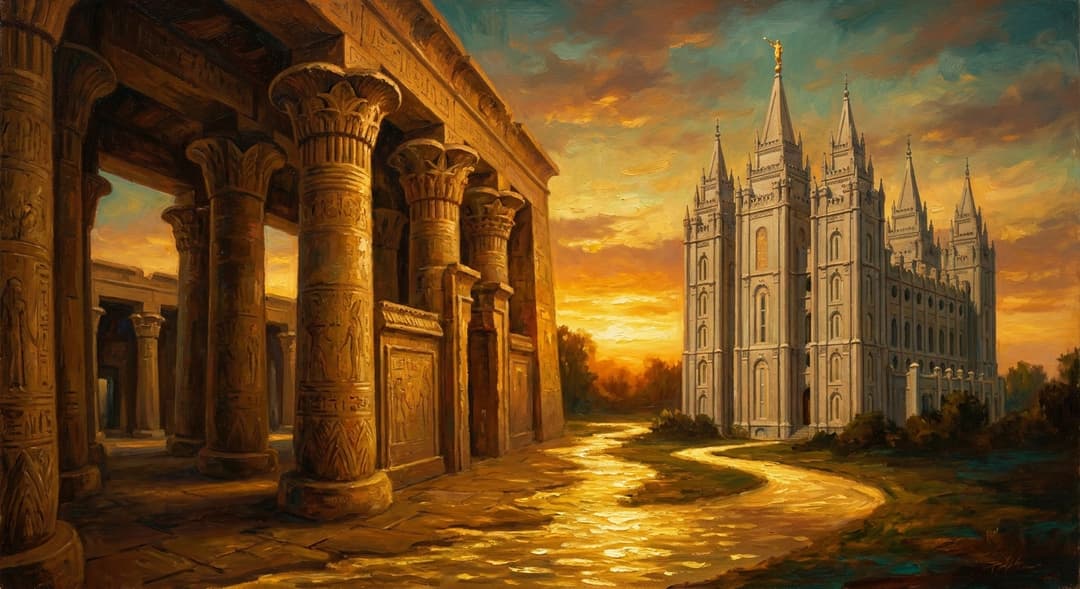
The Universal Quest for Sacred Space
Across cultures and epochs, from the oldest temple sanctuaries (opens in a new tab) to modern worship spaces, the temple has stood as the ultimate expression of humanity’s desire to connect with the divine. In his landmark studies of comparative religion, Mircea Eliade identified the temple as the axis mundi—a cosmic pillar connecting heaven, earth, and the underworld, transforming chaotic space into a sacred center (see Why Temples Matter (opens in a new tab)). This conception of sacred space is central to both the ancient Egyptian civilization and The Church of Jesus Christ of Latter-day Saints. For both traditions, the temple is not a standard house of worship, but a literal \"house of God\" (Egyptian: pr-nṯr; LDS: House of the Lord) designed to mirror the cosmos and serve as an intersection where mortals can commune with the eternal.
The Tripartite Sanctuary: Architecture of Ascension
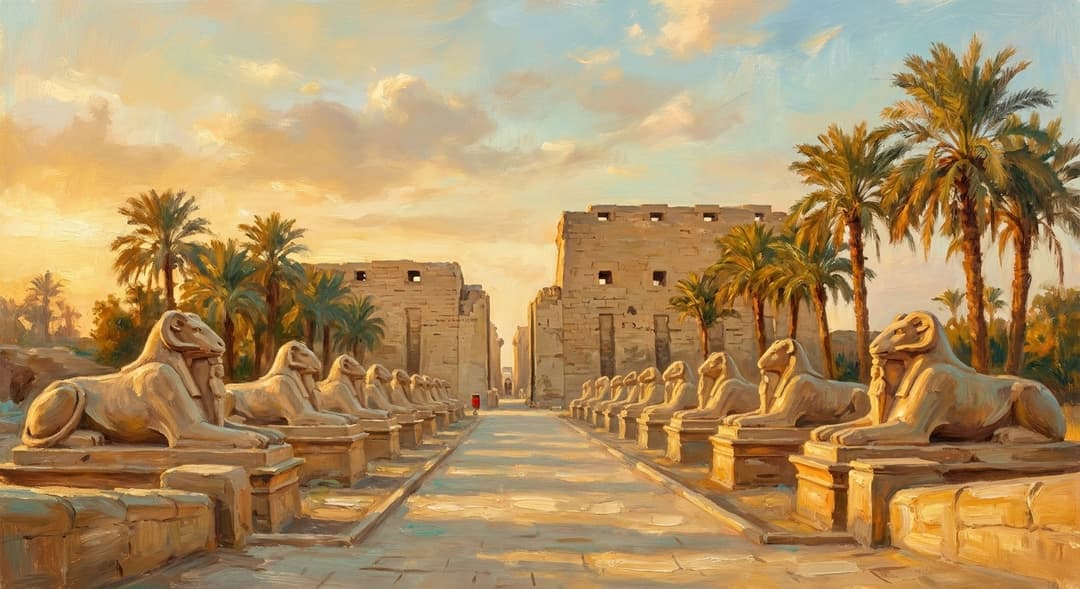
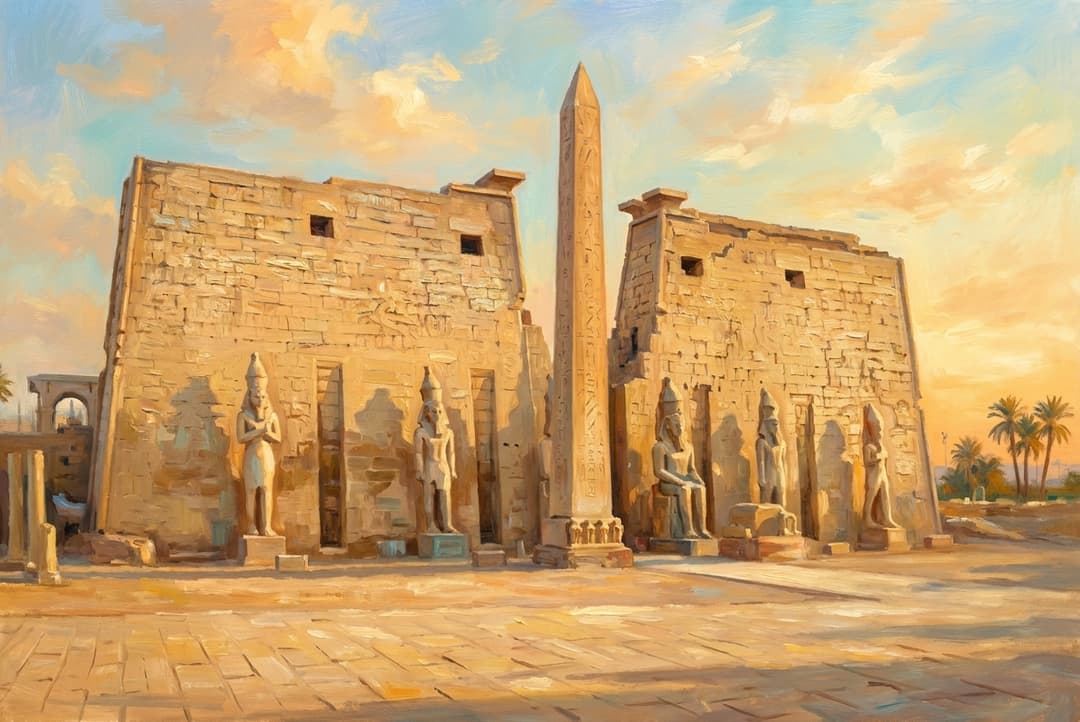
One of the most striking physical parallels is the spatial organization of the sacred structures. Ancient Egyptian temples (such as Karnak (opens in a new tab) and Luxor (opens in a new tab)) were laid out on an axis representing a progressive ascent to heaven. An initiate first entered an open courtyard (accessible to the public), transitioned into a covered Hypostyle Hall (representing the primeval marsh of creation, restricted to priests and initiates), and finally reached the inner sanctuary or Holy of Holies (where the cult statue dwelt, entered only by the High Priest or Pharaoh). Latter-day Saint temples follow a similar tripartite structure: the outer areas and chapel transition into the initiatory and instruction rooms (representing the creation and the world), which culminate in the Celestial Room—a beautifully adorned space representing the presence of God and the highest degree of heaven, where patrons sit in quiet contemplation.
Linguistic Footprints: 'Enlarging the Heart' in Temple Worship
The connection between ancient Egyptian temples and Latter-day Saint scripture extends beyond architecture and ritual into the very language of worship. In Psalm 119:32, the Psalmist writes: \"I will run the way of thy commandments, when thou shalt enlarge my heart\" (Hebrew: tarḥîb libbî). As Egyptologist John Gee has noted, \"enlarging the heart\" is a Hebrew hapax legomenon (a phrase that occurs only once) with a body part, which has long puzzled biblical translators. However, this phrase is a direct loan translation (calque) of the ancient Egyptian temple idiom ꜣwi ib (literally, \"to enlarge the heart\"), which means \"to have joy\" or \"to rejoice.\" In Egyptian temple texts—ranging from the White Chapel of Sesostris I at Karnak (opens in a new tab) to the temple of Ramses III at Medinet Habu—the \"expansion of the heart\" (ꜣwt-ib) is the specific blessing of joy and salvation (di-ꜥnḫ) granted by the deities to the King or initiate when they are brought into the divine presence in the sanctuary. This Egyptian temple idiom is preserved in the Book of Mormon, where writers describe hearts \"swollen with joy\" (Alma 17:29, Alma 19:13, 3 Nephi 4:33) and describe the word of God swelling in the breast to \"enlarge my soul\" (Alma 32:28). This suggests that Lehi’s descendants, who kept records in a language incorporating \"the learning of the Jews and the language of the Egyptians\" (1 Nephi 1:2) and possessed the Plates of Brass, carried this sacred Egyptian temple idiom into the New World.
Purification and Preparation: Washings and Anointings
Before participating in sacred rites, initiates in both traditions had to undergo physical purification. In Egyptian temples, priests and the Pharaoh underwent ab, a ritual washing in sacred pools or with water poured from pitchers, symbolizing the washing away of mortality and rebirth. In the temples of Abydos and Luxor (opens in a new tab), reliefs depict deities like Horus and Thoth pouring water over the Pharaoh in a grid pattern of life-symbols (ankh). Following this washing, the initiate was anointed with sacred oils (madjet) made from expensive resins and perfumes, consecrating them for sacred service. This directly mirrors the Latter-day Saint preparatory temple ordinance known as the \"initiatory,\" in which patrons are symbolically washed and anointed with consecrated olive oil, dedicating them to the service of God and blessing their physical and spiritual faculties.
Sacred Vestments: Clothing the Initiate
Upon purification, the initiate was clothed in special sacred vestments (opens in a new tab). In ancient Egypt, priests wore pure white linen garments, free from animal products, symbolizing purity. High-ranking initiates and the Pharaoh wore specific ceremonial aprons, sashes, and robes representing their office and divine relationship. Latter-day Saint temple worship similarly features the donning of sacred white clothing. Patrons wear standard white clothing to symbolize equality and purity, and during the Endowment ceremony, they put on specific ceremonial robes, aprons, and sashes. These vestments are worn as symbols of priestly authority, covenants made with God, and a shield against spiritual danger, echoing the protective and symbolic nature of ancient temple clothing.
The Ritual Drama: Creation, Fall, and Restoration
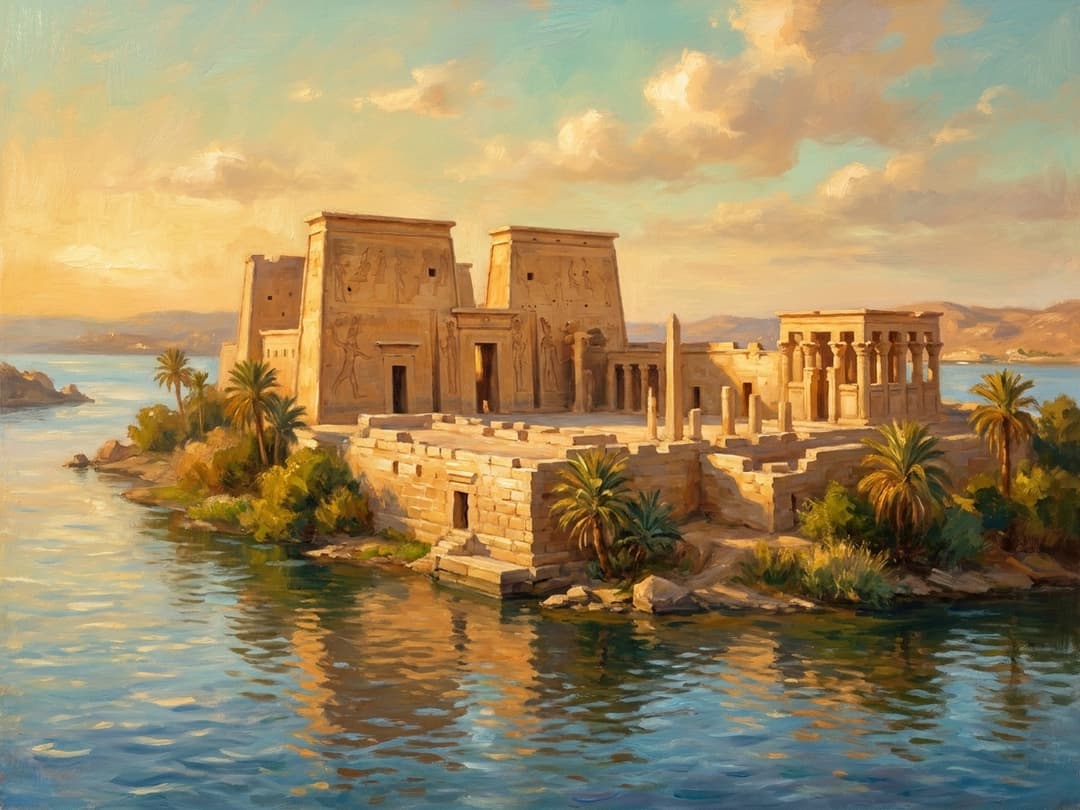
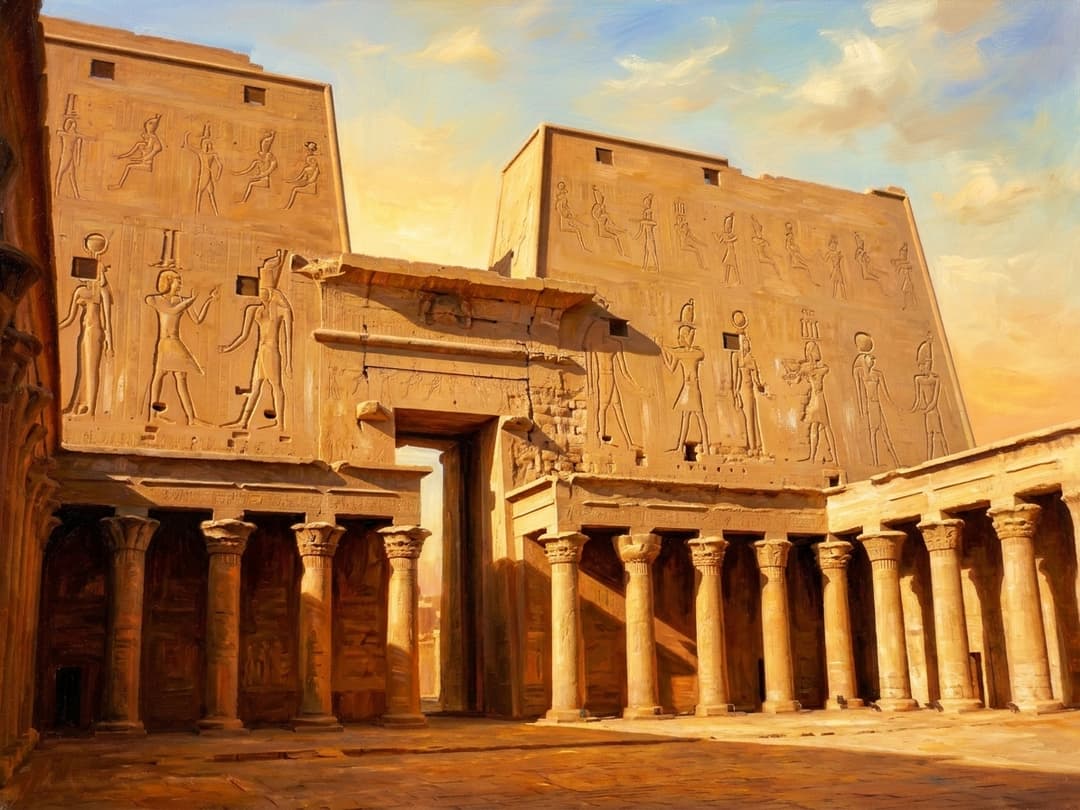
Ritual drama was a key vehicle for teaching sacred truths in antiquity. At the Temple of Edfu (opens in a new tab), inscriptions record a dramatic play—the Triumph of Horus—performed annually. This play depicted the creation of the world, the loss of order through the rebellion of Seth (evil), and the eventual restoration of cosmic order (ma'at) by Horus. In Osiris-centric temples like Philae (opens in a new tab), the ritual recounted the death, resurrection, and ascension of Osiris. LDS temples utilize a similar dramatic structure during the Endowment. Patrons witness a presentation of the Plan of Salvation, depicting the creation of the earth, the Fall of Adam and Eve, the struggle against the forces of Satan, and the ultimate restoration of humanity to God’s presence through the Atonement of Jesus Christ and faithfulness to covenants.
Tokens, Covenants, and Words of Power
In Egyptian belief, crossing the thresholds of the celestial realms required specific knowledge. The Book of the Dead and the Book of Breathings contain instructions for the deceased to pass guardians at various gates. The initiate had to know the name of the gatekeeper, recite specific formulas or \"words of power\" (heka), and present symbolic tokens or gestures. LDS scholars have noted that this matches the covenant-making process in the Endowment, where patrons make solemn promises to God and are given symbolic keys, names, and tokens representing priesthood authority and covenants. These keys are symbolically used to \"walk back to the presence of the Father,\" overcoming the barriers of mortality and the adversary.
The Goal of Exaltation: Becoming an Osiris
The ultimate purpose of the ancient Egyptian temple was deification—enabling the deceased initiate to transcend mortality and become an Osiris, a divine being ruling in the heavenly realms. Through the temple rites, the individual was promised eternal life, physical resurrection, and the ability to dwell among the gods. This concept aligns closely with the Latter-day Saint doctrine of exaltation or eternal progression. Latter-day Saints believe that the ultimate goal of temple covenants is to prepare individuals to inherit the fullness of God’s glory, become joint-heirs with Jesus Christ, and attain godhood, enjoying eternal families and continuous progression in the celestial kingdom.
Diffusion vs. Revelation: Interpreting the Parallels
How do we account for these striking similarities? Latter-day Saint scholars have proposed two main theories. The first is diffusion: the idea that a true, primordial temple order was revealed by God to Adam and Noah, and that as their descendants scattered, they carried fragments of this ritual order with them, adapting it into local mythologies, including Egypt's. The second is revelation: that Joseph Smith did not copy ancient rites, but rather restored a universal pattern of temple worship through direct revelation from God, which naturally aligns with ancient systems because God is the source of both. As Hugh Nibley wrote, the Egyptian rites represent a \"distorted mirror\" or a \"pagan imitation\" of the true priesthood order, serving as a powerful historical witness to the antiquity of the restored LDS temple ordinances.
Related Temples
Sources & Research
Every fact on Temples.org is backed by verified Sources & Research. Each piece of information is rated by source tier and confidence level.
View All Sources (7)
| Field | Source | Tier | Retrieved |
|---|---|---|---|
| From the Egyptian Temple through the Hebrew Bible to the Book of Mormon | The Interpreter Foundation (opens in a new tab) | B | 2026-05-29 |
| The Message of the Joseph Smith Papyri: An Egyptian Endowment | Deseret Book & FARMS (opens in a new tab) | B | 2026-05-29 |
| Temple and Cosmos: Beyond This Ignorant Present | Deseret Book & FARMS (opens in a new tab) | B | 2026-05-29 |
| An Introduction to the Book of Abraham | Religious Studies Center, BYU (opens in a new tab) | B | 2026-05-29 |
| Temple Themes in the Book of Abraham | The Interpreter Foundation (opens in a new tab) | B | 2026-05-29 |
| The Temple in Antiquity: Ancient Records and Modern Temple Worship | Religious Studies Center, BYU (opens in a new tab) | B | 2026-05-29 |
| Temples of the Ancient World: Ritual and Symbolism | Deseret Book & FARMS (opens in a new tab) | B | 2026-05-29 |